
Maruti Dzire vs Honda Amaze vs Hyundai Aura: Which Compact Sedan Should You Buy?

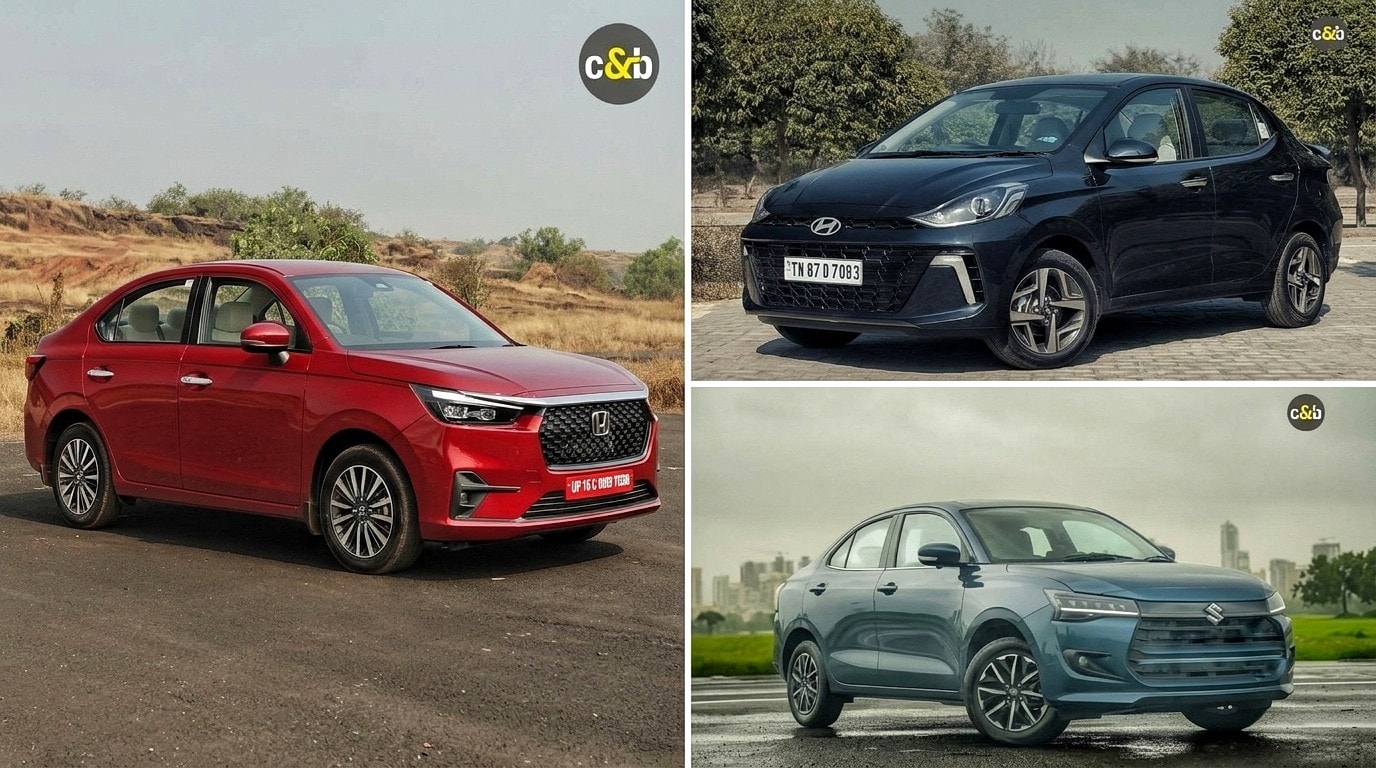
- Amaze offers the biggest boot at 416 litres
- Dzire leads in fuel efficiency
- Aura is the most affordable of the three
Even though SUVs dominate the Indian market today, there was a time when owning a sedan was every family’s dream. And why wouldn’t it be? The comfort a sedan offers has always attracted buyers.Especially for middle-class sedan lovers, choosing a sub-4-metre sedan can be confusing, with the Maruti Suzuki Dzire, Honda Amaze and Hyundai Aura all being popular options. But which of these three is better for your family? That’s what we’re here to find out.
Design
You can call design subjective, but before buying a car, customers always look for something with a strong road presence that leaves a lasting impression. All three sedans look good, but there are noticeable differences. The Amaze belongs to the Honda family, and you can see some resemblance to the Honda City, especially at the rear, while the front gets a bonnet design similar to the Elevate.The Dzire, on the other hand, gets a distinctive face that hasn’t been seen on any other Maruti Suzuki car before. The Aura’s front design also shares some similarities with its hatchback sibling, the Grand i10 Nios.
All three sedans are almost equally long, but the Amaze gets the longest wheelbase, while the Dzire is wider and taller. The Amaze also offers 172 mm of ground clearance.
All three get 15-inch alloy wheels.
The Amaze’s split tail-lamps resemble those of the Honda City, giving it a more premium appearance. The Dzire gets sportier-looking conventional tail-lamps, while the Aura’s rear stands out with its attractive spoiler and tailgate design, something missing on the other two.
Overall, the Dzire and Aura look slightly sportier, while the Amaze has a more premium sedan appeal.
Interior & Tech
If design isn’t enough to help you choose, let’s look at the interiors and technology.
Starting with the Dzire, its strengths are ergonomics and storage spaces. However, the dashboard design feels familiar because its infotainment touchscreen is shared with several Maruti Suzuki models, including the Baleno, Swift, Brezza, Victoris and Grand Vitara. The dashboard also looks slightly busy, so there’s no real wow factor when you step inside.
That said, the Dzire doesn’t fall behind in features. It gets a sunroof, good infotainment connectivity, a head-up display and a 360-degree camera.
Moving to the Aura, its interior feels slightly more premium, but it doesn’t offer anything particularly different in terms of features compared to the Amaze and Dzire. It gets an 8-inch touchscreen with wireless Android Auto and Apple CarPlay, a wireless charger, rear AC vents, a rear-seat armrest with cupholders, Type-C charging and cruise control.
The Amaze, meanwhile, gets a cleaner dashboard, comfortable seats and a slightly more premium feel, with good overall fit and finish. It also gets an 8-inch touchscreen. More importantly, it’s the only car in this segment to offer ADAS. However, if you want a sunroof, neither the Amaze nor the Aura offers one.
Second Row Comfort
Second-row comfort is one of the biggest reasons people choose sedans, and here the Amaze has an advantage over the Dzire and Aura.Its longer wheelbase helps offer better knee room and headroom, while under-thigh support is good too.
The Amaze gets rear AC vents but misses out on Type-A and Type-C charging ports, which are available in the Dzire. All three passengers get headrests, but these are fixed in the Amaze, while the Dzire offers two adjustable headrests.
However, among the three, the Aura offers the best under-thigh support and seat recline angle. But it misses out on adjustable headrests and Type-C charging, just like the Amaze.Overall, the Dzire offers more cabin features, the Amaze feels more spacious and airy, while the Aura offers better seating comfort.
The Amaze also gets the biggest boot at 416 litres, followed by the Aura at 402 litres and the Dzire at 382 litres.
Performance & Drivability
These aren’t performance sedans; they’re family cars. So, along with engine performance, we’ll also look at which one is better for everyday driving.
All three are available with petrol engines and CNG options. However, the Dzire and Aura get factory-fitted CNG, while the Amaze can get a dealership-retrofitted CNG kit.
Both the Dzire and Aura offer AMT options with CNG, while the Amaze’s CVT can be paired with a retrofitted CNG kit.
Starting with the Dzire, it gets a new 1.2-litre, three-cylinder Z-Series engine producing 80 bhp and 112 Nm. Maruti Suzuki claims around 25 kmpl for both manual and automatic versions, which is impressive for the segment. Real-world figures could be closer to 20 kmpl.
The engine performs well in the low and mid-range, and you don’t really feel that you’re driving a three-cylinder car. However, push it harder at higher RPMs and vibrations become noticeable. Outside noise also creeps into the cabin at higher speeds.
The Dzire is otherwise easy to drive, with light steering and slick gear shifts that make everyday city driving effortless.
The Aura and Amaze, on the other hand, get four-cylinder 1.2-litre engines, unlike the Dzire.The Aura’s 1.2-litre petrol engine produces around 82 bhp and 113.8 Nm. It’s known for its smoothness in this segment, with decent linear acceleration and slightly better performance than the Dzire.
Like the Dzire, it’s also easy to drive in the city, thanks to its light steering and good visibility. It comes with a 5-speed manual and AMT gearbox.In terms of fuel efficiency, you can expect around 17 kmpl on the highway. The CNG version can comfortably deliver up to 20 km/kg.
Ride comfort is another strong point. The Aura strikes a good balance between softness and stiffness, offering the kind of comfort you’d expect from a family sedan.
The Amaze also gets a four-cylinder engine, which makes it quite smooth. Its familiar 1.2-litre i-VTEC petrol engine produces 89 bhp and 110 Nm. It offers more power than both the Dzire and Aura, although torque is slightly lower.In terms of refinement, the four-cylinder configuration gives it an advantage over the Dzire. However, fuel efficiency is around 5-6 kmpl lower than the Dzire in both manual and automatic versions.
The Amaze also gets a CVT, which has historically been a good combination with Honda engines.
When driven back-to-back with the Dzire AMT and Aura AMT, you realise that the Amaze’s CVT is more capable in terms of convenience and responsiveness. Paddle shifters are also available if you want more control.Ride quality on the Amaze is better than the Dzire’s, but it can feel slightly bouncy on the highway, especially with a heavy load. This is where the Aura has an advantage, offering a better overall ride balance.
The Amaze also offers good handling, something that has always been one of its strengths.
It’s also the first car in this segment to offer six ADAS functions. Features such as Lane Keeping Assist, Adaptive Cruise Control and the LaneWatch camera are useful additions. Six airbags are standard across all three sedans.
Price & Verdict
The Maruti Suzuki Dzire is priced between Rs. 6.31 lakh and Rs. 9.54 lakh, while the Honda Amaze costs between Rs. 7.65 lakh and Rs. 10 lakh. The Hyundai Aura is the most affordable, with prices ranging from Rs. 5.99 lakh to Rs. 8.68 lakh (all prices ex-showroom).
Clearly, the Aura has a price advantage.All three offer what you’d expect from a family sedan, including space, practicality and good features. However, the Aura offers these qualities at a lower price.So, if your priority is a fuel-efficient sedan at an affordable price, the Dzire is a good choice.
If you want a more premium and spacious sedan with a smoother engine and better rear-seat space, the Amaze makes more sense.But if you want a practical, smooth and comfortable family sedan without spending too much, the Hyundai Aura is worth considering. It may not offer as many segment-first features as the Amaze and Dzire, but it delivers the essentials at a much lower price.
Related News

Latest Cars


Upcoming Cars


Latest News


 car&bike Team | Nov 12, 2026Hyundai Creta vs Maruti Suzuki Grand Vitara vs Toyota Urban Cruiser Hyryder: Which Compact SUV Fits You?The Hyundai Creta, Maruti Suzuki Grand Vitara and Toyota Urban Cruiser Hyryder are among the popular choices in the compact SUV space. But which one fits your bill?10 mins read
 car&bike Team | Nov 12, 2026Kia To Invest USD 2 Billion For Second Andhra Pradesh Manufacturing FacilityThe brand’s annual production capacity from this plant is rated at 2 lakh units.1 min read
 car&bike Team | Nov 12, 2026Why Does Regenerative Braking In EVs Stop At 100% Battery Charge?We have explained why your electric car suddenly glides freely instead of slowing down when driven with a completely full battery pack.1 min read
 car&bike Team | Nov 12, 2026BYD's Denza D9 MPV, Z9 GT Shooting Brake India Launch Tomorrow: What To Expect?BYD’s luxury brand Denza will enter India with two very different electric offerings: the D9 luxury MPV and the 1,140 bhp Z9 GT Shooting Brake.3 mins read
 car&bike Team | Nov 12, 2026Does Hardwiring A Dashcam Void Your Car Warranty?Take a look at whether hardwiring a dashcam really affects your factory warranty and how you can install one safely in India.6 mins read
 car&bike Team | Nov 11, 2026RTI vs Zero Depreciation: Which Car Insurance Cover Pays More?Return to Invoice (RTI) covers the gap between your car's current IDV (Insured Declared Value) and the original invoice value in case of theft or total loss. Zero Depreciation reduces deductions on replaced parts during accident repairs.1 min read