logo
New Delhi

Expert Review on Renault 2025 Triber

  • Expert Rating
    c&b icon8.4/10
  • Safety
    7.75
    Comfort
    8.5
    Styling
    8
    Merit / USP
    9
    Significance
    9
    Value for Money
    8.75

car&bike Expert Take

“The Renault Triber is ideal for those who want seven-seat flexibility at a reasonable price. It is not for those who are chasing the latest features or a premium cabin experience. Its real strength is clever packaging, good ride comfort, and value for money practicality.”

Launched in 2019, the Renault Triber stood tall as a sub-four metre MPV with real seven-seat flexibility at hatchback money. Over the years, Renault has brought incremental updates to the car, but the biggest and most meaningful came with the 2025 model, which featured exterior revisions, interior tweaks, and an elevated safety package as well. This review brings a combination of insights from several car&bike evaluations by multiple experts. Bilal Firfiray drove the 2024 Triber and highlighted its practicality and ride quality as seen in our review.

While the 2024 update added features like a digital instrument cluster, wireless charging (on higher trims), the 2025 update introduced a rework of the front end that adds LED projector headlamps, and received a new grille design as well as six airbags standard across variants. Mechanically, the Triber is still the same. It continues with the 1.0-litre naturally aspirated petrol engine coupled with either a five-speed manual or AMT gearbox.

Renault positions the Triber as the cheapest urban seven-seater automatic in India. It is below compact MPVs such as the Ertiga in terms of pricing, but has a clever modular seating system that allows buyers to remove or completely fold the third row. For families who need a few extra seats occasionally, without having to step into a larger, more expensive vehicle, the Triber still fills a niche that very few cars currently address.

The Triber carries forward the same powertrain setup, but with a more usability and efficiency focus.

Engine Specifications

Engine

Power

Torque

Transmission Options

1.0-litre, three-cylinder naturally aspirated petrol

71 bhp

96 Nm

Five-speed manual / Five-speed AMT

A dealer-fitted CNG kit is still available with the manual variant.

City Driving

  • In urban conditions, the Triber felt easy to handle.
  • The light clutch and straightforward gear shifts make the manual version the more engaging one. 
  • The engine provides enough performance for daily commuting, as long as the expectations are realistic. 
  • With a light foot, it handles traffic duties comfortably. However, when carrying a full load of passengers, acceleration is modest, and refinement is average for the segment. 
  • The AMT focuses on convenience and is not very fast.

Bilal Firfiray described it as:
“Slightly slow and dim-witted.”
Bilal further said during his drive:

“This 1.0-litre naturally aspirated engine is good enough for everyday usability if you are one of those unhurried drivers.”
Highway Driving

  • On highways, the Triber keeps composure at moderate cruising speeds. 
  • It can easily support 80-100 kmph, but overtakes must be planned, which are difficult when fully loaded. 
  • Where the Triber stands out is the ride quality. Ever since the Duster, Renault has been known to tune the suspension well for Indian road conditions.
  • Broken surfaces, expansion joints, and patchy stretches are dealt with with impressive comfort. 
  • However, steering feedback is limited, and it is not particularly sharp. Body roll is also evident during quick lane changes.

Bilal emphasised:
“The ride quality alone is reason enough to buy the Triber.”

Manual vs AMT

The five-speed manual draws the best possible performance from the modest engine. It is more predictable and allows the driver to have better control over momentum. The AMT is an added convenience in traffic, but has less smoothness than a CVT or torque converter. Renault's continued decision not to offer the 1.0-litre turbo-petrol engine from the Kiger is a missed opportunity, particularly for buyers who want stronger highway performance.

When the Triber was first launched in 2019, it didn't look like a typical MPV. It appeared compact, a bit rugged, and cleverly packaged. The 2025 refresh released a more noticeable change at the front. The silhouette is still familiar with a stepped roofline, compact footprint, and upright tailgate, but the new fascia gives it a little more presence.
Jafar Rizvi summed it up during his comparison:
“The new Triber departs from the earlier rounded styling and now has a more upright, sharply sculpted look.”

Renault Triber Dimensions vs Rivals

Dimension

Renault Triber

Maruti Suzuki Ertiga

Kia Carens

Length

3,990 mm

4,395 mm

4,540 mm

Width

1,739 mm

1,735 mm

1,800 mm

Height

1,643 mm

1,690 mm

1,700 mm

Wheelbase

2,636 mm

2,740 mm

2,780 mm

Ground Clearance

182 mm

185 mm

195 mm

Compared to other larger MPVs such as the Maruti Suzuki Ertiga and Kia Carens, the Triber is much shorter. That less-than-four-metre length is exactly what makes it city-friendly. It takes up almost hatchback-like road space and still has three rows. Its high stance and 182mm ground clearance give it reasonable road presence without being bulky.

The 2025 update brought the most extensive design update since launch, especially on the front.

Front Profile

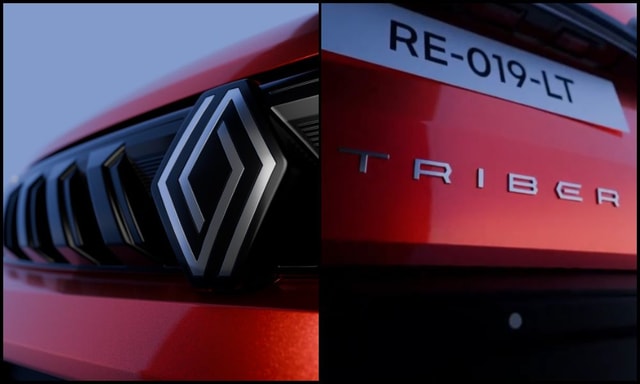
The new front fascia now has a rectangular grille with 3D detailing and Renault's updated 2D diamond logo. LED projector headlamps replace the older units, and the bumper is chunkier with a larger central air intake and re-positioned fog lamps. The bonnet looks flatter and more sculpted than before, and gives the MPV a more upright and confident look.
Aman Ahmed noted in his walkaround:
“The gloss black grille and redesigned headlamps add more depth to the face of the Triber.”

Side Profile

In profile, the Triber has not changed much. The stepped roofline, which was designed to maximise the headroom in the third row, continues to define its shape. The 15-inch flex wheels (steel wheels in the style of alloys) give it a clean look, though true alloys are still lacking. The blacked-out roof (on dual-tone variants) and the body cladding provide a little crossover appeal.

Rear Profile

At the back, smoked LED tail lamps with gloss black surrounds give the updated Triber a fresher look. A black applique is used to connect the lamps, which visually widens the stance. The upright tailgate is also intentional. It maximises the flexibility of the cargo, especially if the third row is folded or removed. The squared-off rear bumper adds some muscle to the design, but overall, it's a practical design rather than flashy.

The 2025 update comes with shades of light grey and beige, replacing the darker theme of before. This modification makes the cabin feel airier, which is important in particular in a three-row layout.

Bilal Firfiray observed during his review:

“It's feature-loaded for its price, but Renault could have done better in terms of the in-cabin feel.”

Cabin Layout and Quality

The dashboard has been redesigned with a freestanding eight-inch touchscreen above the central AC vents. The layout is more modern than before, although many of the switchgear elements are familiar. Plastics are hard-wearing rather than plush. They are built to last, which is important for a family MPV, but don't feel premium to the touch. Fit and finish, however, are constant. The digital instrument cluster (introduced earlier) gives a modern touch, but is not as configurable as in Renault's other models.

Seating Comfort

Front Row

The front seats are high enough to provide good visibility, but not SUV-like. The driver now gets an armrest and height adjustment in higher trims, which improves long-distance comfort. The seating cushioning is comfortable for daily use, but there is relatively little bolstering.

Bilal mentioned:

“The driver's armrest was like a huge boon after being in cars without one.”

Second Row

The second row is one of the Triber's strongest points. It slides and reclines, and passengers can adjust legroom depending on third row occupancy. Headroom is generous thanks to the stepped roof. Three adults can fit, but the shoulder room is best for two adults and a child.

Aman Ahmed highlighted:

“There's a good range of adjustment and you can really lounge in the back if needed.”

Third Row

The third row is best left for children or short adults. Entry requires the second row to be folded in and tumbled. Space is quite limited, and it can be challenging for an average adult.

Aman candidly stated:

“Even for someone like me at 5'6", there isn't a lot of room back here.”

The Renault Triber is priced as the cheapest seven-seater in India. That is still its biggest USP even after the recent update. Prices now start around Rs. 6.29 lakh (ex-showroom), and it goes up to around Rs. 9.17 lakh for the top Emotion AMT variant. While the update has come with a slight increase in prices, the added safety kit, including six airbags as standard, is worth the hike. Even the base variant comes with necessary safety features, making it more value-oriented than it used to be. The AMT, however, is limited to the top Emotion trim.

Renault Triber Ex-Showroom Prices (India)

Variant

Engine & Transmission

Ex-Showroom Price (Approx.)

Authentic

1.0-litre Petrol MT

Rs. 6.29 Lakh

Evolution

1.0-litre Petrol MT

Rs. 7.24 Lakh

Techno

1.0-litre Petrol MT

Rs. 7.99 Lakh

Emotion

1.0-litre Petrol MT

Rs. 8.64 Lakh

Emotion AMT

1.0-litre Petrol AMT

Rs. 9.17 Lakh

Note: Prices are subject to change and vary by state.

Efficiency is also one of the Triber's key strengths, especially in light of its seven-seat capability.

Observed Fuel Efficiency During Testing

Engine & Transmission

ARAI-Claimed Mileage

City Mileage (Real-World)

Highway Mileage (Real-World)

1.0-Litre Petrol Manual

20 kmpl

13–16 kmpl

17–19 kmpl

1.0-Litre Petrol AMT

17–18 kmpl

12–15 kmpl

16–18 kmpl

In real-world situations, the manual variant is slightly better in consistency, especially when driven smoothly. The AMT prioritises convenience over efficiency when the throttle is pressed harder. Bilal Firfiray noticed on his drive that the engine is sufficient when driving gently, but pushing it hard, especially while carrying a full load, affects fuel economy noticeably. For buyers choosing the dealer-fitted CNG kit, running costs are greatly reduced at the cost of boot practicality.

With the latest update, Renault has made safety a more powerful talking point for the Triber.

Passive Safety and Crash Protection

All variants now come with six airbags as standard: dual front, side, and curtain airbags. This is a significant improvement over previous versions. The Triber previously scored four stars in Global NCAP testing using 2021 protocols. However, when tested under more stringent norms for South Africa, the rating fell to two stars. 
As of this time, there is no active testing data for the new Triber. With the addition of six airbags and better structural reinforcements, there are higher expectations for the updated version. And apart from the airbags, the structure of the cabin does feel solid enough for the segment, albeit not the same kind of tank-like solidness that some rivals have.

Active Safety and Stability Systems

Electronic Stability Program (ESP) is now standard throughout the range, as well as ABS with EBD and Brake Assist. Traction control, hill start assist (on AMT variants), rear parking sensors, and a rear-view camera (on higher trims) make Triber an even safer choice for day-to-day safety. Tyre Pressure Monitoring System (TPMS) is also included, which is particularly useful for family road trips. The addition of front parking sensors in higher trims further assists manoeuvrability in tight city spaces.

You will not get oversized digital clusters or panoramic sunroofs here. Instead, Renault has concentrated on usable features that actually enhance the comfort and convenience of family life and daily living.

Infotainment and Interface

The highlight of the updated cabin is the eight-inch freestanding touchscreen infotainment system. It now supports wireless Android Auto and Apple CarPlay in higher trims, which eliminates the need for cables. The interface is cleaner than it used to be, but responsiveness is good rather than class-leading.

The digital instrument cluster provides a modernistic touch and shows fuel efficiency, trip data, and driving information in a clear manner. It is not very configurable, but it enhances readability from the older analogue-heavy layouts. Higher trims also include cruise control, wireless charging, push-button start, and steering-mounted audio controls. The six-speaker audio configuration (in top variants) has balanced sound quality for the segment, although the depth of bass is still moderate.
Bilal added:

“You get decent features for the price, and I have no complains here.”

Cabin Convenience and Practical Tech

Rear AC vents for both the second and third rows improve comfort in Indian summers. The sliding and reclining second row makes flexible space management possible, depending on whether the third row is occupied. Multiple storage areas, such as large bottle holders and dashboard trays, increase the usability of everyday life. The modular third row can either be folded flat or removed completely, turning the MPV into a large cargo carrier when required. Front parking sensors (on higher trims), rear camera, tyre pressure monitoring system, and keyless entry all add to the convenience.

Boot flexibility is Triber's greatest attribute, especially considering its compact size.

  • With all three rows up: 84 litres
  • With third row folded: 625 litres
  • With the third row removed, you get even more usable flat space

With all seats in place, luggage space is limited to small bags. However, once the third row is folded or removed, the Triber becomes one of the most practical vehicles in its price range. The wide-opening tailgate and flat loading area make it easy to load heavier things. The 50:50 split third row and 60:40 split second row make it possible to have multiple seating and cargo configurations. We noted the third row frees up dramatically more space.

The Triber's mechanical package is about comfort and stability. Renault's philosophy of suspension tuning, as seen in previous models such as the Duster, carries on here.

City Driving

This is where the Triber feels most at home. The steering stays light at low speeds, making it possible to park and make tight U-turns despite the three-row layout. Visibility from the driver's seat is good and improves with an upright seating position. The suspension absorbs potholes and broken patches nicely. Even with passengers on board, it manages to remain comfortable over rough surfaces.

Highway Driving

On highways, the ride and handling are fair for the price and load-carrying capability. Overtakes must be planned, especially with a full load of passengers. Handling is not its best forte. Steering feedback is still limited, and body roll is noticeable during a quick change of direction. The emphasis is obviously on comfort and not dynamic precision.
Bilal remarked 
"While the engine is usable, a turbo-petrol option would have made a big difference on the highway.” 

Renault has simplified the Triber lineup with four core trims: Authentic, Evolution, Techno, and Emotion. The manual gearbox is offered in all variants, and the AMT is limited to the top Emotion trim. Here is how the range is structured:

Variant

Engine & Gearbox Options

Key Additions

Best Suited For

Authentic

1.0-litre Petrol (MT)

Six airbags, ESP, ABS with EBD, rear parking sensors, projector headlamps, front power windows

Budget buyers who want maximum safety at an entry price

Evolution

1.0-litre Petrol (MT)

Wheel covers, rear AC vents, remote keyless entry, basic infotainment system

Families upgrading from hatchbacks

Techno

1.0-litre Petrol (MT)

Eight-inch touchscreen with wireless Android Auto & Apple CarPlay, steering-mounted controls, rear camera, cruise control

Buyers seeking value with convenience features

Emotion

1.0-litre Petrol (MT / AMT)

LED projector headlamps, wireless charging, digital cluster, front parking sensors, six speakers, push-button start

Feature-focused family buyers

The Essentials That You Don’t Get

Even with the update, there are a few glaring omissions:

  • No turbo-petrol engine option
  • No diesel option
  • No automatic climate control
  • No sunroof
  • No true alloy wheels
  • AMT is limited to the top variant only

The right Triber is very much dependent on how you intend to use it. Starting from the Authentic trim, you get all the basic essentials and six airbags. Evolution adds the infotainment and other comfort features. Moving ahead, you get the Techno that brings a rear camera and cruise control and last you have the Emotion trim which brings LED headlamps, wireless charging, front parking sensors and other convenience features. 

Best for Budget-Conscious Families: Evolution

If seven-seat practicality at the lowest possible price, while still getting rear AC vents and other necessary conveniences, is your priority, then the Evolution trim is a sensible choice.

Best Value Overall: Techno

The Techno variant brings the best value proposition. It adds a bigger touchscreen with wireless connectivity, cruise control, and a rear camera without pushing the price too high. For the majority of buyers, this is the most value-for-money trim.

Best for Maximum Features & Automatic Convenience: Emotion AMT

If you want the full feature list together with the convenience of an automatic gearbox, the Emotion AMT is the only option. It is the most expensive Triber, but it is still cheaper than other automatic MPVs.

The Triber has its own unique space, but it does overlap to some degree with a couple of vehicles in terms of price and practicality. Key competitors include the Maruti Suzuki Ertiga, Kia Carens, and budget hatchbacks such as the Maruti Suzuki Swift for buyers who are comparing price rather than seating capacity. The Triber undercuts proper MPVs by a significant margin but cannot match them in outright performance or in cabin width.

Model

Engine Options

Mileage (ARAI)

Key Value Proposition

Ex-showroom Price Range

Renault Triber

1.0-litre Petrol (MT / AMT)

20 kmpl

Most affordable seven-seater with modular seating

Rs. 6.29 – Rs. 9.17 Lakh

Maruti Suzuki Ertiga

1.5-litre Petrol / CNG

20.51 kmpl

More powerful engine, larger cabin

Rs. 8.80 – Rs. 12.94 Lakh

Kia Carens

1.5-litre NA / Turbo / Diesel

16–21 kmpl

Multiple engine options, premium features

Rs. 10.99 – Rs. 12.77  Lakh 

Maruti Suzuki Swift

1.2-litre Petrol / CNG

25.75 kmpl

Sportier hatchback alternative

Rs. 5.79 – Rs. 8.80 Lakh 

  • Choose the Renault Triber if you want maximum seating flexibility at the lowest possible price and mainly drive in the city.
  • Choose the Maruti Suzuki Ertiga if you need more power and you do regular highway travel with a full load.
  • If features, engine choices, and premium feel are more important than upfront affordability, choose the Kia Carens.
  • Choose a premium hatchback such as the Maruti Suzuki Swift if you don't need seven seats and you are more interested in driving dynamics.

Pros

  • Most affordable seven-seater in India
  • Good ride quality over broken roads
  • Flexible modular third-row seating
  • Six airbags are standard across the range
  • Strong value-for-money positioning

Cons

  • Underpowered with full passenger load
  • The AMT gearbox feels slow
  • No turbo or diesel option
  • The third row is tight for adults
  • Interior plastics feel basic

Verdict

Renault Triber is one of the most intelligently packaged vehicles in the Indian car market. It does not attempt to be powerful, sporty, or overtly premium. Instead, it focuses on space, affordability, and ride comfort.

Bilal Firfiray summed it up well in his review when he suggested:

“While Renault lost out on the opportunity to include a stronger engine, the Triber still offers what many Indian families really need: flexibility on a budget.”

If your priority is a seven-seater that is practical and easy to maintain without stretching your finances, the Triber makes a strong case. However, if highway performance as well as stronger power engine options are non-negotiable, then larger MPVs will serve you better.

Renault 2025 Triber Price List (Variant Wise)

Renault 2025 Triber Ex-Showroom price ranges from ₹ 5.81 to 8.69 Lakh. Renault offers 2025 Triber in 7 variants. The top variant of 2025 Triber is Emotion AMT DualTone and the base variant is Authentic.

Variants
*Ex-Showroom Price
999 CC, Petrol, 19 KM/L, Manual
Starts at
₹ 5.81 Lakh
999 CC, Petrol, 19 KM/L, Manual
Starts at
₹ 6.7 Lakh
999 CC, Petrol, 20 KM/L, Manual
Starts at
₹ 7.39 Lakh
999 CC, Petrol, 20 KM/L, Manual
Starts at
₹ 8 Lakh
999 CC, Petrol, 20 KM/L, Manual
Starts at
₹ 8.21 Lakh
999 CC, Petrol, 20 KM/L, AMT
Starts at
₹ 8.48 Lakh
999 CC, Petrol, 20 KM/L, AMT
Starts at
₹ 8.69 Lakh

Similar Global NCAP Crash Test

Latest News On 2025 Triber