
Honda Accord Hybrid vs Toyota Camry Hybrid: Specs and Features Comparison
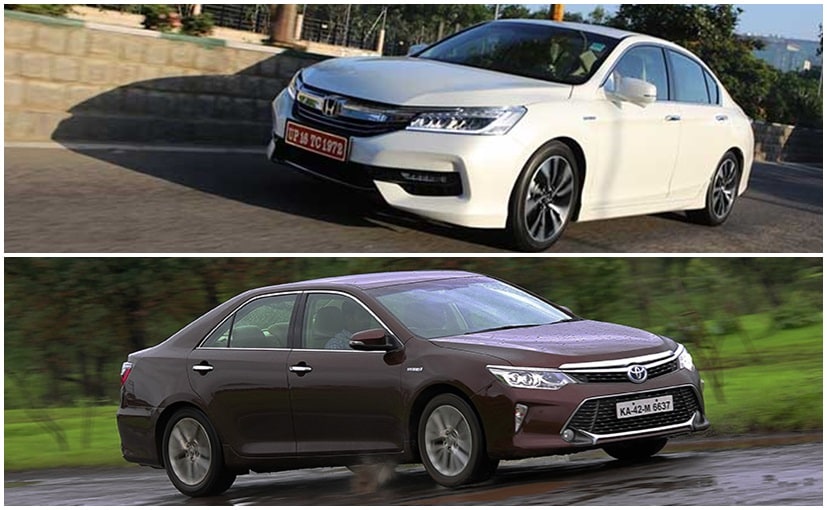
- Both cars use conventional hybrid system - Petrol Engine + Electric Motor
- Both Accord and Camry hybrid get Eco and EV driving modes
- The Camry Hybrid comes with slightly better safety features
Honda has re-launched the Accord sedan in India, and this time the car will come in its hybrid avatar. We recently drove the car in India and you can read all about it in our first drive review. In India, the new Honda Accord Hybrid will lock horns with the Toyota's Camry Hybrid, which has somehow been the undisputed leader of the segment and we have driven this too. Both the cars come with a conventional hybrid powertrain and offer all the luxurious features of an executive sedan. While we will bring you the road test comparison soon, for now, let's see how the cars fare against each other on paper.
Engine Specifications
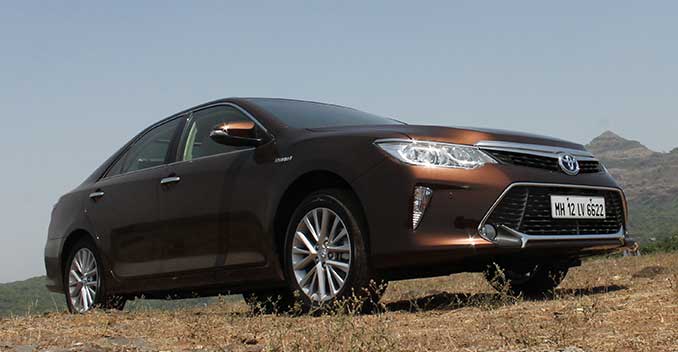
Starting with the current segment leader, Toyota's Camry Hybrid is powered by an efficient 2.5-litre, 4-cylinder petrol engine that is paired to an electric motor. Individually, the petrol engine churns out a maximum of 158bhp and develops 213Nm of peak torque, while the electric motor is good for 140bhp and 270Nm. That said, when combined together, the total power output comes to 202bhp. Transmission duties are handled by Toyota's electronically controlled CVT unit, which is best suited to a hybrid car.
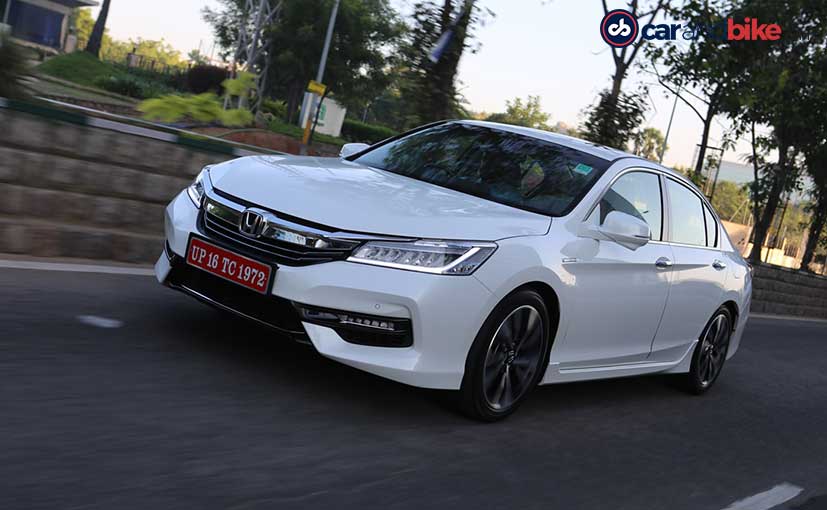
In comparison, Honda's new Accord Hybrid comes with a conventional 2.0-litre, 4-cylinder, naturally aspirated petrol engine that also comes mated to an electric motor that is powered by a 1.3Kilowatt/h Lithium-ion battery pack. The petrol engine alone makes a modest 145bhp and develops 175Nm of torque. As for the electric motor, it develops a maximum output of 184bhp and 315Nm of torque. The total system output is rated at 215bhp, which is about 13bhp more than what the Camry's hybrid system makes. Even here, the transmission duties are handled by a CVT gearbox. Also in the Accord Hybrid, the petrol engine and electric motor can power the car as a pair or independently.
Driving Modes and Fuel Efficiency
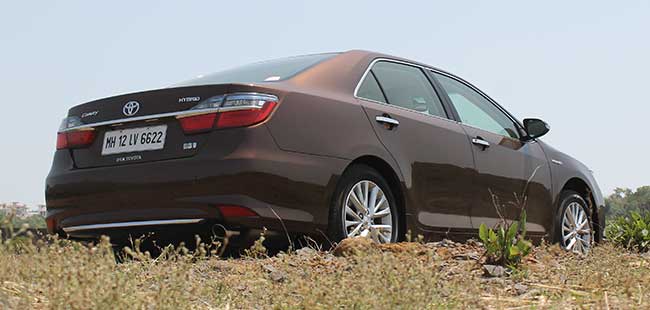
Both the Camry Hybrid and the Accord Hybrid come with different driving modes and superior fuel efficiency. In Toyota's Camry Hybrid there are two driving modes to choose from - EV and Eco. The EV mode kicks in if you're stuck in traffic, as it doesn't allow you to go above 40km/h. Switch to Eco mode and the electric motor and the petrol engine work hand-in-hand with one another. Efficiency wise, Toyota claims that the Camry Hybrid delivers 19.6km/l (ARAI figures), which is truly impressive for a car of this size.
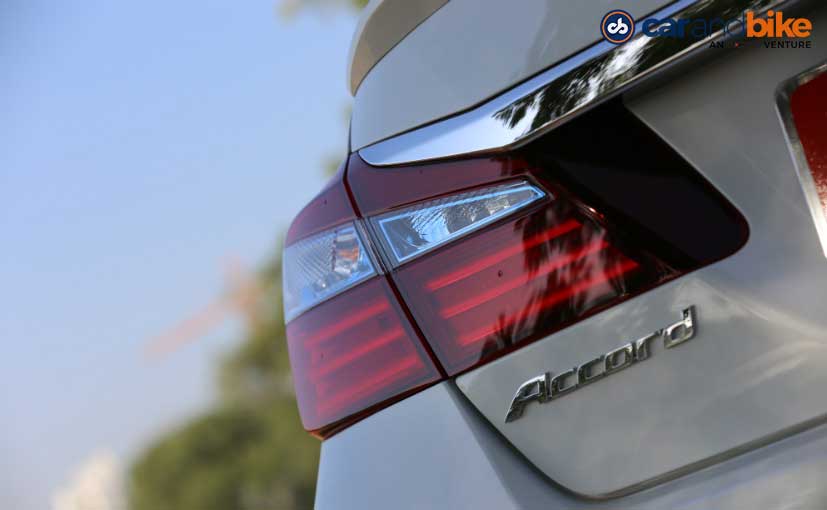
On the other hand, the new Honda Accord Hybrid comes with three drive modes - one pure electric -EV, a Hybrid Drive mode - Eco and an Engine Drive mode - Sport. In EV mode the car entirely runs on electric power and you can access the motor's complete potential but that would limit your range to only 2 km before the petrol engine takes over automatically. In Eco or hybrid mode, the engine runs to power the electric generator and is disengaged from the actual driveline of the car. If you wanted instant power and you floored the throttle pedal, the engine connects up to the driveline by a set of gears and the combination of the electric motor and the engine powers the car. Whereas, in Engine drive or Sport mode, the car runs on the internal combustion engine like any other petrol sedan. The maximum fuel efficiency that you can get from the Accord Hybrid is registered at 23.1 km/l.
Equipment and Features
Among feature offerings, the Camry Hybrid comes with slimmer front grill and sleek looking LED headlamps with LED daytime running lights. The front also comes with the massive trapezoidal air dam brings out the wild side of the car, while the chrome strips run around the chin at the front, the air dam, the door handles, the window sills, the rear and even the tip of the rear bumper, adds to its premium nature. Inside there is a huge touchscreen infotainment display at the centre of the dashboard along with features like - 3-zone automatic Climate control, the rear seat, as on the previous car, gets its own temperature setting. Considering its Toyota the Camry is high on safety features as well that includes - 7 Airbags, ABS with with Electronic Brake Force Distribution and brake Assist, Vehicle Stability Control (with Off Switch), Hill Start Assist Control (with Slope Detection), Rear Camera, Clearance & Back Sonar, and Impact Sensing Fuel Cut-off among others.
The Honda Accord Hybrid, on the other hand, gets an all-LED headlamp cluster with LED daytime running lights and a fat chrome slat on the grille the runs into the headlamp design. The muscular front bumper comes with a wide air dam, air intakes and LED foglamps. The car also comes with features like - dual-zone automatic climate control system, infotainment system with Apple CarPlay and Android Auto, electric sunroof, rain-sensing wipers, remote pre-cooling and pre-heating function for the cabin, and a remote start function. Whereas, safety features airbags, ABS, stability control, traction control and lane watch assist.
Related News


Latest Cars


Upcoming Cars


Latest News


 car&bike Team | Jul 25, 2026Jeep Meridian 85th Anniversary Edition Launched At Rs 36.05 LakhLimited to 85 units, the special edition gets cosmetic changes and also features the CARA AI voice assistant.1 min read
 car&bike Team | Jul 25, 2026River Indie Electric Scooter Crosses 50,000 Units Production MilestoneThe milestone comes less than three years after the first unit rolled out of the company's Hoskote manufacturing facility.2 mins read
 car&bike Team | Jul 25, 20262026 Maruti Brezza Facelift Fuel Efficiency Figures RevealedThe updated model returns up to 26.90 km/kg in CNG guise, while the newly introduced turbo-petrol delivers a claimed 20.47 kmpl.2 mins read
 Jafar Rizvi | Jul 25, 2026Honda ZR-V Hybrid SUV Launched In India At Rs 47.99 LakhThe ZR-V is Honda’s first hybrid SUV for India and arrives as a CBU.1 min read
 Jafar Rizvi | Jul 24, 20262026 Maruti Brezza Facelift: Variants, Features, Engine Options ExplainedThe 2026 Maruti Suzuki Brezza is offered in four trim levels: LXi, VXi, ZXi and ZXi+ and with two engine options.5 mins read
 Jafar Rizvi | Jul 24, 20262026 Maruti Brezza Facelift Launches With Three Major FirstsThe 2026 Maruti Suzuki Brezza has arrived, and along with carrying a five-star Bharat NCAP rating, the model brings three firsts for both the Brezza and, in one case, Maruti itself.2 mins read
 Bilal Firfiray | Jul 24, 2026Honda ZR-V Review: Who Is It For?Honda has brought the new ZR-V to India as their current flagship offering. It’s a CBU, it’s a hybrid, and it’s here for a limited few. Who is it for though?1 min read
 Shams Raza Naqvi | Jul 15, 2026Ferrari 849 Testarossa Spider Driven: Rs. 11.25 Crore Meets 1,000 bhpWe got behind the wheel of the most powerful convertible from Ferrari. What makes the 849 Testarossa Spider Special? We tell you.1 min read
 Bilal Firfiray | Jul 12, 2026Tata Sierra EV Review: Reborn In The Electric AgeThe Tata Sierra EV isn’t drastically different from its ICE counterpart when it comes to design. But being the seventh electric offering from the Indian brand, it has gotten a few things right, and very few things wrong. But is it a compelling package to buy?5 mins read
 Jafar Rizvi | Jul 13, 2026TVS Orbiter Long-Term Review (Report 1): Settling In Takes TimeFirst impressions weren't the strongest, but the Orbiter has made a mark in its first month in the car&bike garage.5 mins read
 Seshan Vijayraghvan | Jul 7, 2026Tata Altroz Petrol DCA Long-Term Review: Intercity & Highway Driving ReportWe tested the Tata Altroz Petro DCA’s highway manners, intercity performance, and real-world fuel efficiency.1 min read