
Bharat NCAP Vehicle Safety Programme Launched; Over 30 Models Already Nominated For Testing

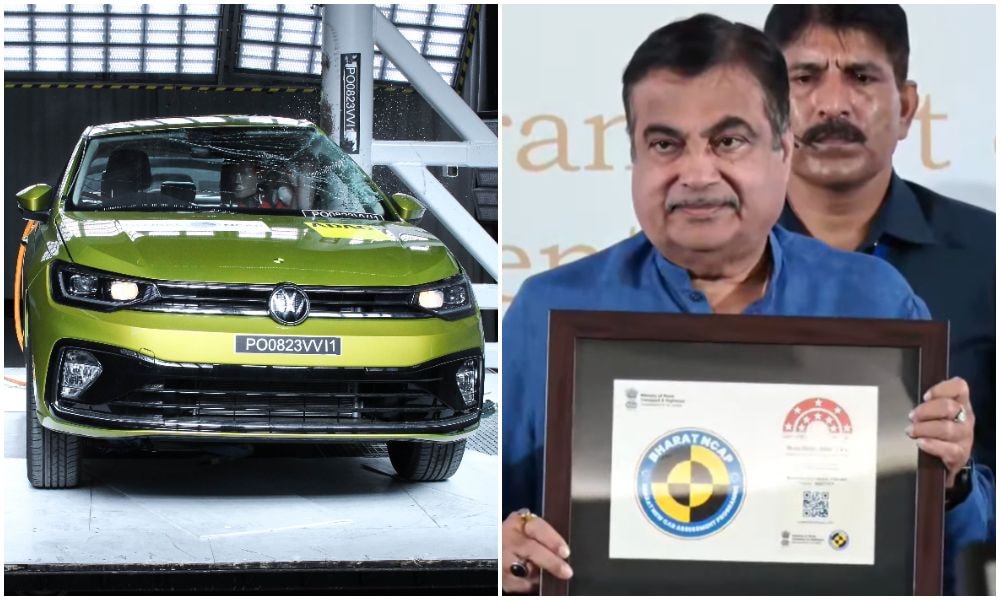
- Bharat NCAP (BNCAP) ratings will be awarded on adult and child occupant protection scores, as well as fitment of safety assist tech.
- Over 30 made-in-India models have already been nominated for testing.
- Cars tested under the programme to bear BNCAP logo and a sticker denoting its rating.
In a monumental move for improvement of road safety, the Indian government has today launched the long-awaited Bharat New Car Assessment Programme (BNCAP). As mooted previously, the BNCAP will become operational from October 1, 2023 onwards, with the road transport and highways ministry (MoRTH) confirming the final stakeholder consultations have been completed, and that most components needed to operationalise BNCAP are in place. Over 30 models have already been nominated for BNCAP testing by their respective manufacturers, said road transport minister Nitin Gadkari, without naming the manufacturers or the models. Having a car tested abroad cost roughly Rs 2.50 crore, but a BNCAP test will cost Rs 60 lakh, outlined Gadkari.
Also Read: Maruti Suzuki Makes ESC Standard On Most Models In Light Of Bharat NCAP Rollout
Vehicles will be subjected to three impact tests, and will receive ratings ranging from one star to five stars.
BNCAP test protocol draws heavily from Global NCAP and Euro NCAP standards. Tested vehicles will be awarded star ratings ranging from a minimum of one star to a maximum of five stars. All vehicles will be judged on three parameters – adult occupant protection, child occupant protection and fitment of safety assist technologies. The crash tests will include a frontal impact test (crashing the vehicle into an offset deformable barrier at a speed of 64 kmph), a side impact test (conducted at 50 kmph) and a pole side impact test (compulsory for vehicles to achieve a rating of 3 stars and above). Vehicles will need to secure a minimum of 27 points on adult occupant protection, and 41 points on child occupant protection, in addition to having electronic stability control (ESC) as standard, in order to secure a full five-star rating.
As per the ministry, the infrastructure (including a dedicated office and preparation of testing agencies) for BNCAP is ready, as is the requisite manpower and the final notification, which is yet to be released. The government is still finalising the IT infrastructure (BNCAP website and server) and the procedures of certification.
The logo and sticker that will be pasted onto vehicles tested by BNCAP.
To get their vehicles tested, manufacturers will have to nominate a model, after which BNCAP representatives will visit the manufacturing facility or dealer outlet of the manufacturer to select the base variant of the model through random sampling. Selected vehicles will be sent to the testing centres by the manufacturer, following which the chosen units will be subjected to crash tests. Post the BNCAP standing committee approval, the star rating and test results of the vehicle will be released by BNCAP, with the Central Institute for Road Transport (CIRT) issuing the certificate.
Also Read: Bharat NCAP (BNCAP) Vehicle Safety Tests To Be Launched On August 22
The ministry is hopeful of helping BNCAP evolve over time to include active safety technologies such as 360-degree cameras, autonomous emergency braking, lane departure warning, along with additional impact tests such as a full frontal crash test, rear impact protection and an oblique pole side impact test. In the future, BNCAP standards could evolve to include electric vehicle and alternate fuel protection risk mitigation tests.
Related News


Latest Cars


Upcoming Cars


Latest News


 car&bike Team | Sep 12, 2026New Hero Dual-Sport Motorcycle Spotted: Impulse 160 Incoming?A production-ready Hero dual-sport motorcycle has been spotted without camouflage.2 mins read
 car&bike Team | Sep 12, 2026Hero Glamour X 125 Gains ABS; Priced At Rs 1.01 LakhABS with integrated IBS is claimed to be segment-first on the Glamour X 125.2 mins read
 car&bike Team | Sep 12, 2026New Maruti Suzuki Wagon R Spotted TestingThe Wagon R was last updated in 2025 with six airbags as standard and has largely remained the same ever since the third-gen model was launched.2 mins read
 car&bike Team | Sep 12, 2026BMW F 450 GS Prices Hiked By Up To Rs 30,000BMW Motorrad has raised F 450 GS prices by Rs 25,000-30,000 in India, with the GS Trophy now costing Rs 5.60 lakh {ex-showroom).2 mins read
 car&bike Team | Sep 11, 2026Royal Enfield Himalayan 440 Accessory Prices AnnouncedPrices for the accessories start at Rs 730 and go up to Rs 29,250.1 min read
 Jafar Rizvi | Sep 11, 2026BMW 7 Series, i7 Facelift Launched In India: Prices Start At Rs 1.95 CroreThe facelifted 7 Series and i7 will be locally assembled at BMW Group’s Chennai plant, making India only the second country after Germany to produce the i7.5 mins read
 Janak Sorap | Sep 12, 2026New Bajaj Pulsar 125 First Ride Review: More Tech, Less Weight, Same Pulsar DNAThe new Bajaj Pulsar 125 retains the familiar Pulsar identity but gets a new engine, lighter construction, more features and a sharper riding experience.5 mins read
 Bilal Firfiray | Sep 10, 2026Mahindra XEV 9S Review: 3 Reasons To Buy It, And 3 Reasons To AvoidEveryone keeps telling me that the Mahindra XEV 9S is not the electric XUV 7XO. I disagree.1 min read
 Abhishek Nigam | Sep 12, 2026New Bajaj Pulsar 150 Review: Is The New Pulsar, Pulsar Enough?The new Pulsar 150 gets a major mechanical and technological makeover, but does it retain the easy-going performance, familiar character and hooligan streak that made the original an icon? We ride the latest iteration to find out.8 mins read
 Shams Raza Naqvi | Sep 8, 20262026 Maruti Suzuki Baleno Review: Heart Matters, Or Does It?The updated Maruti Suzuki Baleno is here and it gets some significant changes some of which have got the opinion divided. We drive it.7 mins read
 Abhishek Nigam | Sep 7, 2026Simple Wave First Ride Review: Space, Pace And More SpaceThe Simple Wave is here to rewrite the rules of the family EV scooter segment. We scoot around to tell you whether it will create waves or not!7 mins read