
F1: Hamilton And Leclerc Disqualified In Austin, Here’s Why
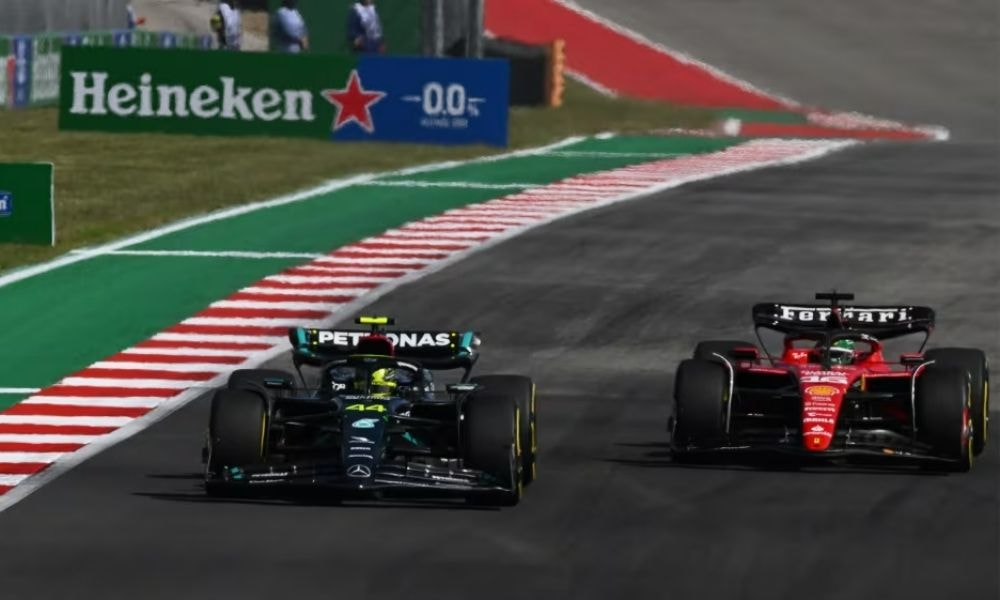
- Excessive wear was found on the skid blocks of both drivers, leading to their disqualification, reshaping the race results.
- Safety regulations designed to control ride height and underfloor downforce were violated by the excessive wear on the planks of Hamilton and Leclerc's cars.
- This unusual disqualification highlights the importance of technical compliance and safety in Formula 1, even in the face of fierce competition.
In a shocking turn of events at the 2023 Formula 1 United States Grand Prix, Lewis Hamilton and Charles Leclerc were both disqualified after post-race checks revealed excessive wear on their car planks. This turn of events reshaped the race results and had significant implications for the championship as Lewis Hamilton was attempting to snatch P2 from Sergio Perez.
Also Read: Verstappen Grabs 50th F1 Win In Austin While Hamilton And Leclerc Disqualified
The disqualification was the result of a breach of Article 3.5.9 e) of the 2023 Formula 1 technical regulations. This article stipulates that the thickness of the plank assembly measured normal to the lower surface must be 10mm, with a tolerance of plus or minus 0.2mm. The plank must be uniform when new, and a minimum thickness of 9mm is acceptable due to wear. This regulation is crucial for ensuring safety by controlling ride height and underfloor downforce.
The plank assembly, a 10mm high-density wood laminate, was introduced in 1994 after the tragic events at Imola that led to the deaths of Roland Ratzenberger and Ayrton Senna. It raised the ride height of cars, reducing the underfloor downforce, and was implemented to enhance safety.
In this race, random post-race floor and plank wear checks were conducted on the cars of Hamilton, Leclerc, Max Verstappen, and Lando Norris. While Verstappen and Norris passed these checks, Hamilton and Leclerc were found to be in breach of the regulations.
Hamilton had been particularly competitive during the final stint of the race, closing in on race winner Max Verstappen. Leclerc's one-stop strategy left him vulnerable in the race's closing stages as he fell back to sixth. However, these performances were marred by the discovery of excessive wear on their car planks.
The combined impact of a bumpy track and the unique sprint race schedule significantly contributed to this irregularity. The sprint weekend format imposes parc ferme rules after a single hour of free practice running on Friday afternoon. This format challenges teams' ability to prepare and check their cars adequately, as evident in the excessive plank wear on Hamilton and Leclerc's cars.
Following Hamilton and Leclerc's disqualifications, Lando Norris was promoted to second place, and Carlos Sainz secured the final spot on the podium. Sergio Perez finished fourth, George Russell fifth, and Pierre Gasly in eighth. The disqualifications also had historic implications, with Logan Sargeant becoming the first American to finish in the points since Michael Andretti in 1993.
Also Read: Lewis Hamilton’s 2013 Mercedes-AMG F1 Car Heads To Auction
It is essential to note that the precise impact of running outside the specified plank thickness is challenging to gauge, as it depends on various factors, including the track's condition. Deliberately taking the risk of running too low is illogical as it could lead to disqualification and isn't guaranteed to confer a performance gain.
Hamilton and Leclerc's disqualifications have shown how even the smallest technical breach can alter the course of a Formula 1 race, and safety remains paramount in the sport.


Related News


Latest Cars


Upcoming Cars


Latest News


 Jafar Rizvi | Oct 1, 2026New Porsche 911 GT3 To Debut In India By Early 2027The 992.2-generation 911 GT3 made its global debut in October 2024.2 mins read
 Seshan Vijayraghvan | Oct 1, 2026New BMW 3 Series Unveiled: Performance-Oriented M350 And Plug-In Hybrid Models AnnouncedThe new BMW 3 Series family will include a performance-oriented M350 xDrive, a regular petrol model, and a PHEV as well.3 mins read
 car&bike Team | Oct 1, 2026Bajaj Pulsar NS400Z Gains TFT Screen: Priced At Rs 1.90 LakhThe 5-inch TFT screen gets Google Maps mirroring among other features.1 min read
 car&bike Team | Oct 1, 2026Honda Elevate Facelift Teased Ahead Of October 6 Launch, Bookings OpenHonda has released the first teaser of the facelift of its compact SUV Elevate which confirms a lot of new features on the SUV2 mins read
 Amaan Ahmed | Oct 1, 2026India To Get Its First-Ever BMW Estate: M5 Touring '100 Jahre Nurburgring' Edition Launch SoonFor the first time in its near two-decade-long journey in India, BMW is introducing a station wagon to its portfolio as part of a limited-series launch paying tribute to the famed circuit in Germany.3 mins read
 Jafar Rizvi | Oct 1, 2026Aprilia SXR GT 175, SXR GT 125 Revealed Ahead Of Launch In OctoberBookings for both the maxi scooters are now open across India.2 mins read
 Janak Sorap | Oct 1, 2026Yamaha YZF-R2 Track Review: New TerritoryYamaha's all-new YZF-R2 brings 200cc performance, lightweight construction and R-series DNA to a new generation of riders, but its true track potential is held back by one crucial component.1 min read
 Bilal Firfiray | Sep 28, 2026Renault Triber 1.0 Turbo Review: Was It Necessary?With the new RGEP platform, the Triber has received a much-awaited turbocharged petrol engine. It makes more power now, but was it necessary for this seven-seater MPV's fitness to purpose?5 mins read
 Girish Karkera | Sep 26, 2026Mahindra Thar OG Review: An Ode To The Past But Aimed At The FutureOn the surface, the new Mahindra Thar OG might look like a facelift, but that is more than meets the eye.7 mins read
 Jafar Rizvi | Sep 28, 2026TVS Orbiter Long-Term Review (Report 2): Slow But SmoothAfter nearly three months with the TVS Orbiter, its relaxed performance remains its biggest weakness, but easy handling, comfort and usable real-world range make it a capable city commuter.1 min read
 Bilal Firfiray | Sep 19, 2026MG Hector Tomahawk EV Review: Play It SafeMG’s new electric SUV has one of the coolest names ever, and the coolest temperament amongst its peers. But is it worth buying?7 mins read