
Camera-Based Enforcement and Fleets: How E-Challans Are Changing Commercial Vehicle Operations

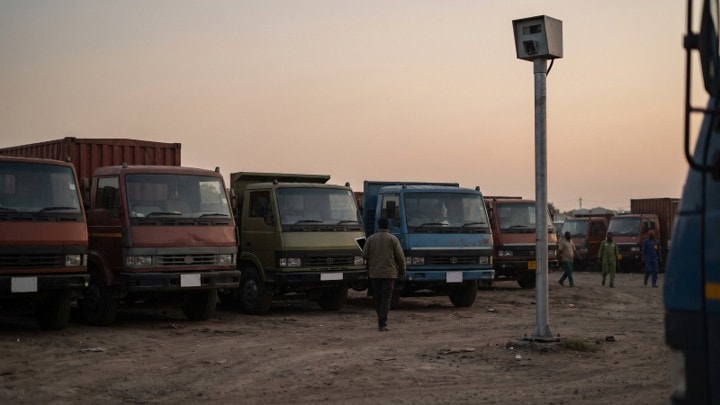
Camera-based enforcement sends every traffic fine straight to the registration number of a vehicle, so a fleet owner now collects challans the driver may never hear about. With 2026 rules and a Supreme Court order now blocking key services for unpaid fines, fleets now need a fixed routine to check and settle e-challans.
How Cameras Issue E-Challans to Commercial Vehicles
Cameras issue e-challans by reading the number plate and matching it to the owner on record, with no officer at the roadside. ANPR (Automatic Number Plate Recognition, cameras that read number plates on their own) units sit at signals, junctions, toll plazas and highway stretches.
The process runs in four steps:
- The camera reads the plate, and a CCTV camera records a photo or short clip of the offence.
- The system matches the plate with the VAHAN database (the national record of registered vehicles).
- An e-challan is created against the registration number.
- A text message goes to the mobile number saved on the registration certificate (RC).
ANPR is now the main way challans are issued in Mumbai, Delhi NCR, Bangalore, Hyderabad and Chennai. Common camera offences for commercial vehicles are over-speeding, jumping a red light, wrong-side driving and no seatbelt. State transport departments also run record checks and issue challans when insurance, fitness or PUC (Pollution Under Control certificate) papers have expired.
Who Pays a Camera Challan in a Fleet
The registered owner receives and pays a camera challan first, because the challan is tied to the RC and not to the driver. The notice and the text message go to the owner, even when a hired driver was at the wheel.
Inside a fleet, the cost is usually split by the kind of offence:
| Offence type | Examples | Who usually pays in a fleet |
| Driving offences | Red light, over-speeding, wrong side, no seatbelt | Driver, recovered by the fleet owner |
| Paper offences | No insurance, expired PUC, expired fitness certificate | Fleet owner |
| Permit and load offences | Overloading, missing permit, wrong route | Fleet owner, sometimes shared |
Recovery from a driver has limits. A fleet can deduct a fine from pay only where this is legally allowed and the driver's contract says so. A leasing company can pass the fine to the customer only if the lease has a traffic-violation clause.
Fleet Challan Monitoring Across Every Vehicle
Fleet challan monitoring means checking every registration number on a fixed schedule, so no fine sits unseen. An e challan search on the Parivahan eChallan portal of the Ministry of Road Transport and Highways works one vehicle at a time.
Each search needs the vehicle number, chassis or engine details and a captcha. The public page has no bulk upload and no spreadsheet export. Fleets of fewer than 50 vehicles can manage with one person checking weekly and keeping a spreadsheet. Larger fleets often use fleet software that checks the full vehicle list every day.
A working routine covers these points:
- Keep one current company mobile number on every RC, so text alerts reach someone.
- Check state portals as well, since Maharashtra, Delhi, Karnataka, Gujarat, Tamil Nadu and Telangana often list more detail than Parivahan.
- Save the challan photo the day it appears, for any later dispute.
- Match the time on each challan to the driver on duty from the trip log.
Central Motor Vehicles Rules on the 45-Day Window
The Central Motor Vehicles (Second Amendment) Rules, 2026 give an owner 45 days from the date of a challan to pay it or contest it online. These rules came into effect on 20 January 2026.
The timeline that follows is fixed:
- If the owner neither pays nor contests within 45 days, the challan is treated as accepted, and payment is due within 30 more days.
- If a challenge is rejected, the owner can pay within 30 days or go to court, but only after paying half the fine as a deposit.
- Five or more offences in one year, counted from 1 January 2026, can lead to action against the driving licence.
The delivery side has deadlines too. Under the Delhi rollout, an e-challan reaches the owner within three days where a mobile number is on record. A physical notice follows within 15 days.
What Unpaid Challans Block for a Commercial Vehicle
Unpaid challans now block the paperwork a commercial vehicle needs to stay on the road. On 28 September 2026, the Supreme Court directed states and Union Territories to stop the following services for vehicles with pending e-challans:
- Renewal of the registration certificate
- Fitness and PUC certificates
- Sale or transfer of ownership, with the vehicle marked as blocked on the central Parivahan portal
- Renewal of the driving licence where there are several offences
The Supreme Court Bench of Justices J.B. Pardiwala and K.V. Viswanathan also asked for random vehicle checks. A vehicle found with unpaid challans can be seized and held until the dues are cleared. The court was told that e-challans worth Rs 49,194.05 crore were still unpaid across the country.
For a fleet, the fitness certificate is the biggest risk. A truck or bus cannot legally run without a valid one, so a single old challan can take a vehicle off the road.
How Fleets Contest a Wrong Camera Challan
Fleets contest a wrong camera challan on the Parivahan eChallan portal within the same 45-day window, with documents that show the error. Every camera challan must carry a photo of the offence and the plate, along with when and where it happened.
Common grounds for a dispute are:
- The camera got the plate number wrong and charged a different vehicle.
- The same offence appears twice.
- The time or place does not match the GPS record of the vehicle.
- The vehicle was at a workshop, backed by a service record.
- The vehicle was leased out, backed by the lease contract.
Use only the official portal for payments. The official e-Challan portal warns that it never asks for passwords, OTPs or card details through calls, emails or text links.
How Fleets Cut Repeat Challans
Fleets cut repeat challans by tracing each fine to the driver and fixing the habit behind it. Over-speeding is a costly offence for heavy vehicles. Under the Motor Vehicles (Amendment) Act, 2019, the fine is Rs 2,000 to Rs 4,000 for medium passenger and goods vehicles. Light motor vehicles such as cabs face Rs 1,000 to Rs 2,000.
Steps that reduce repeat fines:
- Share a monthly challan list with each driver, with the photo and place.
- Brief drivers on speed limits and camera spots along their regular routes.
- Use GPS speed alerts and route limits set in the fleet software.
- Renew insurance, fitness and PUC papers before they expire, since cameras and record checks flag lapsed papers.
A driver with five offences in a year now risks the licence. A fleet that loses a driver to that rule loses a working vehicle as well.
What Transport Unions Protest Against
Transport unions protest mainly against the 50% deposit needed before a court will hear a challenge. The Maharashtra Transporters Action Committee called a strike from 5 March 2026 over this rule and other issues.
Unions of taxi and truck drivers, along with bus and auto operators, gathered at Azad Maidan in Mumbai. Drivers said fines arrive by photograph without any message at the time. Unions also raised multiple challans for the same offence. They asked for a separate body to hear disputes over e-challans and permits.
Frequently Asked Questions
What is a 177 challan?
A 177 challan is the general penalty under Section 177 of the Motor Vehicles Act, used when no specific fine is listed for an offence. The fine is Rs 500 for a first offence and Rs 1,500 for a later one.
Can a camera flag a vehicle with expired insurance or PUC?
Yes, a vehicle with expired insurance or PUC can be flagged without any stop. State transport departments run record checks against VAHAN and issue challans when these papers have run out.
What is the fine for running an uninsured commercial vehicle?
The fine for driving an uninsured vehicle is Rs 2,000, up to three months in jail, or both for a first offence. A repeat offence raises the fine to Rs 4,000.
What details should a camera-generated e-challan show?
A camera-generated e-challan should show a photo that highlights the offence and the number plate. It must also show the date, time and place, and any reading such as speed where it applies.
How can a fleet spot a fake challan message?
A fake challan message usually carries a payment link or asks for an OTP or card number. Look up the challan number on the official Parivahan portal before paying, and never pay through a link in a text.
Key Takeaways
- Camera challans go to the RC owner. The fine follows the registration number, so the fleet owner gets it even when a hired driver was at the wheel.
- Fleets need a fixed checking routine. The public portal checks one vehicle at a time, so larger fleets need a schedule or software.
- The 2026 rules give 45 days to pay or contest. After that the challan counts as accepted and payment deadlines follow.
- Unpaid challans can stop a vehicle from running. The Supreme Court order blocks fitness, PUC, registration renewal and transfer for vehicles with pending fines.
Related News


Latest Cars


Upcoming Cars


Latest News


 car&bike Team | Nov 23, 2026VinFast India To Launch Electric Scooters In Early 2027Multiple electric scooter models are being planned for India, with India-specific tweaks to VinFast’s current scooter range and will be manufactured in India.3 mins read
 Jaiveer Mehra | Nov 23, 2026VinFast VF5 India Launch Confirmed For 2027; Likely To Be Joined By Second Model Under GreenSM Sub-BrandThe VF5 recently received a facelift in global markets, bringing changes to styling, tech and the powertrain.3 mins read
 car&bike Team | Nov 22, 2026Tata Punch vs Maruti Fronx vs Hyundai Exter: Which Small SUV Makes More Sense?Tata Punch, Hyundai Exter or Maruti Fronx – three small SUVs, three different strengths, but only one makes the most sense for your money.6 mins read
 Sarthak Mahajan | Nov 22, 2026Maruti Suzuki Announces Price Hike Of 0.31% From November 22The price increase will apply to select models, with the exact models and revised prices yet to be announced.1 min read
 Sarthak Mahajan | Nov 22, 2026Ferrari Reveals 296 Challenge Stradale And 296 Challenge Evo At Ferrari Finali MondialiThe 296 Challenge Evo is an updated race car that will compete in the Ferrari Challenge from the 2027 season; meanwhile, the 296 Challenge Stradale stands as a road-legal alternative.1 min read
 car&bike Team | Nov 21, 2026BYD Ti7 Banned In Europe Over Resemblance To Land Rover DefenderA Dutch court has blocked the BYD Ti7 from being sold or manufactured in the EU after finding that its design infringes JLR's registered Defender design rights.1 min read