
Automakers Must Commit To Auto Safety Says Michael Bloomberg
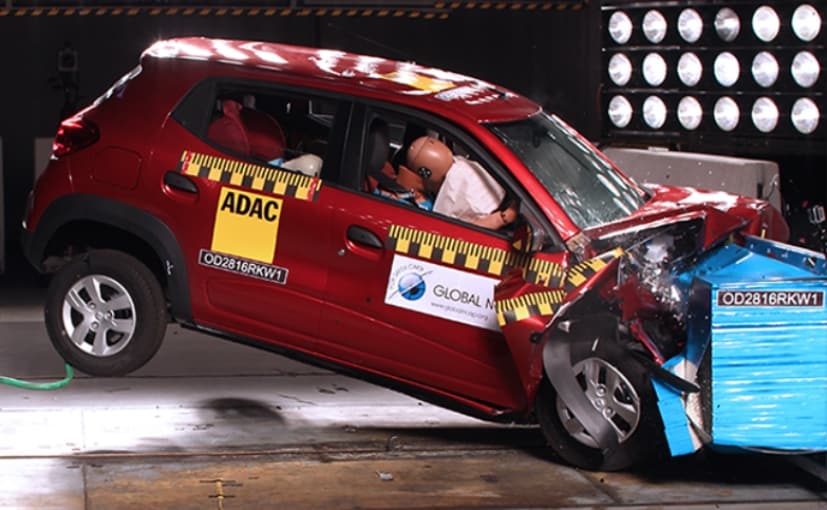
- Last year, more than 600,000 zero-star cars were sold in India
- Road crashes kill an estimated 1.3 million people each year, globally
- 90% of crash fatalities occur in low and middle-income countries
American automobile manufacturers have made enormous progress in recent decades to ensure that the cars we drive here in the U.S. are safer. American consumers now take airbags and anti-collision systems for granted when they buy a car, and the long-term trend is clear: Lives are being saved on our roads. And it's a great time to celebrate those accomplishments this week at the 25th International Technical Conference on the Enhanced Safety of Vehicles in Detroit.
 ( Michael Bloomberg (left) with Global NCAP Secy Gen David Ward. Bloomberg Philanthropies has worked extensively with Global NCAP, including on the crash testing of made-in-India cars)
Unfortunately, vehicle safety is a very different story abroad. Many developing countries have lax vehicle safety standards. Around the world, road crashes kill an estimated 1.3 million people each year and injure up to 50 million. There, automakers - including U.S. and European companies - routinely sell cars without many of the basic safety protections that are standard here at home. Often, they are sold without airbags or electronic stability systems, and they are not capable of protecting passengers in crashes above 56 kmph. The result: An awful lot of people are being killed in crashes that, in the U.S. and Europe, they would likely survive.
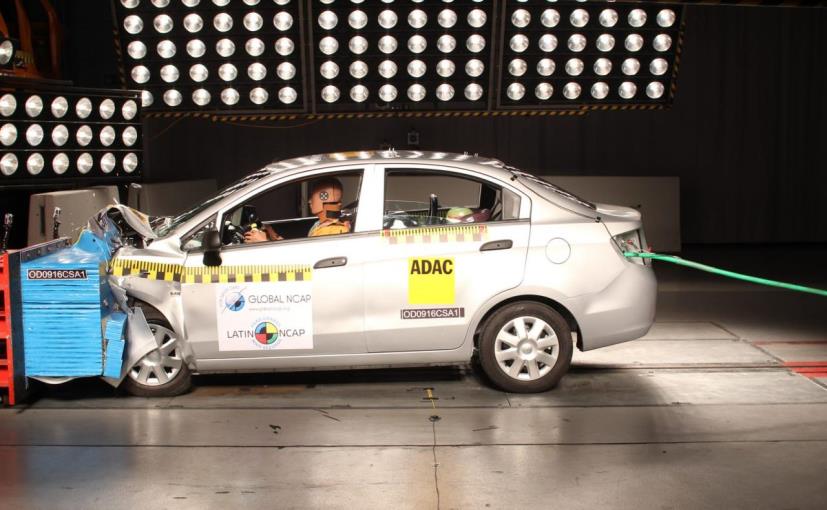 (Chevrolet Sail Crash Test)
Ninety percent of crash fatalities occur in low- and middle-income countries, according to the World Health Organization. Many of these lives could be saved. By 2030, for instance, 40,000 people could be saved from deadly car crashes, and 400,000 serious injuries could be prevented, in just four Latin American countries (Argentina, Brazil, Chile and Mexico), if they adopt minimum vehicle safety standards. Click here to read about Renault Duster's Global NCAP Crash report.
Meeting those standards is not expensive. For car manufacturers, the difference in building a car to the highest or lowest safety ratings can be as small as a couple hundred dollars. For car passengers, it can mean the difference between life and death. Automakers have argued that producing cars without airbags and other basic safety features helps keep them affordable in lower-income markets. But the cost of basic safety features is so low that incorporating them into production would have little impact on affordability.
Consider the Chevrolet Beat (sold as the Spark in Latin America). It's among the best-selling cars in Mexico, yet it received a safety rating of zero out of a possible five stars, based on test crashes carried out last year by the Latin New Car Assessment Program, which is funded in part by Bloomberg Philanthropies. Of the 10 top-selling car models in Mexico, at least four have safety ratings of zero stars. Zero stars means, in short, that a passenger is not likely to survive a crash. Yet the version of the Spark sold in the U.S. receives the highest-possible safety rating. Foreign consumers who think that all cars manufactured by General Motors are built according to U.S. safety standards are tragically mistaken. The same is true for cars manufactured in Europe and sold in Latin America and other regions of the world.
In India, for instance, major global brands including GM, Hyundai, Renault-Nissan and Tata are all selling zero-star cars (as rated by the Global New Car Assessment Programme, also a recipient of funding from Bloomberg Philanthropies) that would fail to pass the safety standards applied in the U.S. or Europe. Last year, more than 600,000 zero-star cars were sold in India, including the best-selling model, the Maruti Suzuki Alto. This is a major public health crisis that has not gotten anywhere near the attention it deserves, and it demands an urgent response both by governments and automakers.
What can be done? Automakers should make voluntary commitments that all of their cars swiftly reach or exceed the safety standards adopted by the United Nations. Cars sold in the U.S., most of Europe, Japan, Korea and Australia already meet these or equivalent national standards, but not those sold in most of the rest of the world.
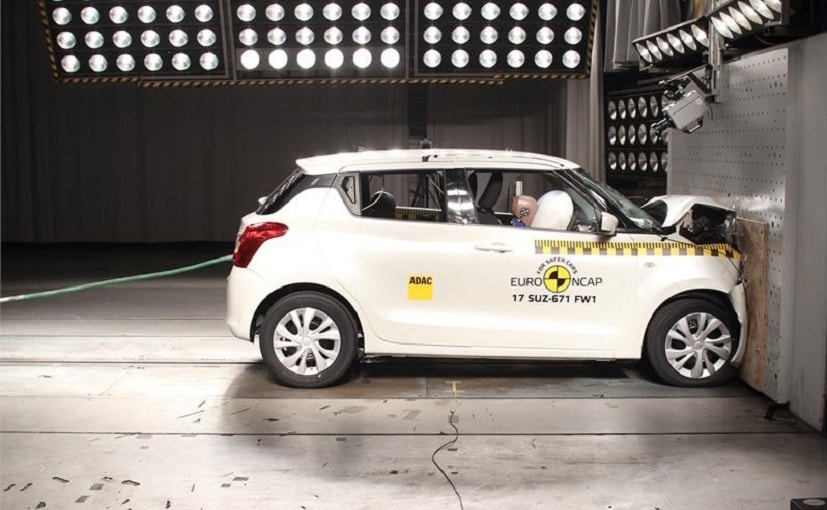 (Suzuki Swift Euro NCAP Crash Test)
At the same time, governments should create and enforce better vehicle safety standards. And raising consumer awareness through independent crash-test programs, like the one in Latin America, would help more consumers make informed choices.
And the truth is, auto companies have good reasons to act, too. As living standards rise across Latin America, India and Asia, consumers with more buying power will demand safer cars. Companies that take the lead are likely to be rewarded with higher sales, as they are in the U.S. and other places where car safety information is readily available. But if history is any guide, action will only come with public pressure. Read about New-generation Suzuki Swift's Global NCAP crash test report, here.
If car crashes were an infectious disease, like malaria or polio, governments, international aid organizations and foundations would pour money and energy into stopping it - as is only right. If that kind of determination is brought to bear on road crashes, we can save millions of lives and prevent untold amounts of heartache and grief.


Related News


Latest Cars


Upcoming Cars


Latest News


 car&bike Team | Oct 8, 2026Harley-Davidson Sprint 440 Teased; Will Be Based On The X440Harley-Davidson has teased its upcoming Sprint 440, suggesting the new motorcycle will be a much more on the lines of a traditional cruiser than the X440.1 min read
 car&bike Team | Oct 8, 2026River Indie Electric Scooter Now Available On FlipkartRiver Mobility is the latest two-wheeler brand in India to list its two-wheeler on Flipkart.2 mins read
 car&bike Team | Oct 8, 2026Mahindra XUV 3XO CNG Launch On October 15The 3XO will be the third subcompact SUV to offer a factory-fitted CNG kit.1 min read
 car&bike Team | Oct 8, 2026Suzuki GSX-8R Gets Rs. 80,000 Discount; Price Drops To Rs. 9.08 LakhSuzuki is offering an Rs. 80,000 discount on the GSX-8R, bringing the price of its middleweight faired motorcycle down to Rs. 9.08 lakh.1 min read
 car&bike Team | Oct 8, 2026VinFast To Open Two-Wheeler Showrooms In Over 30 Indian CitiesAfter its electric cars which made its India debut in 2025, VinFast is gearing up to bring its electric two-wheeler portfolio to the country, most likely at the start of 2027.1 min read
 Janak Sorap | Oct 8, 2026Triumph Bonneville T40 Vs Speed 400: Which Triumph is for you?Triumph now has two very different takes on its small-capacity modern-classic formula, the Speed 400 and the new Bonneville T40. So, which Triumph is better suited to you and why?1 min read
 Bilal Firfiray | Oct 8, 2026Tata Aeris Review: New And Improved, But Is It Good Enough?Tata has replaced the Tigor with the new Aeris and improved it in every aspect. We drove the CNG AMT and Petrol MT derivatives to find out how much it improved over its predecessor.4 mins read
 Seshan Vijayraghvan | Oct 4, 20262026 Skoda Slavia Facelift Review: Upgrades That Matter And A Better AutomaticThe new Skoda Slavia brings a handful of visual and mechanical changes, most notably a new 8-speed automatic for the volume-selling 1.0-litre TSI variants.5 mins read
 Bilal Firfiray | Oct 3, 2026Kia Sorento Review: Is Bigger Always Better?The Kia Sorento has arrived to our shores at the right time. But does it have what it takes to take the market by a storm?7 mins read
 Abhishek Nigam | Oct 2, 2026MINI Countryman C Review: Has MINI Finally Grown Up Without Losing Its Personality?The new Countryman C is bigger, more practical and packed with technology, but its quirky appeal comes with a few compromises.1 min read
 Preetam Bora | Oct 3, 2026ViaTerra Spencer Riding Jacket Review: The Ideal Jacket For Indian Summers?The ViaTerra Spencer mesh riding jacket makes a strong case as a well-built, street-focussed riding jacket, combining good airflow with Level 2 protection and a snug, secure fit. Is it perfect? Read on.6 mins read