
The A-Z Of Bugatti Tourbillon: Power, Top Speed And Other Key Stats Of All-New V16 Hypercar

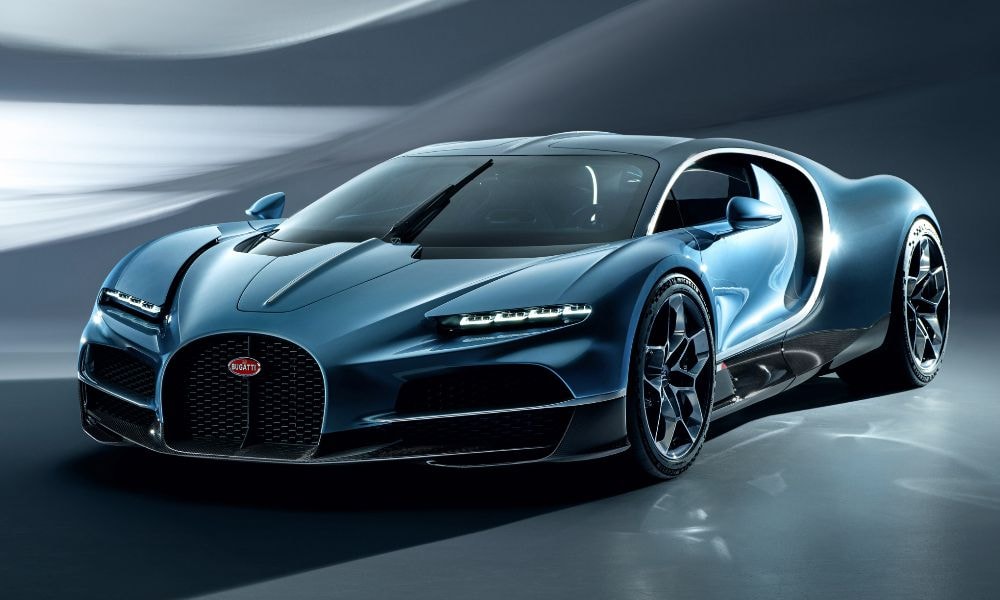
- Bugatti Tourbillon unveiled as the successor to the Chiron; is the most powerful road car yet with an internal combustion engine.
- Powered by a newly-developed 8.3-litre naturally-aspirated V16 engine, assisted by three electric motors for a combined peak output of 1,775 bhp.
- Just 250 units of the Tourbillon will be built; priced at Rs 34 crore (excluding duties and taxes).
Eight long years after the all-conquering Chiron made its debut, its successor has arrived in the form of the Bugatti Tourbillon. Named after the mechanical complication designed to make high-end watches more accurate, the newest Bugatti pushes the benchmarks set by its predecessor, becoming the most powerful road car till date to feature an internal combustion engine. As its forebears, the Tourbillon promises to be a technological tour-de-force, and is packing firsts that need you to sit down and absorb everything, one at a time. So, we’ve put together a full A-Z list of everything you need to know about Bugatti’s latest world-beater – starting with the centrepiece of the hypercar.
Also Read: Chiron L'Ultime Is Final W16-Powered Bugatti Hypercar
The Tourbillon will be built in limited numbers, starting 2026.
What powers the Bugatti Tourbillon?
Out goes the long-running, iconic quad-turbo W16 that powered the Bugatti Veyron, as well as the Chiron. In its place comes an 8.3-litre, naturally-aspirated V16 engine that has been developed by engineering firm Cosworth. It is the first time a V16 has been used in a production vehicle since the Cizeta-Moroder V16T from the 1990s. On its own, the engine produces close to 1,000 bhp, nearly on par with the original Veyron. Thanks to the absence of the turbos and other related components, along with the use of lightweight materials, the V16 weighs just 252 kg.
The naturally-aspirated V16 engine is all-new, developed by engineering firm Cosworth.
However, this time, the V16 has a full-fledged hybrid system for company. The Tourbillon features three electric motors – two motors for the front axle, and one for the rear, all with individual peak outputs of 250 kW (335 bhp), and cumulatively producing close to 800 bhp. The front electric motors enable full torque vectoring, and the powertrain arrangement enables all-wheel drive. Power for the motors comes from a 24.8 kWh battery pack built into the car's structure, positioned behind the passengers in the centre tunnel. Total system output is rated 1,775 bhp, and the car has an 8-speed dual-clutch automatic transmission.
How fast is the Bugatti Tourbillon?
The Tourbillon is still in the testing phase, as production is still a couple of years away. However, Bugatti Rimac estimates the Tourbillon will hit 0-100 kmph in a scant 2 seconds, 0-200 kmph in less than 5 seconds, 0-300 kmph in less than 10 seconds and 0-400 kmph in under 25 seconds. Top speed for the Tourbillon is limited to 380 kmph, but with the ‘Speed Key’ provided, it rises to 445 kmph.
With the ‘Speed Key’, the Tourbillon will hit a top speed of 445 kmph.
What is the Bugatti Tourbillon’s interior inspired by?
In keeping with the car’s name, the Bugatti Tourbillon’s interior draws heavy inspiration from the world of horology. In the words of the brand’s design director Frank Heyl, the Tourbillon’s interior is an example of “digital detoxification” married to the “art of watchmaking”. The company decided to not overload the cabin with screens, instead choosing full analogue instrumentation.
Bugatti calls the interior of the Tourbillon an exercise in “digital detoxification”.
The skeletonised instrument cluster has been designed and built by Swiss watchmakers, bearing the look of an open-heart watch, with the gears housed within as well as gemstones such as sapphire and ruby visible through the sapphire crystal glass cover. Even the centre console features crystal glass and aluminium, providing a glimpse of the mechanisms of the switches and the engine start ‘pull’ lever on the dash.
Instruments wear the look of an open-heart mechanical watch.
The steering wheel has a fixed hub, and there is a small screen that pops out of the dashboard at the press of a button. The screen houses Apple CarPlay and Android Auto connectivity, and can be rotated to keep in either portrait or landscape mode. The lightweight bucket seats are fixed to the car’s floor, and the pedal box is power-adjustable to suit driver’s of different heights. Even the audio system has been lightened, doing away with traditional speakers and woofers.
A small central screen folds out of the dashboard when required.
What materials does the Bugatti Tourbillon use in its construction?
The Tourbillon shares no components whatsoever with either the Chiron or the Veyron, according to Bugatti Rimac CEO Mate Rimac. The car uses an all-new chassis built from T800 carbon composite material. To save weight, the battery is used as a structural part of the monocoque.
The Tourbillon uses a carbon-composite monocoque construction.
Also used are 3D-printed aluminium components, all of which come together to ensure the Tourbillon is lighter than the Chiron. While a final kerb weight is yet to be confirmed, the figure will be lower than the Chiron’s 1,995 kg kerb weight. The new structure also frees up more space for luggage, making the Tourbillon more practical.
What is the Bugatti Tourbillon’s design and styling like?
At first glance, the Tourbillon could be mistaken for yet another Chiron derivative. It retains the essence of both the Chiron and the Veyron, but has details that make it stand out. The signature Bugatti horseshoe grille is where all the design lines originate, and the ‘spine’ that divides the car into two also continues, over the bonnet and stretching back over the roof of the car.
Dihedral, power-operated doors are a first for a Bugatti.
In profile, the Tourbillon appears lower-slung than the car it replaces, with the familiar ‘C’ design element also being retained (and housing the side air intakes). At the rear, the Tourbillon’s segmented, full-width LED tail-lights are somewhat reminiscent of the Centodieci, with the large diffuser also making its presence felt.
Can the Bugatti Tourbillon be driven as a pure electric vehicle?
Thanks to the relatively large battery pack, the Tourbillon can be used as a pure electric vehicle if needed. Bugatti Rimac promises an electric-only range of somewhere between 60 to 70 kilometres, which would ensure the Tourbillon is not banned from being driven in ultra-low or zero emissions zones across the world. What’s interesting is this battery uses an 800-volt architecture, and when plugged into a fast charger, can regain up to 80 per cent charge in less than 15 minutes. In theory, the Tourbillon could well be used as a pure electric car, especially for urban use.
What is the Bugatti Tourbillon’s price?
Over the course of the coming years, Bugatti Rimac will only build 250 examples of the Tourbillon. Each car will cost 3.8 million euros (approx. Rs 34 crore) before options, duties and taxes. Production of the Tourbillon will begin in 2026.





Latest News


 car&bike Team | Aug 5, 2026River Mobility Raises $120 Million, Plots Manufacturing ExpansionThe funding round saw participation from existing investors, including Yamaha Motor Corporation, among others.2 mins read
 car&bike Team | Aug 5, 2026KTM 390 Duke Prices Hiked By Up To Rs 7,000390 Duke R is dearer by Rs 6,000; standard 390 Duke up by Rs 7,000.1 min read
 Seshan Vijayraghvan | Aug 5, 2026BMW X1 Long Wheelbase Teased; India Launch On August 21The BMW X1 LWB will be launched in India on August 21, 20261 min read
 Amaan Ahmed | Aug 5, 2026Ather Konarc Is The Name Of Production-Spec EL01 E-ScooterThe Konarc will be the most affordable Ather model yet, and also the first Ather to feature a 14-inch front wheel.1 min read
 Jaiveer Mehra | Aug 5, 2026Range Rover SV Ultra Launched At Rs 3.80 CroreRange-topping Range Rover brings JLR’s new SV Electrostatic sound system to India.1 min read
 car&bike Team | Aug 5, 2026Supreme Court Mandates Extension Of Third-Party Insurance For New Cars And Two-WheelersThird-party insurance for newly registered cars has been extended to four years, while new two-wheelers will now require six years of coverage.1 min read
 Bilal Firfiray | Aug 1, 2026Toyota Hilux Review: The InvincibleMarking it as the ninth generation, the Hilux comes with a major cosmetic overhaul. But is it still relevant enough for the current times or is it getting too long in the tooth?5 mins read
 Bilal Firfiray | Jul 30, 2026Kia Syros EV Review: Best EV To Buy Under Rs 20 Lakh?The Kia Syros EV comes into the game with a modern design, spacious cabin, strong performance, decent range and an aggressive pricing. But could it become the new benchmark under Rs 20 lakh?5 mins read
 Jaiveer Mehra | Jul 27, 20262026 Maruti Suzuki Brezza Facelift Review: Bestseller Joins The Turbo ClubWhile Maruti’s facelifts have always tended to bring subtle updates over the outgoing models, the latest Brezza brings some heavy updates under the skin, including a new 6-speed manual gearbox and, for the first time, a turbocharged petrol engine option.1 min read
 Bilal Firfiray | Jul 24, 2026Honda ZR-V Review: Who Is It For?Honda has brought the new ZR-V to India as their current flagship offering. It’s a CBU, it’s a hybrid, and it’s here for a limited few. Who is it for though?1 min read
 Girish Karkera | Jul 29, 2026Mercedes-AMG E53 4MATIC+ PHEV First Drive Review: Just What The Doctor OrderedThere are luxury cars and there are high-performance cars. But what if you want both for the price of one? Mercedes-Benz has a recommendation that promises to tread a fine line between the two – the second generation E53 with a twist.7 mins read