
Kawasaki KLX 230 vs Hero Xpulse 210: Specifications, Features, Prices Compared

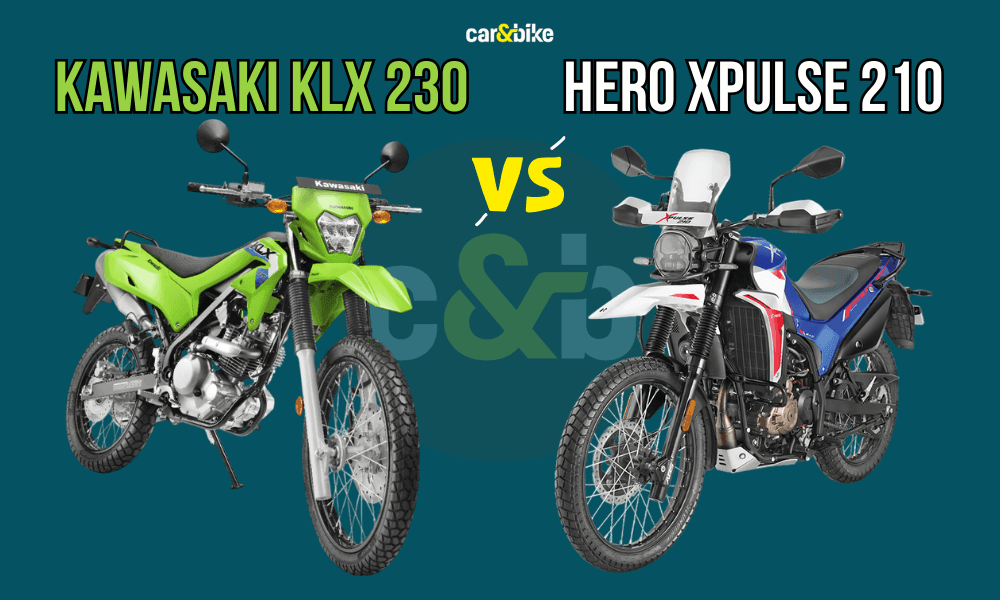
- The KLX 230 is 31 kg lighter than the Xpusle 210
- The Xpulse 210 gets a fuel tank nearly twice the size of the KLX 230
- Price difference between the two is Rs 13,000 at top-spec
Dual-purpose motorcycles have gained a lot of popularity among Indian riders recently. Although the segment has seen rapid growth, enthusiasts have long been waiting for the options to expand in the Indian market. About eight months ago, Kawasaki answered that call by launching the street-legal KLX 230, but its steep ex-showroom price of Rs 3.30 lakh raised some eyebrows. Now, with the KLX 230 being locally manufactured, the price has dropped significantly by Rs 1.31 lakh, making it more accessible to buyers.
The made-in-India Kawasaki KLX 230 now comes with a lucrative Rs 1.99 lakh (ex-showroom) price tag, putting it right in the ring with Hero MotoCorp’s popular Xpulse 210. Let’s see how the two stack up against each other on paper.
Also Read: Kawasaki KLX 230 Prices Slashed: Now Costs Rs 1.99 Lakh
The KLX 230 is 31 kg lighter than the Xpulse 210.
Kawasaki KLX 230 vs Hero Xpulse 210: Specification check
| Kawasaki KLX 230 | Hero Xpulse 210 | |
| Engine | 233 cc air-cooled single SOHC | 210 cc liquid-cooled single DOHC |
| Max Power | 18.74 bhp @ 8,000 rpm | 24.26 bhp @ 9250 rpm |
| Peak Torque | 19 Nm @ 6,000 rpm | 20.7 Nm @7250 |
| Gearbox | 6-speed | 6-speed |
| Kerb weight | 139 kg | 168/170 kg |
| Power-to-weight ratio | 134.8 bhp / tonne | 144.4/142.7 bhp / tonne |
The Kawasaki KLX 230 and Hero Xpulse 210 cater to the same dual-purpose motorcycle segment. The KLX has a 233 cc air-cooled SOHC engine – a simpler, lower-cost design with one camshaft – while the Xpulse features a 210 cc liquid-cooled DOHC engine, which uses two camshafts for better performance and higher rpm. As for output, the Xpulse is ahead with 24.26 bhp vs the KLX’s 18.74 bhp, and it also makes more torque (20.7 Nm vs 19 Nm), though the KLX delivers it lower in the rev range, which can feel more responsive off-road.
However, the Xpulse fights back with a better power-to-weight ratio (up to 144.4 bhp/tonne vs 134.8 on the KLX), meaning it could feel quicker overall. In short, the KLX is simpler and lighter, while the Xpulse brings more power and tech to the mix. Both bikes have a 6-speed gearbox.
Also Read: Kawasaki KLX 230R S Launched In India At Rs 1.94 Lakh
The price difference between the two is Rs 13,000 at the top-spec.
Kawasaki KLX 230 vs Hero Xpulse 210: Dimensions and Weight
| Kawasaki KLX 230 | Hero Xpulse 210 | |
| Kerb Weight | 139 kg | 168/170 kg |
| Seat Height | 880 mm | 830 mm |
| Fuel Tank Capacity | 7.6 litres | 13 litres |
| Wheelbase | 1,370 mm | 1446 mm |
| Ground Clearance | 255 mm | 220 mm |
The Kawasaki KLX 230 is significantly lighter, weighing 31 kg less than the Hero Xpulse 210 (139 kg vs 168–170 kg). It also has a 50 mm taller seat height at 880 mm, compared to the Xpulse’s 830 mm, while the Xpulse remains more accessible for a wider range of riders. However, the suspension on the KLX compresses noticeably as soon as the rider gets on, which effectively reduces that seat height by a few mm.
When it comes to fuel capacity, the Xpulse offers more with a 13-litre tank, nearly double the KLX’s 7.6 litres. The wheelbase is longer on the Xpulse at 1446 mm versus the KLX’s 1370 mm. That said, the KLX provides 35 mm more ground clearance (255 mm vs 220 mm), which is a clear benefit for clearing obstacles.
Also Read: India-Made Kawasaki KLX 230 Vs CKD Model: Differences Explained
Cycle parts are more or less similar on both machines.
Kawasaki KLX 230 vs Hero Xpulse 210: Cycle Parts
| Kawasaki KLX 230 | Hero Xpulse 210 | |
| Front/Rear Shock | Telescopic fork/ Monoshock | Telescopic fork/ Monoshock |
| Travel Front/Rear | 220mm/223mm | 210mm/205mm |
| Tyre size front | 21-inch wire spoke | 21-inch wire spoke |
| Tyre size rear | 18-inch wire spoke | 18-inch wire spoke |
| Brakes front | 290 mm petal disc | 276 mm petal disc |
| Brakes rear | 230 mm petal disc | 220 mm petal disc |
Both the Kawasaki KLX 230 and the Hero Xpulse 210 come equipped with a telescopic fork up front and a monoshock at the rear, but the KLX offers slightly more suspension travel, 220 mm front and 223 mm rear, compared to 210 mm and 205 mm on the Xpulse. This gives the KLX a bit more cushion over rough terrain, though, as mentioned earlier, its suspension tends to sag noticeably when a rider gets on, which could slightly reduce the usable travel.
In terms of wheels, both bikes ride on 21-inch front and 18-inch rear wire-spoke wheels. For braking, the KLX takes the lead with a slightly larger 290 mm front disc and 230 mm rear, compared to the Xpulse’s 276 mm front and 220 mm rear discs. However, do note that the KLX 230 is offered with single-channel ABS, while the Xpulse 210 not only comes equipped with dual-channel ABS but also gets 3 modes for it.
Also Read: Honda CB125 Hornet vs Hero Xtreme 125R vs TVS Raider: Specifications Compared
The KLX 230 is available in a single variant with an LCD unit, while the Xpulse 210 comes in both LCD and TFT dash options, depending on the variant.
Kawasaki KLX 230 vs Hero Xpulse 210: Features
The Kawasaki KLX 230 and Hero Xpulse 210 aren’t tech-heavy machines, but since many riders might end up using the two for daily commutes (especially the Xpulse) as well, both come with a few handy features. The KLX keeps things simple with a digital LCD showing essential readouts while also offering Bluetooth connectivity and app-based functions. It features Kawasaki’s ‘dual-purpose ABS’, tuned for both on-road and off-road use, and includes a switch to disable front ABS for off-road riding.
The Xpulse 210, which received a recent update, comes in two variants: base and top. The base gets a 4.2-inch LCD, while the top variant steps it up with a 4.2-inch TFT screen. Like the KLX, it also includes Bluetooth connectivity with full app-based functionality. Moreover, as mentioned earlier, the Xpulse features dual-channel ABS with three selectable ABS modes.
Also Read: KTM 160 Duke Vs Yamaha MT-15: Specifications, Features, Prices Compared
The Xpulse 210 gets a fuel tank nearly twice the size of the KLX 230.
Kawasaki KLX 230 vs Hero Xpulse 210: Price
| Kawasaki KLX 230 | Hero Xpulse 210 | |
| Prices (ex-showroom) | Rs 1.99 lakh | Rs 1.76 lakh – Rs 1.86 lakh |
Lastly, coming to prices. The Hero Xpulse 210 is the more affordable option, with ex-showroom prices ranging from Rs 1.76 lakh to Rs 1.86 lakh, depending on the variant. The Kawasaki KLX 230, on the other hand, is priced at Rs 1.99 lakh (ex-showroom), making it around Rs 13,000 to Rs 23,000 more expensive. The KLX 230 most recently received a massive price cut from Rs 3.30 lakh to Rs 1.99 lakh, thanks to Kawasaki, as it is now made in India. The price slash brings the KLX much closer to the Xpulse, making it a more attractive option.


Latest News


 Jafar Rizvi | Sep 23, 2026Mercedes-AMG G 63 Offroad Pro Launched At Rs 3.80 CroreThe new trim is Rs 6 lakh dearer than the standard counterpart. The difference gets you a few off-road features and equipment.2 mins read
 car&bike Team | Sep 23, 2026Ultraviolette Raises $85 Million To Accelerate Global EV ExpansionUltraviolette has raised $85 million in a new funding to scale up production, develop new EV platforms and expand into international markets.1 min read
 Jafar Rizvi | Sep 23, 2026Mahindra Thar OG: Top 5 Changes Over 2025 Thar 3-DoorThe Mahindra Thar OG gets several changes over the old Thar, including new suspension hardware, more powerful engines and more.3 mins read
 Abhishek Nigam | Sep 23, 20262026 Mahindra Thar OG vs 2025 Thar: What’s New And What’s Changed?The Thar gets a major mechanical and feature overhaul for 2026, while retaining the iconic three-door design and off-road-focused character4 mins read
 Amaan Ahmed | Sep 23, 2026Hyundai Bayon Confirmed As 4.2M-Long Petrol SUV; Bookings OpenYou can now book Hyundai's new segment-splitting SUV -- but you'll have to do it without seeing a single image of the real deal1 min read
 car&bike Team | Sep 23, 20262027 Mahindra Thar OG Colour Options RevealedThe 2027 Mahindra Thar OG is available in eight exterior paint schemes.2 mins read
 Bilal Firfiray | Sep 19, 2026MG Hector Tomahawk EV Review: Play It SafeMG’s new electric SUV has one of the coolest names ever, and the coolest temperament amongst its peers. But is it worth buying?7 mins read
 Preetam Bora | Sep 16, 2026Royal Enfield Himalayan 440 Review: Better Than the 450?The new Himalayan 440 with an upsized engine and gearbox has certainly improved as a touring machine and at an extremely attractive price of Rs. 2.29 Lakh. Is it the better Himalayan to choose for many riders?9 mins read
 Seshan Vijayraghvan | Sep 15, 2026BMW i5 LWB Review: Not The M60, This Is The Proper Electric 5 SeriesThe BMW i5 LWB takes the electric 5 Series formula and puts a stronger focus on rear-seat comfort and long-distance luxury. With a 669 km claimed range, 268 bhp and a more relaxed character, is this the i5 that makes the most sense for India?7 mins read
 Preetam Bora | Sep 14, 2026Ladakh Uncharted: Himalayan Basecamp Off-Road Ride ExperienceA day-long off-road excursion from Royal Enfield’s Himalayan Basecamp event in Ladakh, the Ladakh Uncharted ride by Alpinestars was all about re-discovery!6 mins read
 Janak Sorap | Sep 12, 2026New Bajaj Pulsar 125 First Ride Review: More Tech, Less Weight, Same Pulsar DNAThe new Bajaj Pulsar 125 retains the familiar Pulsar identity but gets a new engine, lighter construction, more features and a sharper riding experience.5 mins read