
India-Made Kawasaki KLX 230 Vs CKD Model: Differences Explained

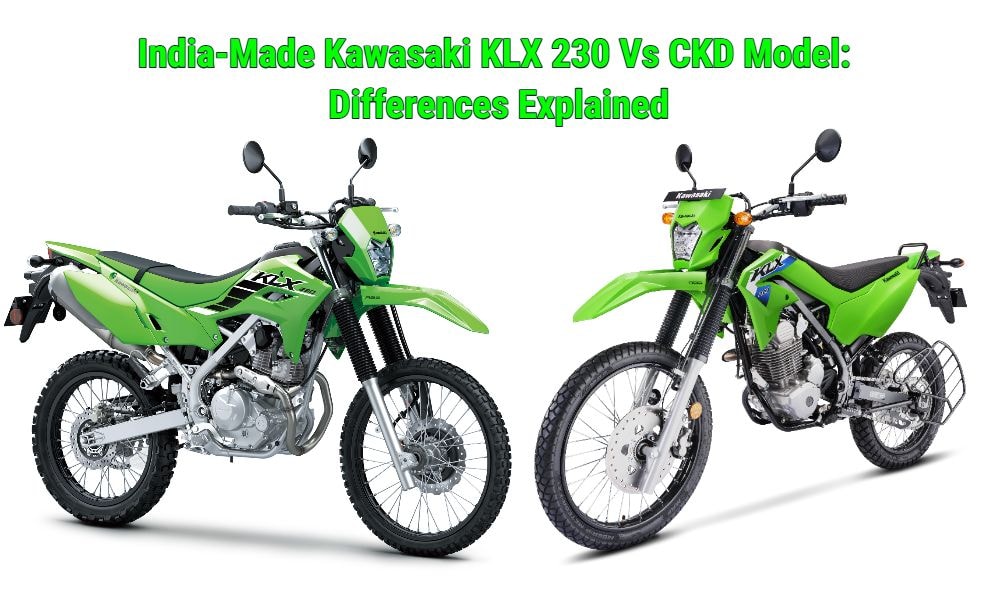
- KLX 230 is now offered with 90 per cent localisation.
- Price slashed by Rs 1.31 lakh, now retailing at Rs 1.99 lakh ex-showroom.
- Chassis, cycle parts, body panel and more now locally sourced.
The Kawasaki KLX 230 is a very capable off-road ready motorcycle that had a lot of off-road enthusiasts all excited at the time of its announcement. However, the enthusiasm fizzled out so soon after Kawasaki announced the prices of the motorcycle. Carrying a sticker price of Rs 3.30 lakh, ex-showroom, it was a steep acquisition cost for the buyers. The high asking price has been mainly because Kawasaki was bringing the KLX 230 to India via the CKD (Completely Knocked Down) route but that has changed as the brand has managed to significantly localised the motorcycle by up to 90 per cent which has resulted in a massive price drop of Rs 1.3 lakh. If you have been planning to purchase the KLX 230, here are the differences between the CKD and localised version that you need to take note of before you put down your money.
Also Read: Kawasaki KLX 230 Prices Slashed: Now Costs Rs 1.99 Lakh
Styling
Placed side-by-side, there are hardly any differences between the two versions at first glance. While both versions retain the iconic KLX design language, on closer inspection the differences start to appear. The localised KLX has slightly different headlamp housing with small air scoop on the side, meanwhile, the LED headlamp has remained the same. Moving to the side panels, while the overall shape is largely the same, but there are few differences in how the panels are formed. The dual-tone seat on the CKD version has been replaced with a single-tone black coloured one for the localised version.
Other differences include a fresh set of graphics package with a blue highlight, different engine covers, shorter exhaust muffler, blacked out chassis and swingarm.
Also Read: Kawasaki Ninja ZX-6R Recalled Over Engine Issue
Cycle Parts
While both versions share the same fundamental platform, there are notable differences to take note. The design of the steel perimeter type chassis is the same but is now locally sourced, while the aluminium swingarm on the CKD model is replaced with a steel box-type one. As for the suspension, the Showa units are replaced with a similar setup from Endurance. The setup is slightly stiffer, and the travel has gone down by 20 mm to 220 mm at the front and 27 mm to 223 mm at the rear.
Correspondingly, the ground clearance has also reduced by 10mm, but continues to be off-road capable at 255 mm. Despite the change in suspension setup, the seat height continues to be the same at 880 mm. Moving to the brakes, the localised version loses out on the petal discs but is offered with larger rotors. The front comes with a 290 mm disc while the rear features a 230 mm disc, compared to the 265 mm and 220 mm discs on the CKD version.
Also Read: Kawasaki KLX 230R S Launched In India At Rs 1.94 Lakh
Notably, the kerb weight between both the versions has remained the same at 139 kg. The fuel tank capacity is down from 7.6 litres to 7.5 litres, this is negligible. The wheel rims, suspension components, brakes, chassis and swingarm and some more are now locally sourced. Both versions continue to feature the same MRF Mogrip Meteor dual-purpose tyres.
Powertrain
In terms of the powertrain, both versions share the same 233cc air-cooled single-cylinder engine. The power output has received a slight bump now registering 18.73 bhp at 8,000 rpm and 19 Nm of torque at 6,000 rpm. Gearbox duties continue to be handled by a 6-speed gearbox. How the locally assembled motor performs is something we’ll get to know once we get to ride the motorcycle soon.
Electronics
The electronics kit on the India-made KLX 230 is of lower spec compared to the CKD model. While the instrumentation remains the same, the former doesn’t get the Rideology smartphone connectivity app. Next, the dual-channel ABS system has been replaced with a single-channel ABS system with a dedicated ABS switch on the left switch block.
Also Read: 2025 Kawasaki Versys-X 300 Launched At Rs 3.80 Lakh
Pricing
With all the localisation, the price difference between the CKD and India-made KLX 230 is of staggering Rs 1.31 lakh. The KLX 230 at the time of launch was introduced at a sticker price of Rs 3.30 lakh, which has now reduced to Rs 1.99 lakh, ex-showroom.
Verdict
Maintaining the core dual-sport formula, the India-made Kawasaki KLX 230 continues to be a motorcycle that is light weight, offers usable performance, versatile, practical, and now a lot more affordable. It is now pretty close to the Hero Xpulse 210 which retails at the sticker price starting from Rs 1.75 lakh going up to Rs 1.85 lakh (both ex-showroom) for the top-spec variant.
Related News


Learn more about

Popular Models


Latest Cars


Upcoming Cars


Latest News


 car&bike Team | Sep 24, 2026BMW F 450 R Teased Ahead of Official UnveilBMW Motorrad’s upcoming roadster is likely to be called the F 450 R and is expected to share the 421 cc parallel-twin engine with the F 450 GS.2 mins read
 Jafar Rizvi | Sep 23, 2026Mercedes-AMG G 63 Offroad Pro Launched At Rs 3.80 CroreThe new trim is Rs 6 lakh dearer than the standard counterpart. The difference gets you a few off-road features and equipment.2 mins read
 car&bike Team | Sep 23, 2026Ultraviolette Raises $85 Million To Accelerate Global EV ExpansionUltraviolette has raised $85 million in a new funding to scale up production, develop new EV platforms and expand into international markets.1 min read
 Jafar Rizvi | Sep 23, 2026Mahindra Thar OG: Top 5 Changes Over 2025 Thar 3-DoorThe Mahindra Thar OG gets several changes over the old Thar, including new suspension hardware, more powerful engines and more.3 mins read
 Abhishek Nigam | Sep 23, 20262026 Mahindra Thar OG vs 2025 Thar: What’s New And What’s Changed?The Thar gets a major mechanical and feature overhaul for 2026, while retaining the iconic three-door design and off-road-focused character4 mins read
 Amaan Ahmed | Sep 23, 2026Hyundai Bayon Confirmed As 4.2M-Long Petrol SUV; Bookings OpenYou can now book Hyundai's new segment-splitting SUV -- but you'll have to do it without seeing a single image of the real deal1 min read
 Bilal Firfiray | Sep 19, 2026MG Hector Tomahawk EV Review: Play It SafeMG’s new electric SUV has one of the coolest names ever, and the coolest temperament amongst its peers. But is it worth buying?7 mins read
 Preetam Bora | Sep 16, 2026Royal Enfield Himalayan 440 Review: Better Than the 450?The new Himalayan 440 with an upsized engine and gearbox has certainly improved as a touring machine and at an extremely attractive price of Rs. 2.29 Lakh. Is it the better Himalayan to choose for many riders?9 mins read
 Seshan Vijayraghvan | Sep 15, 2026BMW i5 LWB Review: Not The M60, This Is The Proper Electric 5 SeriesThe BMW i5 LWB takes the electric 5 Series formula and puts a stronger focus on rear-seat comfort and long-distance luxury. With a 669 km claimed range, 268 bhp and a more relaxed character, is this the i5 that makes the most sense for India?7 mins read
 Preetam Bora | Sep 14, 2026Ladakh Uncharted: Himalayan Basecamp Off-Road Ride ExperienceA day-long off-road excursion from Royal Enfield’s Himalayan Basecamp event in Ladakh, the Ladakh Uncharted ride by Alpinestars was all about re-discovery!6 mins read
 Janak Sorap | Sep 12, 2026New Bajaj Pulsar 125 First Ride Review: More Tech, Less Weight, Same Pulsar DNAThe new Bajaj Pulsar 125 retains the familiar Pulsar identity but gets a new engine, lighter construction, more features and a sharper riding experience.5 mins read