
Ampere Nexus Review: A Fighting Chance?
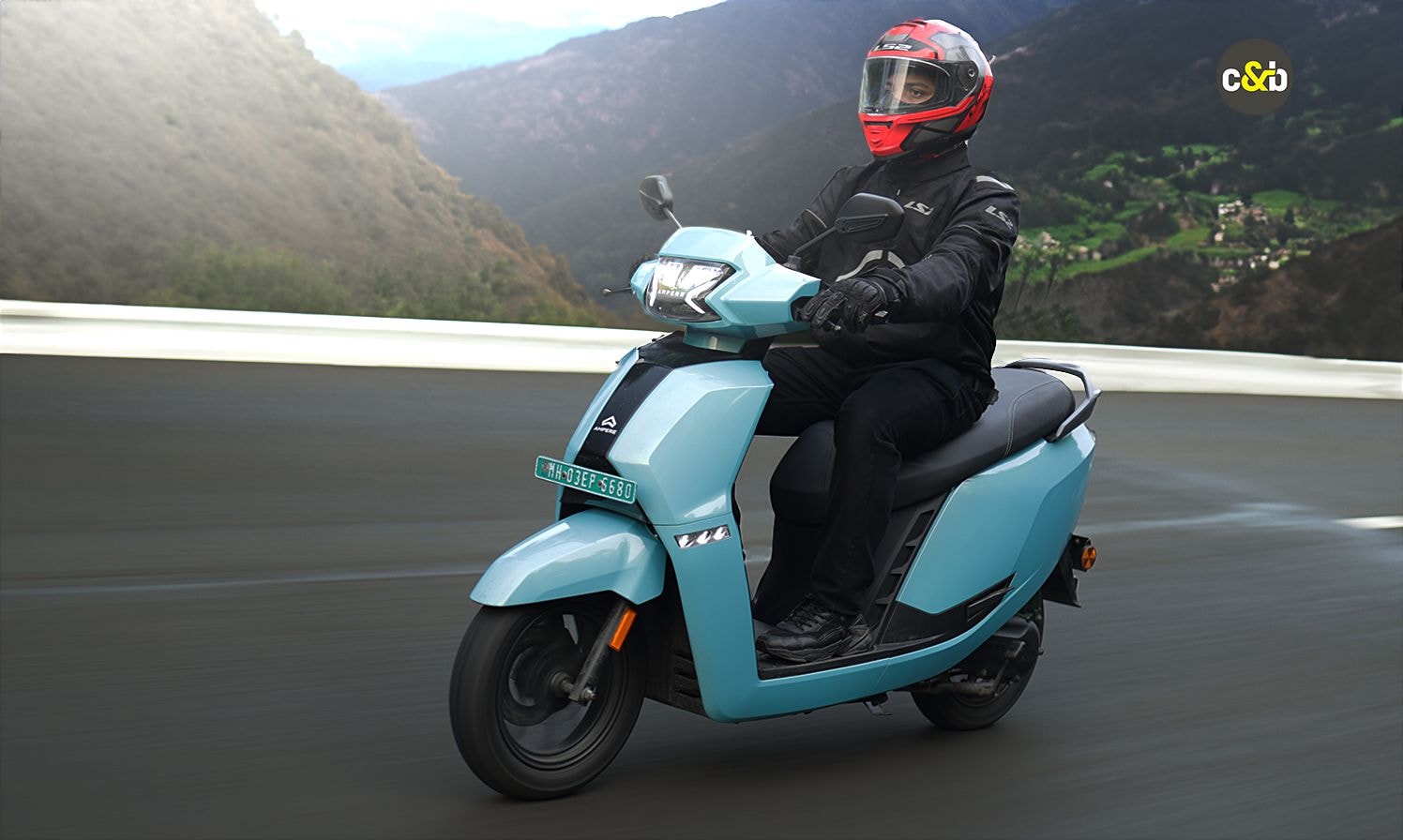
- Nexus looks smart, but build quality is only average.
- Performance is decent; real-world range is a limiting factor.
- Availability of established rivals at similar or lower prices will make life tough for the Nexus.
PHOTOGRAPHY: Pawan Dagia
Greaves Cotton’s Ampere has found itself in the middle of controversy relating to FAME-II subsidies and has endured quite a torrid 12 months, but it is wanting to break free from the shackles of those times with a brand new scooter – the Nexus. It was launched in April this year, but we are only getting to ride it now. This is the scooter that Ampere hopes will give it a fighting chance against established rivals – but can the Nexus really impress?
Also Read: Ampere Nexus Electric Scooter Launched At Rs 1.10 Lakh: Gets 3 kWh Battery, 136 KM Range
Ampere Nexus: Design and dimensions
Ampere really wanted to make the Nexus look very different compared to anything else it has built before and you can make that out from the design and styling of the Nexus. This is at least two steps forward compared to any other Ampere offering that we've seen so far. What I like is this particular shade, it looks quite refreshing in the flesh. And I also like how there is a little bit of a contrast element over here with this black band running down the centre.
Nexus looks smart yet subdued – but look closely, and you will find some uneven panel gaps.
The LED headlight provides decent illumination, but the lighting itself is a little skewed and I feel the headlight could do with some improvement. This is a reasonably long scooter. The wheelbase of the Nexus is longer than that of an Ather Rizta and it does look pretty sizable in the flesh so you will notice it on the road and at the back is where I feel it looks a little awkward because of the tail lights and the way the vents are positioned.
Nexus weighs 128 kg.
Ampere Nexus: Comfort, practicality and features
The seat is at a friendly 765 mm in height, so even shorter riders will be able to put both feet on the ground comfortably. The seat itself is a little bit on the firmer side after spending about half an hour to 45 minutes riding it, I did feel like I was ending up with a numb backside.
Seat height is 765 mm, and seat length is 712 mm, which is adequate to accommodate a pillion.
In terms of practicality, the Nexus isn't the most versatile electric scooter that you can get. There is some storage space built into the back of the apron, but it's only about enough to be able to accommodate your smartphone and maybe your wallet. The under seat storage too is rather limited compared to some of its competitors. It is a deep space but there is an obstruction. So it isn't a flat area and there are other electric scooters with a bigger under seat storage though, you do get a phone charger upfront so that enhances its practicality quotient.
Underseat storage is 22 litres, and is smaller than that of other electric scooters.
The switches are flush fitting and they look nice, but there is quite a bit of play in some of the buttons and I'm not too sure how they will hold up over time The indicators have been turned into buttons so there is one for the left indicator on the left cube, one for the right indicator on the right cube and it takes a while getting used to also the feedback from these buttons isn't great. And there will be instances where you will feel like you've pressed the button, but the indicator has not been activated.
Flush-fit buttons do not provide sufficient feedback and feel flimsy.
The Nexus ST, the top variant, has a 7.0-inch colour display. It's a touch screen which you don't get on the Ather Rizta. The screen is fairly legible even under harsh sunlight, and it also has adaptive lighting. Now, this isn't the most responsive touchscreen I've used, especially compared to one that you would find on an Ather 450X. This is rather laggy and it is also limited in terms of what it can do.
Touchscreen has adaptive lighting, but it isn't the most responsive.
Once you've paired it with your phone, using Bluetooth, you can control music, you can also view if you have any calls or messages and you can use it for navigation though, I have to say that I was only able to see turn by turn navigation on this dashboard. The difference between this one and the lower variant is literally just the cluster. So if you want to save some money, if you don't want the touchscreen, you can have this scooter for ₹10,000 less.
Front storage bin can accommodate a smartphone; note USB charging port on top.
Engaging reverse mode is also a little bit of a pain on the Nexus because unlike other electric scooters where you can just enable reverse by pressing a button Once. here you need to press and hold down the button while you apply the throttle. The moment you, the moment you pull your finger off the reverse mode button, the scooter will stop reversing. I think a few people may find that useful in terms of safety. But for me, this was a little annoying to use.
Progress in Eco mode is decently quick, but top speed is limited to 45 kmph.
Ampere Nexus: Performance, ride and handling
In terms of performance, the Ampere Nexus is more or less like any other family electric scooter. You have a mid mounted permanent magnet motor. Peak output is 4 kW. You have three ride modes – Eco, City and Power. I've been riding for most of the time in eco. And I'm happy to say that this does not feel overly restrictive. It does give you enough power to be able to slice through city traffic, but it is limited to a top speed of 45 kmph.
Nexus slows after clocking 80 kmph; stability is decent at high speed.
City gives you a little more power, crisper throttle response and a higher top speed of 63 kmph. And in Power, you get the full 4 kW, so you will be able to hit a top speed of over 90 kmph. I was able to see a top speed of 85 to 86 kmph. And this is because after 80 the scooter struggles a little bit but it does feel fairly planted. Thanks to the long wheelbase and the 12 inch wheels.
In terms of ride quality, the Nexus at low speeds feels fairly pliant. As you go faster and especially over rougher roads, it starts to feel a little too firm and it gets uncomfortable also because of the seat which is on the firmer side. So if you spend a longer amount of time in the saddle, your backside will start to feel the effects of this firm set up. When it comes to handling, it is neutral as you would expect. This is not a sporty scooter, so it's not expecting to be thrown around. But the grip from the MRF Zapper tyres is sufficient and the brakes too are adequate. The front end has a little bit of dive but you will get used to it and stopping power is sufficient.
Front disc brake provides ample stopping power.
Ampere Nexus: Range and charging
But what is not sufficient is the range of the Ampere Nexus. You see this one has a 3 kWh LFP battery and the range Ampere says is 136 kilometres, but that's on the Indian drive cycle. in real world use, despite sticking to eco for about 90 per cent of my riding time. I was only able to see a range of 75 kilometres. And if you choose to ride in City or Power modes, the range will drop even further and quite substantially. So using it in everyday situations where you want to travel long distances may be an issue if you do not know where to plug it in. You get a standard bundled charger with the Nexus, which will take about 3 hours, 30 minutes to charge the scooter fully, a faster charger will be available but Ampere has not told us how much that costs or how much that'll bring down the charging time by.
Standard 15A charger takes about 3 hours and 30 minutes to charge the scooter fully.
Ampere Nexus: Verdict
For Ampere, a company that has traditionally struggled to make quality electric scooters, the Nexus represents a big leap forward. This is nothing like anything we've seen from before. That being said, the Nexus is still in need of improvement. There are still things which Ampere can work on enhancing on the scooter and there isn't a single factor that stands out as the main reason to recommend the scooter to anyone looking for a family e-scooter. It looks smart but there are still some uneven panel gaps. The build quality doesn't feel great. Yes, there is a touch screen but it isn't the slickest to use and it doesn't offer much in the way of functionality. The ride is on the firmer side and ultimately, the range is pretty limiting.
Prices for the Nexus range from Rs 1.10 lakh to Rs 1.20 lakh (introductory, ex-showroom).
And the biggest challenge for the Nexus is the fact that established rivals now have offerings at this price point or even lower. So you can now have a Bajaj Chetak for just a little over 1 lakh rupees, you can have a TVS iQube for the same amount of money. There's also the Ather Rizta, which is far more practical than the Nexus which makes me believe that the Nexus arrived just a little too late on the scene. Had this been here in 2023, maybe even in 2022, things could have looked a little bit different. But this year competition has intensified and convincing electric scooter buyers to look at the Nexus will be an uphill task because of this.

With the automotive universe on the cusp of a once-in-a-lifetime transformation, Amaan believes that the present is the most exciting of times for a motoring enthusiast. Having spent nearly a decade covering the auto sector for several leading publications including BBC TopGear and Firstpost, he is now deeply invested into the electric vehicle space, as the learnings to be made are immense. Amaan also enjoys sport nearly as much as he enjoys cars, bikes, and hopes to be at the Isle of Man TT someday.
Read all latest news and reviews from Amaan Ahmed →


Related News


Learn more about

Popular Models


Latest Cars


Upcoming Cars


Latest News


 Sarthak Mahajan | Oct 6, 2026Triumph Bonneville T40 and T40 Black: Top HighlightsTriumph has introduced the Bonneville T40 and T40 Black, which go up against the Honda CB350 H’ness and the Royal Enfield Classic 350.3 mins read
 Janak Sorap | Oct 6, 2026Triumph Bonneville T40, T40 Black and T4 Launched; Prices Start At Rs 2.55 LakhTriumph has expanded its modern-classic lineup with the launch of the Bonneville T40, T40 Black and Bonneville T4, combining traditional styling with a new 350cc engine, a circular TFT display and lean-sensitive rider aids.3 mins read
 car&bike Team | Oct 6, 2026Honda Elevate Facelift Launch LIVE Updates: Exterior, Interior, Price, DetailsHonda will roll out complete details of the Elevate facelift in India today. Watch this space to get all the information firsthand, straight from its launch.0 mins read
 car&bike Team | Oct 6, 2026Skoda Octavia Gets Strong Hybrid Powertrain OverseasSkoda has introduced a full hybrid powertrain with two output options and can run the Octavia on electric power alone.2 mins read
 Janak Sorap | Oct 6, 2026Bajaj Pulsar Range Gets Festive Benefits Of Up To Rs 12,000Bajaj Auto has announced festive offers of up to Rs 12,000 on select Pulsar motorcycles, with benefits including cash discounts, zero processing fees and five free services.1 min read
 Sarthak Mahajan | Oct 6, 2026Skoda Slavia Facelift Launched At Rs 10.00 LakhFeatures a new design, 8-Speed automatic gearbox and rear-seat massager.3 mins read
 Seshan Vijayraghvan | Oct 4, 20262026 Skoda Slavia Facelift Review: Upgrades That Matter And A Better AutomaticThe new Skoda Slavia brings a handful of visual and mechanical changes, most notably a new 8-speed automatic for the volume-selling 1.0-litre TSI variants.5 mins read
 Bilal Firfiray | Oct 3, 2026Kia Sorento Review: Is Bigger Always Better?The Kia Sorento has arrived to our shores at the right time. But does it have what it takes to take the market by a storm?7 mins read
 Abhishek Nigam | Oct 2, 2026MINI Countryman C Review: Has MINI Finally Grown Up Without Losing Its Personality?The new Countryman C is bigger, more practical and packed with technology, but its quirky appeal comes with a few compromises.1 min read
 Preetam Bora | Oct 3, 2026ViaTerra Spencer Riding Jacket Review: The Ideal Jacket For Indian Summers?The ViaTerra Spencer mesh riding jacket makes a strong case as a well-built, street-focussed riding jacket, combining good airflow with Level 2 protection and a snug, secure fit. Is it perfect? Read on.6 mins read
 Janak Sorap | Oct 1, 2026Yamaha YZF-R2 Track Review: New TerritoryYamaha's all-new YZF-R2 brings 200cc performance, lightweight construction and R-series DNA to a new generation of riders, but its true track potential is held back by one crucial component.7 mins read