
Ather Konarc vs TVS iQube: Specifications Compared

- Ather Konarc’s claimed range is 100 km
- Konarc Prices start at Rs 99,999
- Available in six variants, with the highest-range variant offering up to 200 km
Following a series of teasers in the build up to its launch, Ather Energy has launched the Konarc at Rs 99,999 (ex-showroom). It is the first model to be based on the brand's new EL platform and is now the most affordable electric two-wheeler in its lineup. However, the TVS iQube has received subsidy, bringing its price down to 1,11,310. This represents a reduction of over Rs 11,311 from its original price of Rs 1.16 lakh.
Hence, the TVS iQube is the closest competitor to the Ather Konarc in this price range. Let’s see which one you can choose under the Rs 1 lakh price tag.
Ather Konarc vs TVS iQube: Range And Pricing
| Model | Battery | IDC Range | Effective Starting Price |
| Konarc S 100 | 2.1 kWh | 100 km | ₹99,999 |
| Konarc S 125 | 2.7 kWh | 125 km | ₹1,21,999 |
| Konarc S 161 | 3.5 kWh | 161 km | ₹1,44,999 |
| iQube 2.3 | 2.3 kWh | 114 km | ₹1,11,310 |
| iQube 3.1 | 3.1 kWh | 123 km | ₹1,29,256 |
| iQube 3.5 | 3.5 kWh | 145 km | ₹1,36,586 |
| iQube S 4.7 | 4.7 kWh | 175 km | ₹1,56,490 |
| iQube ST 5.3 | 5.3 kWh | 212 km | ₹1,76,877 |
When it comes to pricing, the Ather Konarc 3.5 kWh is priced at ₹1.45 lakh, while the TVS iQube 3.5 kWh costs ₹1.37 lakh. This makes the Konarc around ₹8,400 more expensive than the iQube. However, the Konarc offers a higher claimed range and more performance-oriented specifications, while the iQube has a lower entry price, making it the more affordable option for buyers prioritising value.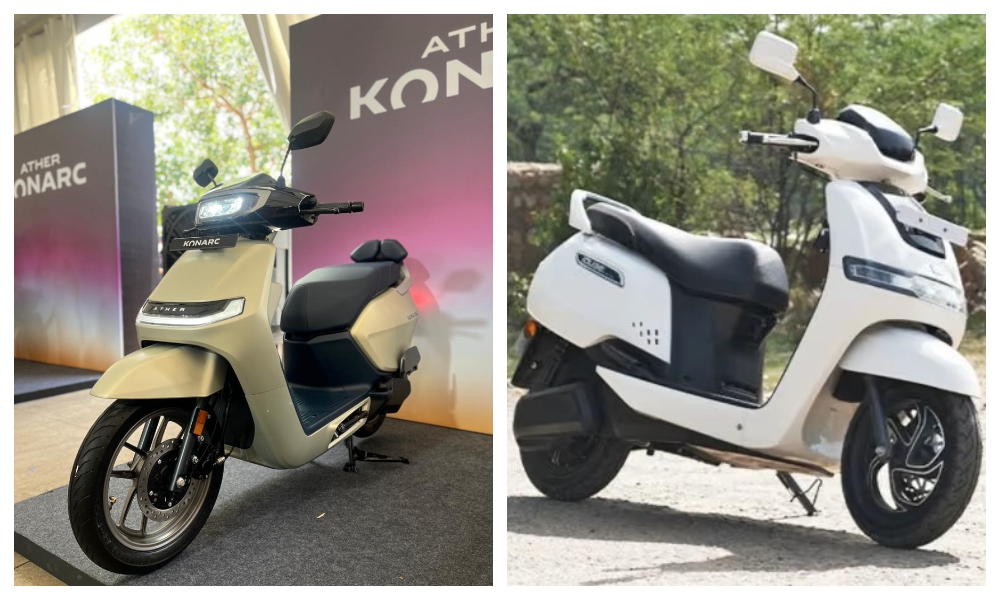
However, this is not a permanent price reduction. It is the effective price after applicable subsidies, and the final price depends on the time and location of registration. Furthermore, the Konarc, as of now, does not qualify for any state government subsidy.
Ather Konarc vs TVS iQube: Powertrain
| Specification | Ather Konarc S 100 | TVS iQube 2.3 kWh |
| Battery capacity | 2.1 kWh | 2.3 kWh |
| Battery type | Lithium-ion | Lithium-ion |
| IDC range | 100 km | 114 km |
| True range | 80 km | — |
| Top speed | 70 km/h | 68 km/h |
| Motor type | PMSM | BLDC hub-mounted |
| Peak power | 4 kW | 3.68 kW |
| Peak torque | 16 Nm | 140 Nm* |
| 0–40 km/h | 5 seconds | 4.7 seconds |
| Riding modes | SmartEco, Eco, Power | Power, Eco and Ride |
The Ather Konarc S 100 uses a 2.1 kWh battery paired with a PMSM motor, producing 4 kW of peak power and 16 Nm of maximum motor torque. It has a 70 km/h top speed and a claimed 100 km IDC range. The TVS iQube 2.3 kWh, meanwhile, uses a 2.3 kWh battery with a BLDC hub-mounted motor, producing 3.68 kW of peak power and 140 Nm of peak torque, with a 68 km/h top speed and 114 km IDC range.
Importantly, the torque figures are measured differently and therefore should not be directly compared; the Ather's 16 Nm figure is its motor torque, while TVS quotes 140 Nm for the motor; TVS also lists 33 Nm as rated torque.
Also read: Ather Konarc Electric Scooter Launch Highlights: Specifications, Prices, Images
Ather Konarc vs TVS iQube: Dimensions
| Specification | Ather Konarc S 100 | TVS iQube 2.3 kWh |
| Front wheel | 14-inch | 12-inch |
| Rear wheel | 12-inch | 12-inch |
| Front suspension | Telescopic | Telescopic |
| Rear suspension | Long-travel | Hydraulic twin-tube |
| Front brake | Disc | Disc |
| Rear brake | Drum | Drum |
| Wheelbase | 1,352 mm | 1,301 mm |
| Ground clearance | — | 157 mm |
| Seat height | — | 770 mm |
| Storage | 31 litres | 32 litres |
| Kerb weight | — | 109 kg |
| Body construction | Metal/steel body | Tubular structure |
The specifications show that the Konarc a longer wheelbase and a larger 14-inch front wheel, features that the TVS iQube misses out on. Furthermore, the TVS iQube offers more storage space, which adds to the scooter’s practicality.
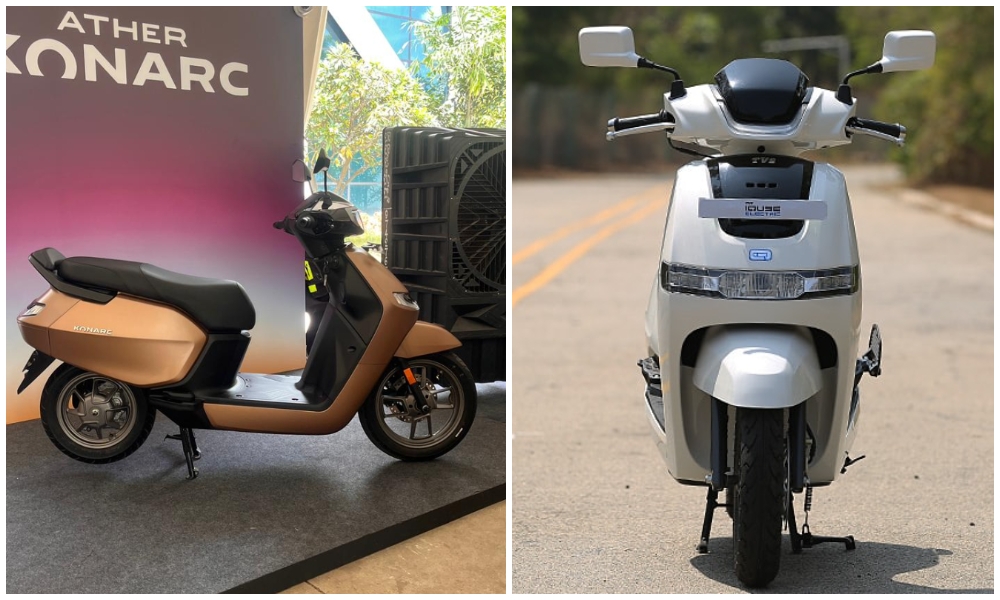
In terms of construction, the Konarc gets a metal body, while the TVS iQube uses a tubular structure. Ather has not yet disclosed the ground clearance and seat height of the Konarc.
Ather Konarc vs TVS iQube: Charging details
| Specification | Ather Konarc S 100 | TVS iQube 2.3 kWh |
| Charging | 450W onboard charger | Off-board charger |
| 0–80% charging | 4 hours | 2 hours 50 minutes |
| Battery protection | IP67 | IP67 |
| Regenerative braking | Yes | Yes |
Moreover, the charging time of the TVS iQube is around one hour shorter than that of the Konarc.
Also Read: Ather Konarc Launched in India, Prices Start At Rs 1 Lakh
Features
In terms of features, both the Ather Konarc and TVS iQube come equipped with connected technology, multiple riding modes and digital instrument clusters. The Konarc gets a 7-inch touchscreen display with smartphone connectivity, navigation and onboard apps, while the iQube is available with a 5-inch TFT display on select variants and supports connected features through the TVS SmartXonnect system.
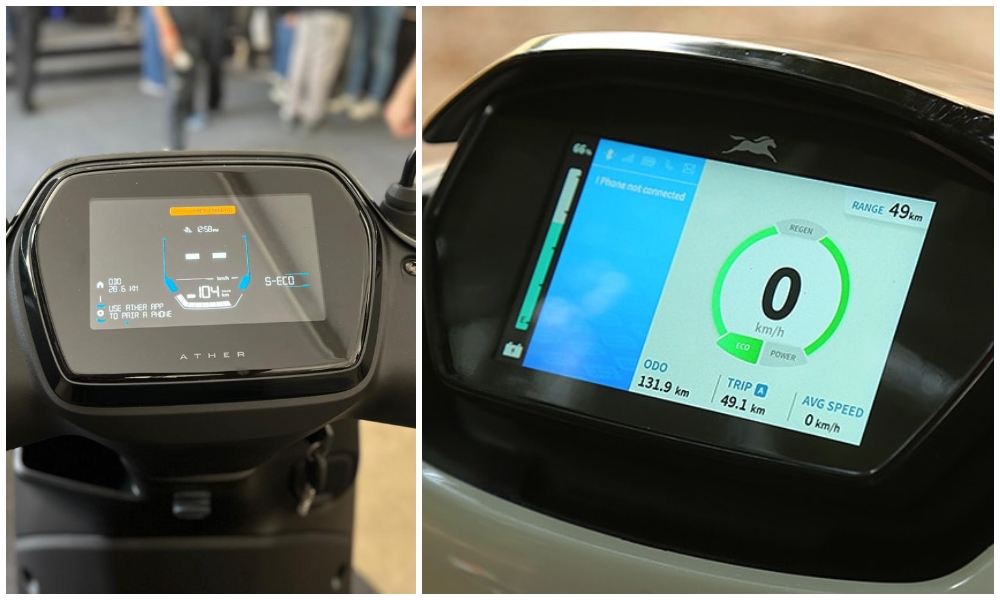
The Konarc also gets features such as traction control and a larger 14-inch wheel setup, while the iQube focuses on practicality with features such as ample storage, a USB charging port and a spacious floorboard. Overall, the Konarc has a more technology-focused feature list, whereas the iQube places greater emphasis on everyday practicality.
Overall, the Ather Konarc is positioned as the more premium and technologically advanced option of the two. It could be attractive to buyers looking for a balance between performance and technology. It also gets a steel body construction, which should offer a sturdy and durable build.
On the other hand, the TVS iQube focuses more on practicality and value for money. It offers larger storage, a wider range of battery options and a broader service network than Ather. Therefore, buyers prioritising technology and performance may find the Konarc more appealing, while those looking for practicality and value may prefer the iQube.


Latest News


 car&bike Team | Oct 16, 2026Renault Duster Hybrid Launch Today: What To Expect?The hybrid will become the third powertrain option in the line-up, joining the existing 1.0-litre and 1.3-litre turbo-petrol engines.2 mins read
 car&bike Team | Oct 16, 20262026 Hero Xtreme 160R 4V: In PicturesJust before Diwali, Hero Motocorp has launched the 2026 Hero Xtreme 160 4V with new upgrades and features.1 min read
 Jafar Rizvi | Oct 16, 2026New Audi Q3 Launched In India At Rs 51.99 LakhThe third-gen Q3 is offered in two variants, Nova and Zenith, with prices starting at Rs 51.99 Lakh.3 mins read
 Jaiveer Mehra | Oct 16, 20262027 Hero Xtreme 250R Launched In India: Priced at Rs 1.98 LakhThe 250R sees the addition of new features including a ride-by-wire throttle, bi-direction quick shifter and a world-first frequency selective damping for the rear suspension.1 min read
 Jaiveer Mehra | Oct 16, 2026New Xtreme 160R 4V Launched At Rs 1.27 Lakh2027 Xtreme 160R 4V gets updates to the styling along with some new features.2 mins read
 Sarthak Mahajan | Oct 16, 2026MINI Cooper Oxford Edition Launched In India At Rs 55.50 LakhThe special edition celebrates 25 years of modern MINI production at Oxford in the UK and gets exclusive exterior and interior design elements.1 min read