
Lamborghini Huracan Evo Revealed; Gets More Power


Automobili Lamborghini has finally revealed the Huracan Evo. Based on the prowess and performance of the Huracan Performante, the Evo incorporates next-generation vehicle dynamic control and aerodynamics. The Huracan Evo gets a new front bumper which gives the car a low profile and assures aerodynamic efficiency via the front splitter with integrated wing. The enlarged air intakes feature the Ypsilon shape that we've seen in many a Lamborghinis. On the side, the Huracan Evo features hexagon design references in the windows, the new wheel design and around the new side air intakes.
At the rear, the Huracan Evo reflects the wide, open, naked rear seen in its race-car brother, the twin outlets of the new sports exhaust system are positioned high up in the car's rear bumper. At the upper end of the tail an integrated, slotted spoiler provides enhanced air flow. The company has even shaped the underbody maximise aerodynamic efficiency. This aerodynamic styling improves downforce and aerodynamic efficiency more than five times over the first generation Huracan, according to the company.

The company has even shaped the underbody of the Huracan Evo maximise aerodynamic efficiency.
Stefano Domenicali, Chairman and Chief Executive Officer of Automobili Lamborghini said, "Lamborghini is intent on leading the advance to the highest level of super sports car technologies and driving emotion. This is the essence of the new Huracan EVO. It takes the extraordinary abilities of the Huracan Performante and combines state-of-the-art vehicle dynamic control to amplify the everyday Huracan driving experience. The Huracan EVO is the very definition of evolution: it is a step ahead, redefining the segment parameters. It is remarkably easy to drive, while delivering the most responsive, sensory and agile driving experience, in every environment."

Hexagonal shapes adore the sides of the Lamborghini Huracan Evo, keeping in touch with the company's DNA
Under the hood the Huracan Evo features the 5.2-litre naturally-aspirated V10 engine, uprated to produce higher power output and puts out 630 bhp at 8,000 rpm with 600 Nm of torque delivered at 6,500 rpm. With a dry weight of 1,422 kg the Huracan EVO reaches a weight-to-power ratio of 2.22 kg/hp. The supercar accelerates from 0-100 kmph in 2.9 seconds and from 0-200 kmph in just 9 seconds. Braking from 100 kmph to 0 is achieved in just 31.9 m, with a top speed of more than 325 kmph.
The Huracan Evo features new Lamborghini rear-wheel steering and a torque vectoring system working on the four wheels, while at the heart of the car is the new feature of Lamborghini Dinamica Veicolo Integrata (LDVI): a Central Processing Unit that controls every aspect of the car's dynamic behaviour, fully integrating all of the car's dynamic systems and set-up to anticipate the next move and needs of the driver, interpreting this into perfect driving dynamics.
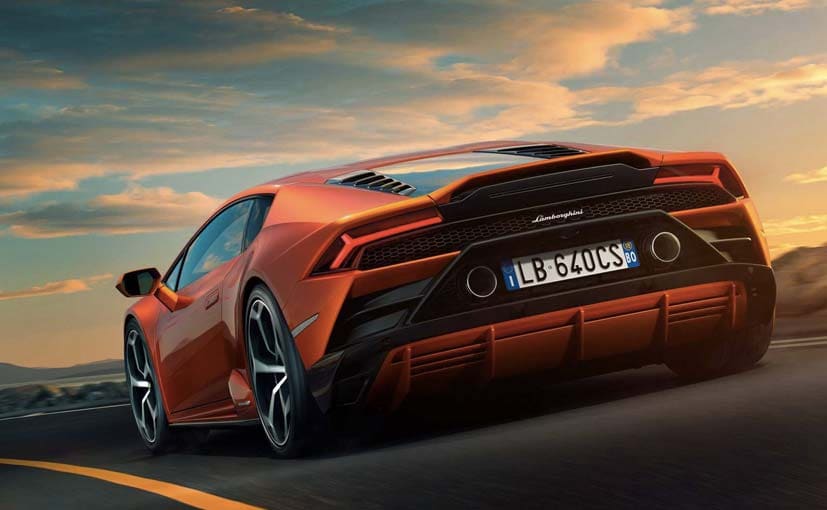
The Lamborghini Huracan Evo sees twin outlets of the new sports exhaust system positioned high up in the car's rear bumper
Lamborghini Piattaforma Inerziale (LPI), a comprehensive set of accelerators and gyroscope sensors placed at the car's centre of gravity, has been enhanced to version 2.0. With improved precision, it monitors in real-time the dynamic vehicle attitude regarding lateral, longitudinal and vertical accelerations, as well as roll, pitch and yaw rate. The magneto rheological suspension, upgraded to version 2.0, instantaneously adapts the damping following inputs from the LPI. A new advanced traction control system together with enhanced all-wheel drive and torque vectoring, allows traction to be directed to a single wheel as required.

Inside, the Lamborghini Huracan Evo comes with Apple Carplay with smartphone connectivity
The Huracan now gets an 8.4-inch HMI capacitive touchscreen, located in the centre console just above the start button which puts connectivity at the driver's fingertips, with multi-finger gesture control. Governing car functions including seats, climate and the status of the LDVI system in real-time it also puts all infotainment, such as Apple CarPlay with smartphone integration, at the cabin occupants' disposal. A multimedia system incorporates connected navigation and entertainment including web radio and video player. The interface allows voice commands and puts the driver in touch with Siri. An optional dual-camera telemetry system is also offered via the touchscreen, allowing telemetry recording and analysis.
Priced at $261274 (approximately Rs. 1.8 crore) we expect India to get the Huracan Evo very soon. The Huracan Evo already has its sets of customers and deliveries for the first orders will begin from March 2019.
Related News


Latest Cars


Upcoming Cars


Latest News


 car&bike Team | Jul 25, 2026Jeep Meridian 85th Anniversary Edition Launched At Rs 36.05 LakhLimited to 85 units, the special edition gets cosmetic changes and also features the CARA AI voice assistant.1 min read
 car&bike Team | Jul 25, 2026River Indie Electric Scooter Crosses 50,000 Units Production MilestoneThe milestone comes less than three years after the first unit rolled out of the company's Hoskote manufacturing facility.2 mins read
 car&bike Team | Jul 25, 20262026 Maruti Brezza Facelift Fuel Efficiency Figures RevealedThe updated model returns up to 26.90 km/kg in CNG guise, while the newly introduced turbo-petrol delivers a claimed 20.47 kmpl.2 mins read
 Jafar Rizvi | Jul 25, 2026Honda ZR-V Hybrid SUV Launched In India At Rs 47.99 LakhThe ZR-V is Honda’s first hybrid SUV for India and arrives as a CBU.1 min read
 Jafar Rizvi | Jul 24, 20262026 Maruti Brezza Facelift: Variants, Features, Engine Options ExplainedThe 2026 Maruti Suzuki Brezza is offered in four trim levels: LXi, VXi, ZXi and ZXi+ and with two engine options.5 mins read
 Jafar Rizvi | Jul 24, 20262026 Maruti Brezza Facelift Launches With Three Major FirstsThe 2026 Maruti Suzuki Brezza has arrived, and along with carrying a five-star Bharat NCAP rating, the model brings three firsts for both the Brezza and, in one case, Maruti itself.2 mins read
 Bilal Firfiray | Jul 24, 2026Honda ZR-V Review: Who Is It For?Honda has brought the new ZR-V to India as their current flagship offering. It’s a CBU, it’s a hybrid, and it’s here for a limited few. Who is it for though?1 min read
 Shams Raza Naqvi | Jul 15, 2026Ferrari 849 Testarossa Spider Driven: Rs. 11.25 Crore Meets 1,000 bhpWe got behind the wheel of the most powerful convertible from Ferrari. What makes the 849 Testarossa Spider Special? We tell you.1 min read
 Bilal Firfiray | Jul 12, 2026Tata Sierra EV Review: Reborn In The Electric AgeThe Tata Sierra EV isn’t drastically different from its ICE counterpart when it comes to design. But being the seventh electric offering from the Indian brand, it has gotten a few things right, and very few things wrong. But is it a compelling package to buy?5 mins read
 Jafar Rizvi | Jul 13, 2026TVS Orbiter Long-Term Review (Report 1): Settling In Takes TimeFirst impressions weren't the strongest, but the Orbiter has made a mark in its first month in the car&bike garage.5 mins read
 Seshan Vijayraghvan | Jul 7, 2026Tata Altroz Petrol DCA Long-Term Review: Intercity & Highway Driving ReportWe tested the Tata Altroz Petro DCA’s highway manners, intercity performance, and real-world fuel efficiency.1 min read