
Ola S1 Pro Gen 2 First Look: Flagship E-Scooter Gets Lighter And More Powerful

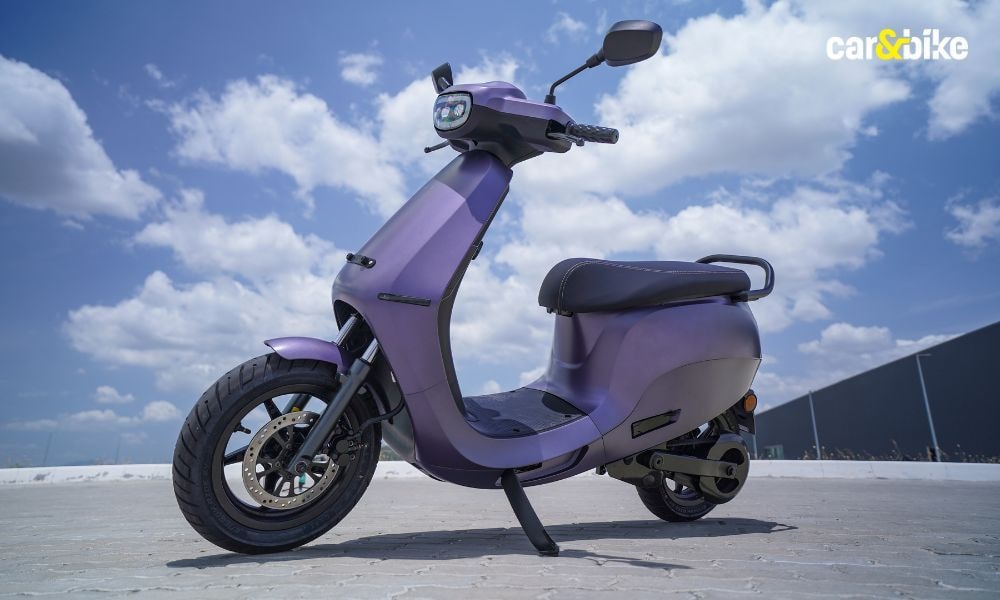
- Ola S1 Pro Gen 2 drops single-sided front suspension for conventional telescopic fork.
- Gains pace rapidly thanks to increased peak motor output of 11 kW.
- Lower weight has helped improve acceleration times and top speed.
Since its debut in 2021, the Ola S1 Pro has easily been one of the most widely talked-about two-wheelers in India, but it hasn’t always been in the headlines for the right reasons. Still, there is no downplaying the significance of the S1 Pro – and the S1 line-up in general – in helping electric scooters go mainstream in the country. With the S1 portfolio, Ola has pushed rivals aside to climb to the top of electric two-wheeler sales charts, and now holds over 40 per cent market share. However, the start-up seems to have realised that to consolidate and build on this early momentum, it needs its flagship product to be stronger than it has been so far. And so, almost exactly two years on from the debut of the original, here is the Ola S1 Pro Gen 2.
Also Read: Ola S1 Pro Gen 2 Launched At Rs 1.47 Lakh; Promises Higher Range And More Power
It’s clear that Ola saw no point in tinkering with the design and styling of the scooter, which remains pretty much the same as before. The signature Ola LED headlight, too, remains untouched. However, it’s when you look at the mechanicals that you realise how significant an update this is.
Kerb weight drops from 121 kg to 116 kg.
Having faced intense scrutiny after customers reported failures, the single-sided front suspension has been done away with. In its place comes a conventional telescopic fork, and while the rear monoshock has been retained, it is now offset to the right. Also new is the double-sided swingarm, in place of the single-sided version seen on the original. The changes do take away from some of the visual slickness of the scooter, but it still looks smart on the whole.
Also Read: Ola S1 X Launched At An Introductory Price of Rs 79,999
Telescopic fork replaces single-sided front suspension; note new 5-spoke wheel design.
The units showcased were pre-production models, so it’s best to reserve comment on overall quality and fit-and-finish levels for now. There are no changes to the connectivity and entertainment features of the scooter, and it retains the 7.0-inch touchscreen system, which we didn’t have enough time to fully explore during our first meeting with the S1 Pro Gen 2.
Flat floorboard can carry loads of up to 150 kg, says Ola.
As part of the transition to the upgraded ‘Gen 2’ platform, the S1 Pro’s frame is said to utilise 14 per cent fewer parts. The spine-like protrusion in the floorboard has been eliminated, so you now get a flat floorboard, and it can sustain loads of up to 150 kg, as per the start-up. The pillion grab handle is now a single-piece unit (unlike the split handle seen on the S1 Pro previously) and feels sturdier. Also new are the open pockets carved into the back of the front apron, which you can use to store your phone and other odds and ends. Underseat storage, meanwhile, has dropped marginally to 34 litres, but it’s still sizeable and well-shaped.
Seat height is 805 mm, so shorter riders will find themselves tip-toeing around often.
Another major change comes with the revised powertrain. Battery capacity remains unchanged at 4 kWh, but the pack itself has been redesigned, with a 33 per cent reduction in parts. Ola also promises increased thermal efficiency and an improved BMS, which, coupled with the overall weight reduction (from 121 kg to 116 kg), results in a higher certified range of up to 195 kilometres. Ola pegs true range at up to 180 kilometres in Eco mode, and up to 143 kilometres in Normal mode, both of which are claims we’ll need to test at a later date.
Also Read: Ola Electric Showcases Four New Electric Motorcycle Concepts
The S1 Pro now employs a new motor that Ola says it has designed in-house. With continuous output rated at 5 kW and peak output rated at 11 kW, the Gen 2 model is now the most powerful electric scooter on sale in India. Coupled with the drop in scooter weight, the more potent motor has helped cut 0-40 kmph acceleration time to 2.6 seconds, 0-60 kmph time to 4.3 seconds, and increased top speed by a touch to 120 kmph.
I had the chance to take the Gen 2 for a short ride around the Ola Futurefactory. I had only a few minutes of actual seat time, which I used to subject the revamped S1 to a series of full-bore acceleration runs. Slotting it into Hyper mode, I was able to get up to 80 kmph rapidly, and repeatedly, on an open stretch right outside the factory. The S1 Pro scurries off the line and feels pretty quick, even by electric scooter standards. That said, we’ll need to spend more time with the scooter to better understand how the mechanical changes have impacted the overall riding dynamics.
At Rs 1.47 lakh (ex-showroom), the upgraded S1 Pro is Ola Electric's priciest offering, but the Gen 2 is only about Rs 8,500 more expensive than the outgoing version. And, it must be noted that the equivalent Ather 450X Pro (with the 3.7 kWh battery) costs roughly Rs 20,000 more.
Related News



Research More on Ola Electric S1 Pro


Popular Ola Electric Models


Latest Cars


Upcoming Cars


Latest News


 car&bike Team | Aug 7, 20262026 Ducati Monster India Launch On August 10; Gets New 890cc EngineDucati is set to launch the 2026 Monster in India on August 10, bringing an updated design, new engine and revised electronics package to the premium streetfighter segment.1 min read
 car&bike Team | Aug 7, 2026New Bajaj Pulsar 150 Spotted Ahead Of LaunchThe updates point to one of the biggest overhauls the nameplate has received in years.2 mins read
 Jaiveer Mehra | Aug 7, 2026FADA Sales July 2026: Auto Sales Up By Over 25 Per Cent; Passenger Vehicle, Two-Wheelers Report Best-Ever Numbers For The MonthFADA reported sales across all segments stood at a new high for July - a first-ever.1 min read
 Sarthak Mahajan | Aug 7, 2026Maruti Suzuki Brezza vs Skoda Kylaq vs Hyundai Venue vs Tata Nexon Camo: Manual Turbo-Petrol Engine BattleWe compare the specifications of the Maruti Suzuki Brezza's Boosterjet engine with its rivals to see where it stands.3 mins read
 car&bike Team | Aug 7, 20262026 Bajaj Pulsar N160: Variants ExplainedBajaj has expanded the Pulsar N160 lineup with two new variants: the N160 S and the top-spec N160 SS.3 mins read
 Abhishek Nigam | Aug 7, 2026Bajaj Pulsar N160 S, N160 SS Launched: Prices Start At Rs 1.34 LakhThe N160 model gets a host of major updates to give it an upper hand amongst the competition2 mins read
 Bilal Firfiray | Aug 1, 2026Toyota Hilux Review: The InvincibleMarking it as the ninth generation, the Hilux comes with a major cosmetic overhaul. But is it still relevant enough for the current times or is it getting too long in the tooth?5 mins read
 Bilal Firfiray | Jul 30, 2026Kia Syros EV Review: Best EV To Buy Under Rs 20 Lakh?The Kia Syros EV comes into the game with a modern design, spacious cabin, strong performance, decent range and an aggressive pricing. But could it become the new benchmark under Rs 20 lakh?5 mins read
 Jaiveer Mehra | Jul 27, 20262026 Maruti Suzuki Brezza Facelift Review: Bestseller Joins The Turbo ClubWhile Maruti’s facelifts have always tended to bring subtle updates over the outgoing models, the latest Brezza brings some heavy updates under the skin, including a new 6-speed manual gearbox and, for the first time, a turbocharged petrol engine option.1 min read
 Bilal Firfiray | Jul 24, 2026Honda ZR-V Review: Who Is It For?Honda has brought the new ZR-V to India as their current flagship offering. It’s a CBU, it’s a hybrid, and it’s here for a limited few. Who is it for though?1 min read
 Girish Karkera | Jul 29, 2026Mercedes-AMG E53 4MATIC+ PHEV First Drive Review: Just What The Doctor OrderedThere are luxury cars and there are high-performance cars. But what if you want both for the price of one? Mercedes-Benz has a recommendation that promises to tread a fine line between the two – the second generation E53 with a twist.7 mins read