
Toyota Slashes September Output Amid Chip Crunch, COVID Resurgence


Toyota Motor Corp said it will slash global production for September by 40% from its previous plan, becoming the last major automaker to cut output due to a global chip crunch, but it maintained its annual sales and production targets. Toyota's success in navigating the chip shortage better than rivals has come down to its larger stockpile of chips under a business continuity plan adopted after the 2011 earthquake and the Fukushima nuclear disaster. The world's largest automaker by sales volumes reiterated on Thursday its global production target of 9.3 million vehicles for the year ending in March, as well as its plan to sell 8.7 million cars in the period.
"The 9.3 million global production plan takes into account certain risks," executive Kazunari Kumakura told reporters. "We want to achieve the numbers."
Toyota said the September cuts included 14 factories in Japan and overseas plants, and that the company would reduce its planned global production that month by around 360,000 vehicles.
Of these, 140,000 will be at Japanese plants, with the rest in the United States, China, Europe and other Asian countries.
Toyota would reduce its planned global production that month by around 360,000 vehicles
Car makers worldwide have been cutting production due to the months-long chip shortage, but a resurgence in COVID-19 cases in Japan, Philippines, Thailand, Vietnam and Malaysia - home to auto factories and chip plants - have led to stricter curbs and compounded the crisis.
Germany's Volkswagen said on Thursday it may need to cut production further and that it expected the supply of chips in the third quarter to be "very volatile and tight."
Ford Motor Co said Wednesday it will temporarily shut its Kansas City assembly plant that builds its best-selling F-150 pickup truck due to a semiconductor-related part shortage as a result of rising cases in Malaysia.
Earlier this month, Toyota had flagged an unpredictable business environment due to fresh COVID-19 cases in emerging economies, the semiconductor shortage and soaring material prices.
had already halted assembly lines at some Japanese factories between late July and early August, including its Tahara plant
Toyota shares closed down 4.4% in their biggest daily drop since December 2018, pulling the benchmark Nikkei average to a seven-month low.
The carmaker had already halted assembly lines at some Japanese factories between late July and early August, including its Tahara plant, due to a surge in infections in Vietnam which had constrained the supply of parts, the Nikkei reported earlier.
A person familiar with the matter told Reuters this month that Toyota had also suspended production at one assembly line in Guangzhou, China, which it operates with its Chinese joint-venture partner Guangzhou Automobile Group Co Ltd.
In Thailand too, Toyota suspended production last month at three factories due to a pandemic-related parts shortage.
(This story has not been edited by NDTV staff and is auto-generated from a syndicated feed.)
Related News


Popular Toyota Models


Latest Cars


Upcoming Cars


Latest News


 car&bike Team | Jun 13, 2026Kawasaki Ninja ZX-10R Offered With Rs 2.89 Lakh DiscountKawasaki has extended its Rs 2.89 lakh discount on the Ninja ZX-10R until the end of June 2026.1 min read
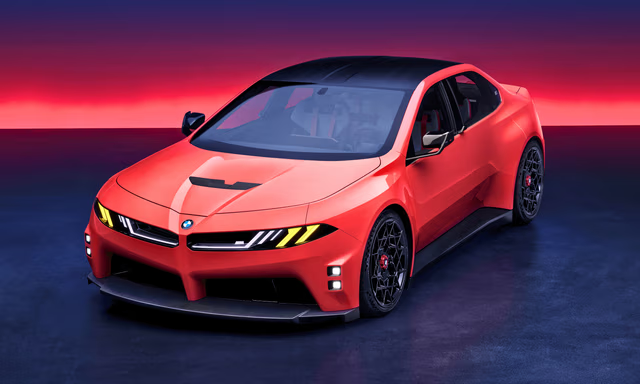 Jafar Rizvi | Jun 13, 2026BMW M Concept Neue Klasse Revealed; Previews Electric M3The concept presents BMW M's future design language and packs a quad-motor electric drivetrain, 800V architecture and over 100 kWh battery capacity.4 mins read
 Jafar Rizvi | Jun 13, 2026New-Gen Hyundai i20 RevealedHyundai has unveiled the fourth-generation i20 in Brazil, giving the hatchback a completely fresh design inside and out.3 mins read
 car&bike Team | Jun 12, 2026Maserati Partners With Navnit Motors For Sales & Service In Western IndiaThe new showroom will open in Bandra Kurla Complex in Mumbai with Maserati’s entire range of vehicles available.1 min read
 car&bike Team | Jun 12, 2026Honda CBR1000RR-R Fireblade SP Reintroduced In India; Priced At Rs 33.50 LakhThe CBR1000RR-R Fireblade SP remains unchanged but gets a considerable price hike.2 mins read
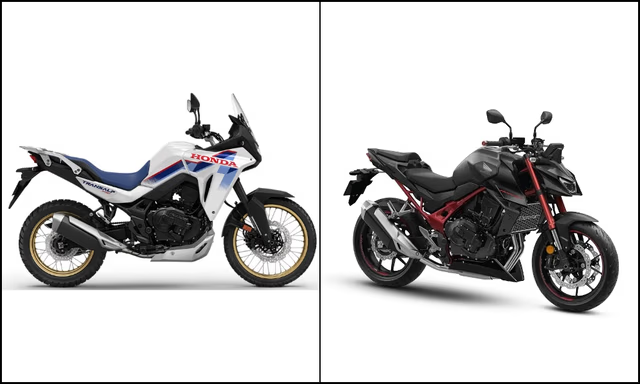 car&bike Team | Jun 12, 2026Honda CB750 Hornet and XL750 Transalp Launched with E-ClutchHonda has introduced E-Clutch-equipped versions of the CB750 Hornet and XL750 Transalp in India, bringing clutch-free gear shifts to its 755cc twin-cylinder range.1 min read
 Preetam Bora | Jun 10, 20262026 BMW F 450 GS Review: A True GS - But Should You Buy It?The GS badge on a BMW means something and always has. Can the new made-in-India BMW F 450 GS truly live up to that legacy? We spent a few days getting familiar with the F 450 GS to see if it’s worth a buy.12 mins read
 Jaiveer Mehra | Jun 10, 20262026 Tata Altroz Long-Term Review: Initial Impressions After 45 DaysTata’s premium hatchback brings a lot to the table, but some rough edges are still apparent.4 mins read
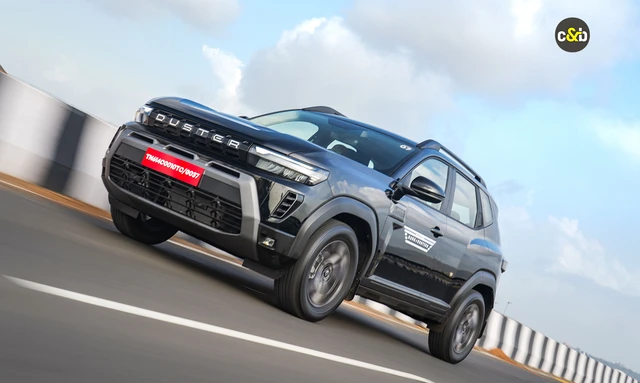 Seshan Vijayraghvan | Jun 9, 2026Renault Duster 1.0-Litre Turbo Review: Small Engine, More Than Enough PerformanceThe Renault Duster's TCe100 engine is the 1.0-litre turbo petrol that makes 99 bhp and 166 Nm of peak torque. And it only comes with a 6-speed manual.6 mins read
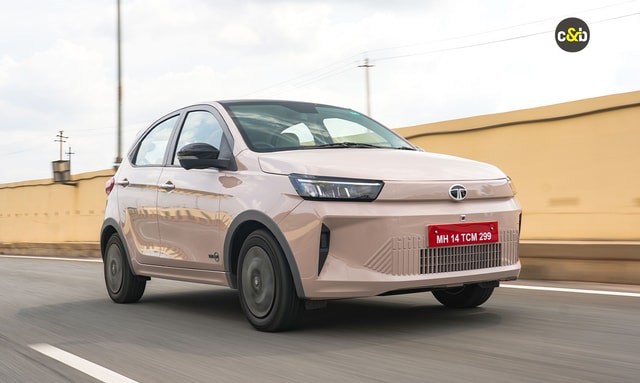 Seshan Vijayraghvan | Jun 8, 20262026 Tata Tiago EV Review: Small EV Gets Big ImprovementsThe 2026 Tata Tiago EV promises a sharper design, segment-first features at sub-Rs. 10 lakh price point, and better real-world range. But does it deliver?1 min read
 Seshan Vijayraghvan | Jun 6, 20262026 Tata Tiago And Tiago iCNG Review: Budget Hatch Offers Premium AppealThe 2026 Tata Tiago range brings a lot of new things to the segment, and on paper, it looks like a solid product. But,, is the premium appeal real?1 min read