
Can You Safely Fill E85 Fuel In A Normal Petrol Car to Save Money?

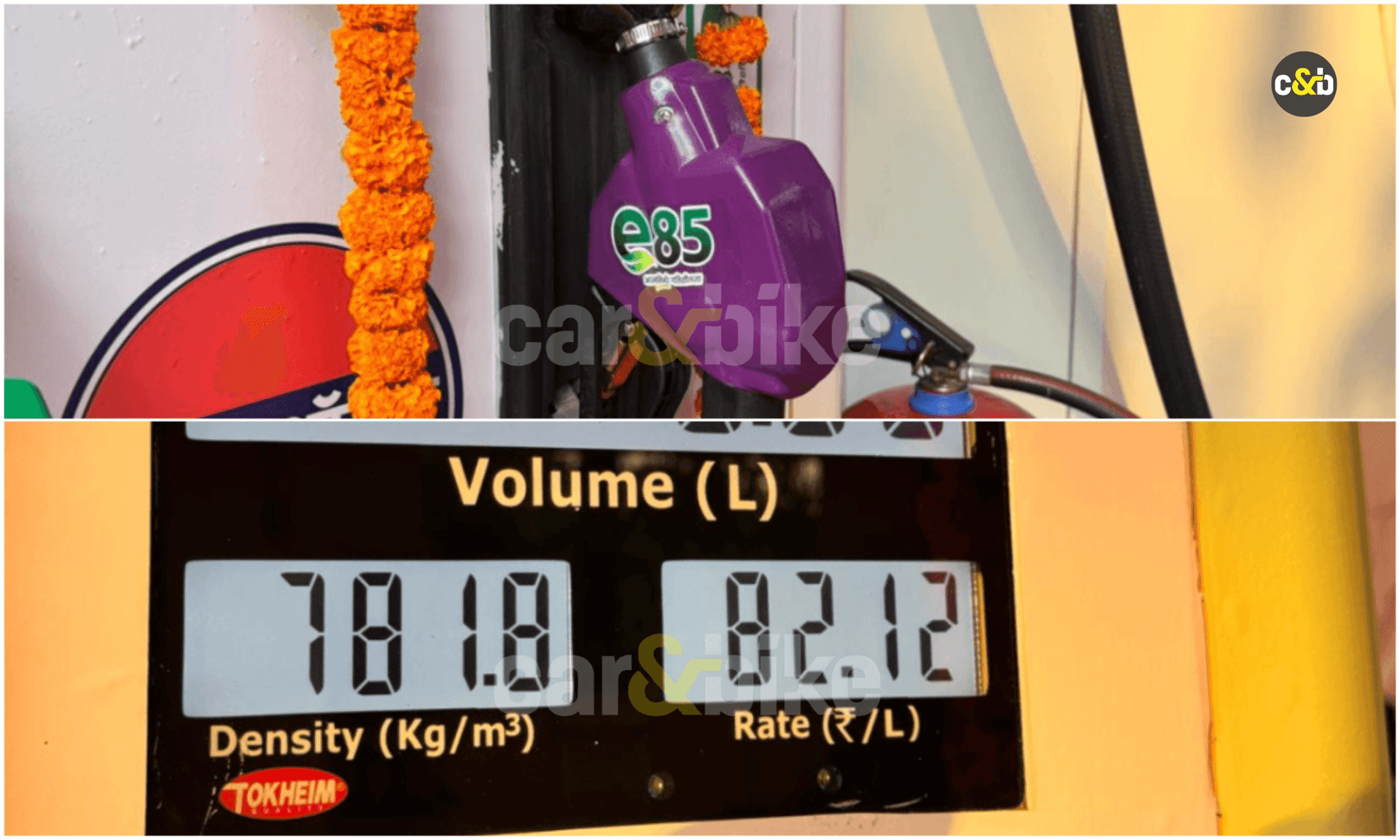
- Putting high ethanol blends in standard cars can corrode plastic and rubber fuel lines
- The engine computer in a regular vehicle cannot adjust for the lower energy density of E85
- Because ethanol burns faster than regular petrol, the actual cost per kilometre is the same
The government has recently rolled out E85 fuel pumps in cities like Delhi, pricing the new blend at around Rs. 82 per litre. Compared to standard E20 petrol, which has climbed as high as up to Rs. 102 per litre (because of geopolitical factors), the new fuel might look like a massive bargain for everyday commuters. However, if you do not have a vehicle specifically badged as a flex-fuel model, pumping E85 into your regular car can actually become a very expensive mistake.
Also Read: How To Check If Your Existing Vehicle Is 100% Compatible With E10, E20, Or E85 Blended Petrol
What Happens When You Put E85 in a Standard Car
Regular petrol cars, even the modern ones built to handle the current E20 fuel, are strictly engineered for a maximum of 20 per cent ethanol. But E85 contains 85 per cent ethanol, and only 15 per cent petrol. When you introduce that much alcohol into a standard E20 engine, you will notice several mechanical failures immediately.
Regular cars are built to accept blends of up to E20 fuel.
Rubber and Plastic Corrosion
Ethanol acts as a very strong solvent. In a normal car, the fuel lines, seals, and gaskets are made from standard rubber and plastic. When exposed to E85, these materials can start drying out, swelling, and eventually cracking, leading to severe fuel leaks. Furthermore, ethanol absorbs moisture directly from the air. When this water settles inside a standard metal fuel tank, it can cause internal rust. This rust eventually flakes off and completely clogs the fuel filter and injectors.
Fuel Pump Failure
Because ethanol contains less energy than regular petrol, an engine needs to burn about 30 per cent more fuel to create the same amount of pulling power. A standard fuel pump is not able to push that much liquid continuously. If you run E85 in a normal car, the fuel pump has to work at maximum capacity all the time, causing it to overheat and fail prematurely.
Engine Computer Confusion
Your car's electronic brain is programmed with specific fuel maps based on regular petrol. When you fill up with E85, the sensors in the exhaust notice that the fuel is burning differently and the engine is running very lean. The computer tries to inject more fuel to fix the problem, but standard injectors in standard E20 cars are too small to deliver the required amount. It causes the engine to misfire, hesitate heavily during acceleration, and eventually trigger the check engine light.
Severe Cold Start Issues
Pure ethanol also has a very hard time vapourising in cooler temperatures. Flex-fuel vehicles use special cold-start systems to counter this exact problem. But if you put E85 in a regular car, especially during winter mornings in northern India, the engine will crank repeatedly without starting. You will likely drain your battery entirely before the engine manages to fire up.
Using higher blends of ethanol may result in insurance complications.
Insurance Complications
Besides the mechanical setbacks, using E20 fuel in an older, non-compatible car can also have serious financial consequences when it comes to your vehicle's insurance. Insurers may claim that by using an incorrect fuel blend, the owner has shown “negligence” or “improper use”. And since standard insurance policies do not cover consequential, gradual damage (like corrosion buildup), E20 fuel damage claims will typically be rejected.
Also Read: What Exactly is E85 Fuel? A Complete Breakdown Of India's New Rs. 82/Litre Petrol Alternative
The Mileage Reality: Are You Actually Saving Money?
Even if we ignore the mechanical damage for a moment, the idea that E85 saves you a lot of money is slightly misleading. The economics of ethanol are very different from traditional petrol because of how much energy the fuel actually holds.
| Fuel Type | Ethanol Content | Approximate Pump Price (Delhi) | Energy Density | Impact on Mileage |
| E20 Fuel | 20 Per Cent | Rs. 102 per litre | High | Normal |
| E85 Fuel | 85 Per Cent | Rs. 82 per litre | Low | Drops 20%-30% |
Because E85 has a lower energy density, your car has to burn a lot more of it to travel the same distance. For example, if your standard petrol car gives you 18 kilometres per litre on E20, running it on E85 would drop your mileage down to about 13 or 14 kilometres per litre. When you calculate the actual cost per kilometre, the Rs. 20 discount at the pump is completely wiped out by the lower fuel efficiency. You end up spending almost the same amount of money on your daily commute, while simultaneously destroying your engine from the inside.
Flex-fuel cars are substantially more expensive than their petrol equivalents.
Avoid Filling Up a Normal Petrol Car with E85 Fuel
There’s no doubt that the introduction of E85 is a thoughtful step taken to cut down India's energy import costs and protect the environment, but it is strictly designed for flex-fuel vehicles. Cars and motorcycles engineered for this fuel come from the factory with upgraded, corrosion-resistant fuel lines, massive injectors, and smart sensors that know exactly what is in the tank. If you drive a regular petrol vehicle, sticking to standard E20 petrol is the only way to keep your engine running smoothly and avoid massive repair bills. Until you decide to upgrade to a dedicated flex-fuel model, ignoring the cheaper price tag at the E85 pump is the smartest financial decision you can make.
Related News


Latest Cars


Upcoming Cars


Latest News


 car&bike Team | Aug 7, 20262026 Ducati Monster India Launch On August 10; Gets New 890cc EngineDucati is set to launch the 2026 Monster in India on August 10, bringing an updated design, new engine and revised electronics package to the premium streetfighter segment.1 min read
 car&bike Team | Aug 7, 2026New Bajaj Pulsar 150 Spotted Ahead Of LaunchThe updates point to one of the biggest overhauls the nameplate has received in years.2 mins read
 Jaiveer Mehra | Aug 7, 2026FADA Sales July 2026: Auto Sales Up By Over 25 Per Cent; Passenger Vehicle, Two-Wheelers Report Best-Ever Numbers For The MonthFADA reported sales across all segments stood at a new high for July - a first-ever.1 min read
 Sarthak Mahajan | Aug 7, 2026Maruti Suzuki Brezza vs Skoda Kylaq vs Hyundai Venue vs Tata Nexon Camo: Manual Turbo-Petrol Engine BattleWe compare the specifications of the Maruti Suzuki Brezza's Boosterjet engine with its rivals to see where it stands.3 mins read
 car&bike Team | Aug 7, 20262026 Bajaj Pulsar N160: Variants ExplainedBajaj has expanded the Pulsar N160 lineup with two new variants: the N160 S and the top-spec N160 SS.3 mins read
 Abhishek Nigam | Aug 7, 2026Bajaj Pulsar N160 S, N160 SS Launched: Prices Start At Rs 1.34 LakhThe N160 model gets a host of major updates to give it an upper hand amongst the competition2 mins read
 Bilal Firfiray | Aug 1, 2026Toyota Hilux Review: The InvincibleMarking it as the ninth generation, the Hilux comes with a major cosmetic overhaul. But is it still relevant enough for the current times or is it getting too long in the tooth?5 mins read
 Bilal Firfiray | Jul 30, 2026Kia Syros EV Review: Best EV To Buy Under Rs 20 Lakh?The Kia Syros EV comes into the game with a modern design, spacious cabin, strong performance, decent range and an aggressive pricing. But could it become the new benchmark under Rs 20 lakh?5 mins read
 Jaiveer Mehra | Jul 27, 20262026 Maruti Suzuki Brezza Facelift Review: Bestseller Joins The Turbo ClubWhile Maruti’s facelifts have always tended to bring subtle updates over the outgoing models, the latest Brezza brings some heavy updates under the skin, including a new 6-speed manual gearbox and, for the first time, a turbocharged petrol engine option.1 min read
 Bilal Firfiray | Jul 24, 2026Honda ZR-V Review: Who Is It For?Honda has brought the new ZR-V to India as their current flagship offering. It’s a CBU, it’s a hybrid, and it’s here for a limited few. Who is it for though?1 min read
 Girish Karkera | Jul 29, 2026Mercedes-AMG E53 4MATIC+ PHEV First Drive Review: Just What The Doctor OrderedThere are luxury cars and there are high-performance cars. But what if you want both for the price of one? Mercedes-Benz has a recommendation that promises to tread a fine line between the two – the second generation E53 with a twist.7 mins read