
Kia Seltos 1.5 Petrol iMT Review

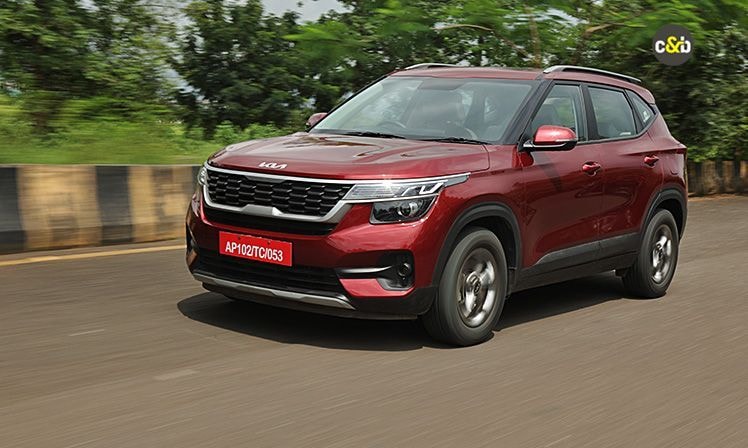
The Kia Seltos doesn’t really need an introduction. Launched in India in 2019, the Seltos was Kia’s debut model and established itself as not only the brand’s best-seller but also a sought-after model in the compact SUV space. And while we have driven the Seltos before, the iMT variant arrived only last year. Simply put, the iMT is a manual variant which doesn’t require you to use the clutch while changing gears - in fact, the clutch pedal is missing altogether. The Seltos is available with the iMT in the naturally aspirated petrol and turbo-diesel guise with the MY2022 version, though what we have here is the petrol model. So let’s get down to it.
Also Read: 2022 Citroen C5 Aircross Review: Still The Most Comfortable SUV?
Kia Seltos iMT: Engine and Performance
The Seltos petrol iMT uses the familiar 1.5-litre naturally aspirated petrol engine developing 113 bhp at 6,300 rpm and 144 Nm of torque at 4,500 rpm. The unit puts its power down to the front wheels via a 6-speed gearbox. While the numbers may not be too impressive on paper compared to, say, the turbo-petrol, it is more than adequate for city driving and even out on the highway. The unit itself is quite refined at low engine speeds and builds power in a linear fashion making the car quite easy to drive. There’s ample grunt low down in the power band, and while the engine can spin up to around 6,500 rpm it’s not one to be wrung out. What does take some getting used to is the gears.
Also Read: 2022 Mahindra Scorpio Classic Review
The key difference between the manual and iMT is the clutch pedal, or lack thereof.
Being an iMT, you still need to row through the gears like a traditional manual though, unlike the latter, there is no physical clutch pedal. The clutch modulation is left to the vehicle which uses sensors to detect when you tug or push the lever to depress the clutch and lets you shift gears smoothly. So, if you are moving from a manual, it might take a little time to adapt to keeping your left foot firmly resting against the dead pedal rather than hunting for a clutch pedal when changing gears.
The 114 bhp 1.5-litre petrol has ample power for city driving and even for cruising on the highway
The gearbox itself is smooth to operate and as the clutch action is entirely automatic; stalling the vehicle also takes some effort. This isn’t an SUV for spirited driving, partly due to the clutch action, and partly due to its performance. It is smooth in operation, though there is a slight delay in the clutch release when you slot it into a new gear – you will feel a bit of a jerk when the revs climb in the intervening period. Driven in a relaxed manner, there is little fuss, and progress is smooth. The car will also give you a warning to downshift should your speed fall too low in a gear.
Also Read: Kia Seltos Adds 6-Airbags As Standard Across Trims; Prices Hiked
The 6-speed gearbox is smooth to row through though the lack of a clutch pedal does take some getting used to.
Out on the highway too, the Seltos iMT performs admirably. A short stint on the highway revealed that the car has ample power on hand to hit triple-digit speeds without fuss. Even overtakes are handled easily enough.
Also Read: Kia Sonet X-Line Range Topping Variant Launched In India; Prices Start At Rs. 13.39 Lakh
Kia Seltos iMT: Ride and Handling
The iMT's 16-inch wheels and fatter tyres help soften the sharp impacts of broken tarmac and expansion joints.
Coming to the ride, the petrol iMT is only available in the mid-spec HTK+ trim, and thus you get smaller 16-inch wheels compared to the HTX+’s 17-inchers. This does have a positive effect on the ride with the smaller wheels and fatter tyres rounding out sharp edges better. Straight line stability too is good, though there is some body movement, particularly over broken sections of road. The steering has a heft to it though it feels artificial with little feedback coming through from the wheels.
Also Read: Kia, Honda 2 Wheeler Tops FADA’s Dealer Satisfaction Study 2022
Kia Seltos iMT: Exterior
The iMT gets projector headlamps as compared to the all-LED headlamps of the top-spec Seltos; fog lamps too are non-LED.
Being an HTK+ variant you notice some differences in this SUV compared to higher variants on offer. For one, the all-LED headlamps with DRLs are replaced by a projector headlamp set-up with the main unit housed in the lower cluster and the LED DRL, turn signal and parking lamps sitting in the upper cluster. The DRLs too are smaller and don’t stretch into the nose while lower down you get simpler projector fog lamps as against the Ice Cube LED stacked units on higher variants. At the back, the tail lamps lack LED detailing.
Also Read: Auto Sales August 2022: Kia Reports Flat Month-On-Month Sales Growth
Taillamps lack the LED detailing offered on higher models.
Kia Seltos iMT: Interior
The differences to higher variants within the cabin come down to the colours, materials, and features. The dashboard is all-black with the soft-touch element on the passenger side replaced by a patterned black trim piece. The centre console is crowned by a smaller 8.0-inch touchscreen while the instrument cluster gets a smaller MID between the large analogue RPM gauge and Speedometer.
No soft-touch materials on the dash though the iMT does come with lighter fabric seats as compared to the equivalent manual.
The iMT does get you some additional features over the standard manual including a sunroof, auto climate control and beige fabric seats – we foresee these getting stained quite easily.
On the feature front, while the 8.0-inch touchscreen may lack Kia’s connected car tech, it does get wireless Android Auto and Apple CarPlay which work well enough. The screen itself is quite smooth to operate with the physical shortcut buttons and knobs adding a little convenience should you decide to reach across to open a menu or change the volume – not required as you get steering-mounted controls.
8.0-inch touchscreen lacks connected car tech but gets wireless Android Auto & Apple CarPlay; Auto climate control, sunroof only offered with the iMT in HTK+ trim.
You also get sound mood lighting – the lights can be set to pulse with the tune of the music in single or multiple colours, keyless entry and go, auto headlamps, sunshades on the rear doors, remote engine start, a rearview camera, cruise control and an Arkamys audio system.
In terms of safety kit, the Seltos now comes with 6 airbags, all-wheel disc brakes, ABS with EBD and brake assist, ESC, hill start assist and a highline tyre pressure monitoring system as standard. Do note that the variant on test with us was the 2021 model so some of this kit wasn’t available.
Also Read: Planning To Buy A Used Kia Seltos? Here Are Things You Need To Consider
Kia Seltos iMT: Price and Verdict
Coming to the price, the Seltos petrol iMT is priced at Rs 13.05 lakh (ex-showroom, Delhi), or about Rs 40,000 more than the equivalent petrol manual model. Buyers also have just one variant on offer – the HTK+. For the premium, the Seltos iMT adds a touch of more convenience to the daily drive while still allowing the driver full control of the gears – unlike in traditional automatics. The premium also gets you some added features over the standard manual.
Those wanting a traditional automatic can opt for the CVT which is only available in the higher and better equipped HTX trim and will set you back a notable Rs 15.45 lakh – a Rs 2.40 lakh premium.
The iMT is only available in HTK+ trim and costs about Rs 40,000 more than the regular manual.
Seen for what it is, the iMT makes a compelling buy for a self-driver wanting to still enjoy the involving drive of a manual without the hassle of the constant use of the clutch. Sure, it’s not as quick as a traditional manual as you don’t control the clutch operation but in stop-and-go of city traffic, the system does make sense. It works well as a daily commuter for the city and there’s ample pep too for the occasional highway jaunt. So, if you are looking for a more involving driver experience without the hassle of having to constantly use a clutch, the Kia Seltos iMT is one to consider.


Latest News


 Shams Raza Naqvi | Sep 18, 2026Kia Carens CNG, Carens Clavis CNG Launched In India: Prices Start At Rs. 12.12 LakhWhile the Carens CNG has been introduced in a single variant, the Clavis CNG will have two variants.1 min read
 Girish Karkera | Sep 18, 2026Maruti Suzuki Swift, Dzire and Baleno CNG AMT Launched: Check Mileage, PricesAutomated manual gearbox option makes the petrol-CNG hybrid a viable option for everyday city use for Swift, Dzire and Baleno models4 mins read
 car&bike Team | Sep 18, 20262026 TVS Apache RTR 200 4V: Top 5 UpdatesThe TVS Apache RTR 200 4V has been introduced in a new top-end variant which gets a lot of new features, including preload adjustable front suspension. Here’s a look at what’s new on the top-spec Apache RTR 200 4V.1 min read
 Jaiveer Mehra | Sep 18, 20262027 Mahindra Thar 3-Door Facelift Teased Ahead Of LaunchSecond update in two years to bring additional cosmetic changes and more features.1 min read
 Amaan Ahmed | Sep 18, 2026Tata Sierra Legend Series Launched At Rs 11.99 Lakh; Adds More Features To Entry And Mid TrimsA slew of features, previously limited to the top-spec Sierra, have been introduced on the Smart+, Pure, Pure+ and Adventure+ variants of the SUV.3 mins read
 car&bike Team | Sep 18, 2026Raptee.HV Commences Customer Deliveries in Bengaluru, Targets 100+ Motorcycles by NovemberThe electric motorcycle maker has begun deliveries in Bengaluru and aims to deliver more than 100 motorcycles across Bengaluru and Chennai by November1 min read
 Preetam Bora | Sep 16, 2026Royal Enfield Himalayan 440 Review: Better Than the 450?The new Himalayan 440 with an upsized engine and gearbox has certainly improved as a touring machine and at an extremely attractive price of Rs. 2.29 Lakh. Is it the better Himalayan to choose for many riders?9 mins read
 Seshan Vijayraghvan | Sep 15, 2026BMW i5 LWB Review: Not The M60, This Is The Proper Electric 5 SeriesThe BMW i5 LWB takes the electric 5 Series formula and puts a stronger focus on rear-seat comfort and long-distance luxury. With a 669 km claimed range, 268 bhp and a more relaxed character, is this the i5 that makes the most sense for India?7 mins read
 Preetam Bora | Sep 14, 2026Ladakh Uncharted: Himalayan Basecamp Off-Road Ride ExperienceA day-long off-road excursion from Royal Enfield’s Himalayan Basecamp event in Ladakh, the Ladakh Uncharted ride by Alpinestars was all about re-discovery!6 mins read
 Janak Sorap | Sep 12, 2026New Bajaj Pulsar 125 First Ride Review: More Tech, Less Weight, Same Pulsar DNAThe new Bajaj Pulsar 125 retains the familiar Pulsar identity but gets a new engine, lighter construction, more features and a sharper riding experience.5 mins read
 Bilal Firfiray | Sep 10, 2026Mahindra XEV 9S Review: 3 Reasons To Buy It, And 3 Reasons To AvoidEveryone keeps telling me that the Mahindra XEV 9S is not the electric XUV 7XO. I disagree.1 min read