
Tata Nano GenX First Drive Review


That is all ancient history now though. The main task for the company now is to simply get a move on, and start focusing on the business end of how to make the car more desirable and appealing to the people it wants to sell the Nano to. Girish Wagh, Senior VP-Product Planning at Tata Motors was the chief engineer for the Nano all those years ago. He explained to me that Tata has taken an intentionally incremental approach with the Nano - meaning that the car has got more and more added on to it as time progressed. Model Year 2012 got better handling and ride, Model Year 2014 had the addition of the power steering, and now we have what Tata is calling the second generation Nano.
Also See: Tata Nano GenX Picture Gallery
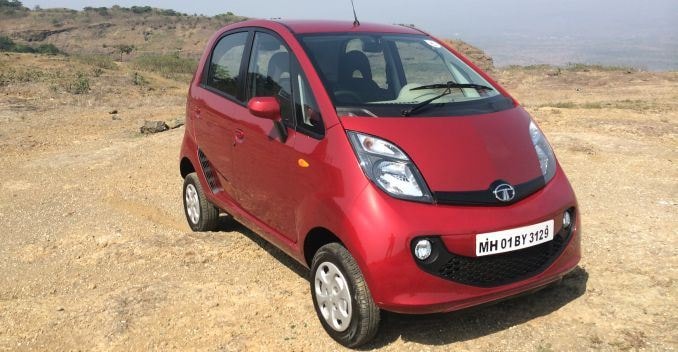
Like so many "new" generation cars that we have seen off late - which reach into the existing product for a lot more than inspiration when developing the next gen, the Nano too builds on the existing platform & existing chassis - and even uses the same powertrain. Hence I am loathe to call it an all-new car. But GenX is okay by me! The new car does have enough new bits to fairly say that it is an improved version of its former self.
The most significant change that is immediately apparent is the styling and the fact that the rear now sports a hatch that can be opened. Tata says it had major feedback on this topic from existing Nano buyers, and so it was imperitive to do this. The 110 litres of boot space is no doubt limited and the company says you can put in one carry-on suitcase and two hand bags. The engine remains at the rear of course, and sits below the boot space, but there is good insulation to keep the engine heat mostly out. The automated manual transmission (AMT) version means the engine compartment is a bit raised, which is why this variant has 94 litres of cargo room. Of course if you fold down the rear seats you get 500 litres in all - which is a good amount of space.
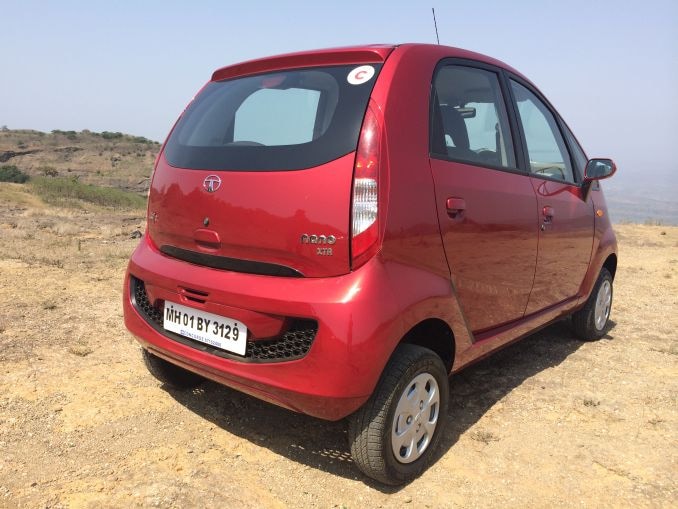
Lets quickly get to the AMT itself next - as that's really all that is new on the mechanical side of things. Tata has sourced the AMT actuator from Italy's Magnetti Marelli - which also supplies it to Maruti Suzuki. The AMT uses a 5-speed gearbox though, unlike the manual which has a 4-speed still. As with any automated manual transmission, the AMT takes getting used to. There are small delays and the car lurches as the gears shift, but its really just a matter of minutes, and you adjust to it. The gear ratios change if you put the car into Sport Mode (yes there is one believe it or not), but for the most part it doesn't necessarily translate into significantly different performance. Where it does help is when you're trying to overtake or quickly accelerate. Being in Sport Mode helps you to hold on to a lower gear to get the right burst of energy.
I have to say that even though the 624 cc/37.4bhp engine remains unchanged, it now sounds better (when you are inside the car) with the right kind of growl when accelerating. The engine now has improved thermal management, and the radiator has been moved to the front of the car. Tata says this helps distribute weight better and helps the cause of better handling. I honestly couldn't pick up on any perceived change on that count. Handling has otherwise been improved by the car's chassis and frame getting stiffer. The changes in the body-in-white to integrate the new rear hatch door have also meant the rear needed to be strengthened. Tata has worked on strengthening the front-end too, and has increased the frontal-crash crumple zone in length. Side impact beams have been added in all the doors too. Overall this has meant an increase in torsional stiffness and rigidity. I am pleased that Tata has at least made an effort to enhance safety. I can also happily report that the company is considering at least optional airbags too now for the Nano, and I can only hope that happens.
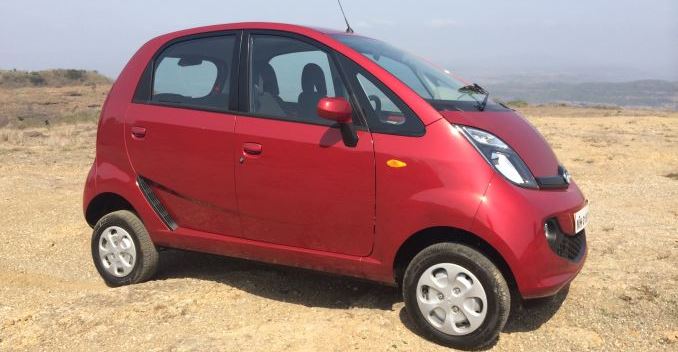
On the whole the car drives quite well, given its size. The electric power assisted steering that came with the Nano Twist a few months ago is now also available on the mid-variant and no longer just the preserve of the top-end. Its ground clearance remains a healthy 180 mm, and it still has the 4-metre turning radius that bests it's class. Tata engineers have taken not just customer feedback into account, but also visited several markets across India to monitor traffic and parking conditions. The idea was to use this data to recalibrate the engine settings - in an effort to increase fuel efficiency. The manual now offers 23.6 kmpl (Alto800: 22.74Km/l, Eon 0.8 IRDe: 21.1Km/l), while the AMT version has a mileage of 21.9Km/l which is lower than the Alto K10's (AltoK10 AMT: 24.71Km/l).
The new Nano now also has a 24 litre fuel tank. Girish Wagh says here too customer feedback prompted a change from the previous 15 litre tank, as many users didn't appreciate having to make two trips to the gas station every week, to tank up. The additional fuel capacity means the driving range is extended by approximately 210 kilometres now to over 500.
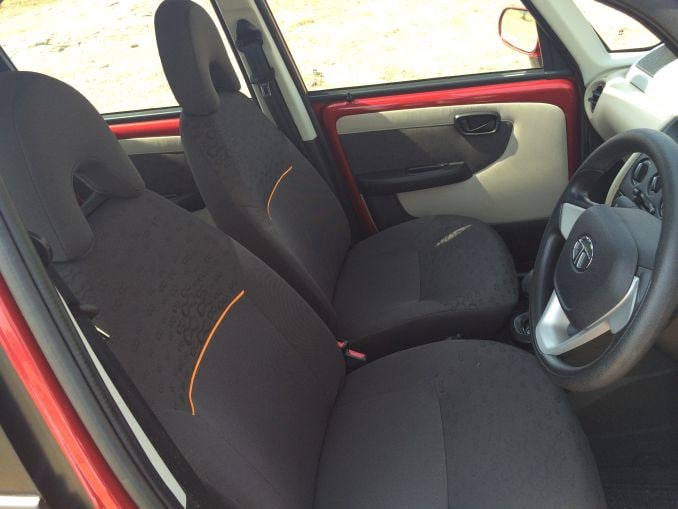
The car maintains its small footprint, overall shape and proportions. But there are some styling changes to speak off. The bumpers are new, and house what Tata designers call the brand's 'humanity line'. This is finished in black with an infinity symbol motif. The same motif finds its way on to the seat and door-trim fabric. The headlamps with black bezels are new, with the Nano badging housed within the cluster. They are now connected with a piano-black grille-like strip that also houses the Tata logo. The car looks a bit grown up and mature - which is perhaps apt given the other changes. I did think the original Nano was very cute and had an appealing, innocent expression - which is now gone though! The seats are better contoured which does make a difference to ride comfort. Depending on the body colour and variant, interior trim is finished in either beige or black with silver, red or light brown inserts. The mid-trim XM also has the silver and white body colours, being offered with contrast red outside mirrors. Pretty cool.
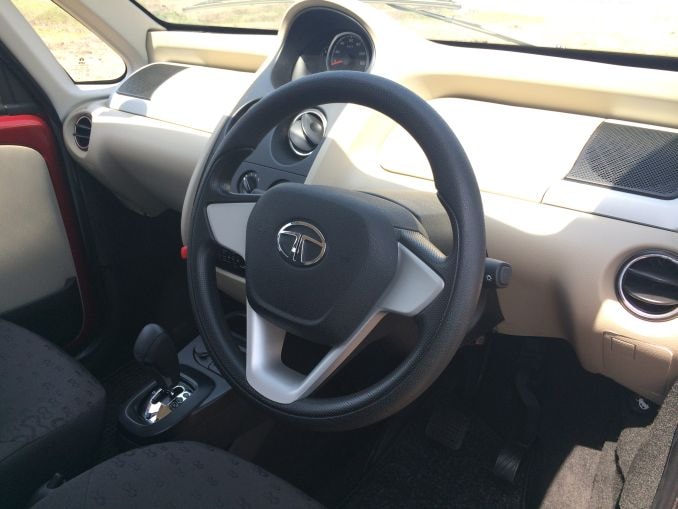
The car also now has a bluetooth enabled phone and music-streaming function - only in the top end XT and XTA (which is the AMT version). I tried both and they work just fine. I do believe Tata should think of offering these in the XM (mid-variant) too, since by its own admission thats the variant that attracts younger buyers - and yes I've already told Girish this! Overall plastic quality and fit is much improved on the interior, and works - with respect to the segment and price point that the Nano operates at.
There is a lot more Tata could do with the Nano. It's management believes higher sophistication levels for the product might mandate a different product line. I don't agree. The Nano is a car that could and should be a revolution. And that's not solely on price alone. The potential for Tata to go places with this brand is huge and I hope we get to see some of that. In the meanwhile is the GenX Nano as they're calling it - a better car than the original 'lakhtakiya'? Short anwer - yes indeed.
Also Read: Tata Motors Announces Pre-Launch Campaign For the New GenX Nano
Related News


Latest Cars


Upcoming Cars


Latest News


 Sarthak Mahajan | Sep 22, 20262027 Mahindra Thar 3-Door Facelift: In PicturesThe facelifted Mahindra Thar has been renamed the Mahindra ‘Thar OG’.1 min read
 car&bike Team | Sep 22, 2026Amkette Launches AirPulse Tyre Inflator Range In India; Prices Start At Rs 1,399With five AirPulse models, ranging from a compact wired inflator to a 4-in-1 emergency device with a jump starter.1 min read
 Amaan Ahmed | Sep 22, 20262027 Mahindra Thar 3-Door Facelift Launched As 'Thar OG', Priced From Rs 10.32 LakhWith a midlife update, the ever-popular 3-door Thar gains structural reinforcements, new rear suspension, larger wheels, more powerful engines and a slew of additional features.4 mins read
 car&bike Team | Sep 22, 20262027 Mahindra Thar Facelift Launch Highlights: Price, Images, Specifications, DetailsMahindra will launch the 2027 Thar 3-door in India today. Watch this space to get all the information first-hand.0 mins read
 Sarthak Mahajan | Sep 22, 2026Saudi Arabia’s New EV Brand CEER Unveils First ModelsCEER, Saudi Arabia’s newly established EV brand, has unveiled the EXOBOT sedan and SUV as its first products.3 mins read
 car&bike Team | Sep 22, 2026JSW Group Introduces New Ampstar Brand For Electric Commercial VehiclesThe company has showcased a 55-tonne electric tractor-trailer and an electric bus at the new brand’s launch.1 min read
 Bilal Firfiray | Sep 19, 2026MG Hector Tomahawk EV Review: Play It SafeMG’s new electric SUV has one of the coolest names ever, and the coolest temperament amongst its peers. But is it worth buying?7 mins read
 Preetam Bora | Sep 16, 2026Royal Enfield Himalayan 440 Review: Better Than the 450?The new Himalayan 440 with an upsized engine and gearbox has certainly improved as a touring machine and at an extremely attractive price of Rs. 2.29 Lakh. Is it the better Himalayan to choose for many riders?9 mins read
 Seshan Vijayraghvan | Sep 15, 2026BMW i5 LWB Review: Not The M60, This Is The Proper Electric 5 SeriesThe BMW i5 LWB takes the electric 5 Series formula and puts a stronger focus on rear-seat comfort and long-distance luxury. With a 669 km claimed range, 268 bhp and a more relaxed character, is this the i5 that makes the most sense for India?7 mins read
 Preetam Bora | Sep 14, 2026Ladakh Uncharted: Himalayan Basecamp Off-Road Ride ExperienceA day-long off-road excursion from Royal Enfield’s Himalayan Basecamp event in Ladakh, the Ladakh Uncharted ride by Alpinestars was all about re-discovery!6 mins read
 Janak Sorap | Sep 12, 2026New Bajaj Pulsar 125 First Ride Review: More Tech, Less Weight, Same Pulsar DNAThe new Bajaj Pulsar 125 retains the familiar Pulsar identity but gets a new engine, lighter construction, more features and a sharper riding experience.5 mins read