
The Evolution of the Maruti Suzuki Dzire: From Compact Sedan to Sales Champion


When the Maruti Suzuki Dzire first arrived in 2008, it was simply a sedan derivative of the Swift hatchback with a larger boot. While it initially divided opinions, buyers quickly looked beyond the styling because the Dzire delivered exactly what Indian families wanted: good mileage, low running costs and reliability, backed by Maruti's extensive service network.
The Dzire did not become India's best-selling sedan overnight. Maruti Suzuki kept improving it with every generation, whether it was fuel efficiency, features, comfort or safety. Those constant updates have helped the Dzire’s sales cross the 30 lakh unit mark and turn it into one of the company's biggest success stories.
First Generation Dzire (2008-2012)
The original Swift Dzire in 2008 shared most of its front-end design with the Swift hatchback but added a large boot to suit buyers who preferred the practicality and status of a sedan. Although many people felt the rear looked slightly oversized, buyers appreciated what mattered more: a decently spacious cabin, a generous boot and low ownership costs.
Petrol and Diesel Engines
The first-generation Dzire was available with both petrol and diesel engines.
| Engine | Output |
| 1.3-litre Petrol | 87 bhp, 113 Nm |
| 1.2-litre K-Series Petrol (introduced later) | 84 bhp, 113 Nm |
| 1.3-litre DDiS Diesel | 75 bhp, 190 Nm |
The diesel version quickly became the more popular choice. Its Fiat-sourced 1.3-litre DDiS engine offered excellent fuel economy and plenty of low-end torque, making it great for long highway drives as well as commercial fleet operators.
In 2010, Maruti replaced the older 1.3-litre petrol engine with its newer 1.2-litre K-Series unit to meet stricter emission norms while improving refinement and efficiency.
Why Buyers Loved It
The first Dzire became a success for some very simple reasons.
- Spacious cabin
- Large boot for luggage
- Fuel-efficient petrol and diesel engines
- Affordable servicing and maintenance
- Strong resale value
It was not the most stylish sedan on the road, but it offered dependable everyday ownership, something that mattered far more to Indian buyers.
Second Generation Dzire (2012-2017)
In 2012, Maruti Suzuki made one of the smartest decisions in the Dzire's history. Instead of making the sedan larger, the company shortened it to just under four metres. This allowed the Dzire to qualify for lower excise duties available on small cars, helping Maruti keep prices competitive without compromising cabin space. The result was a sedan that looked cleaner than before while becoming even more affordable.
Better Packaging Than Before
One compromise of the shorter body was boot space. It reduced from 440 litres to 316 litres, but Maruti managed to preserve rear-seat comfort by redesigning the rear section more efficiently. The overall styling also looked much more balanced than the original model.
Familiar Engines, New Convenience
The second-generation Dzire continued with the proven engine options buyers already trusted.
| Engine | Output |
| 1.2-litre K-Series Petrol | 84 bhp, 113 Nm |
| 1.3-litre DDiS Diesel | 75 bhp, 190 Nm |
The biggest upgrade was not under the bonnet but in the gearbox. Maruti introduced its Auto Gear Shift (AGS) automatic transmission on the diesel model, giving buyers an affordable automatic option at a time when conventional automatics were still expensive. It made city driving much easier without significantly increasing the car's price.
The Dzire Continued to Grow
This generation built on everything buyers already liked while making the car more practical for everyday use.
Highlights included:
- Sub-four-metre design with lower taxation
- Better integrated styling
- Improved fuel efficiency
- Affordable AGS automatic option
- Continued reputation for low running costs
By the end of this generation, the Dzire had already established itself as one of India's favourite compact sedans.
Third Generation Dzire (2017-2024)
The 2017 Dzire was one of the biggest turning points in the model's history. For the first time, Maruti dropped the "Swift" badge completely. The car was now simply called the Maruti Suzuki Dzire, signalling that it had become a standalone product rather than just a sedan version of the hatchback. The Dzire looked more premium, the cabin felt roomier and the driving experience improved noticeably.
A New Platform Changed Everything
The third-generation Dzire moved to Maruti Suzuki's lightweight HEARTECT platform. The new architecture reduced weight and improved rigidity, helping the sedan deliver better fuel efficiency, sharper handling and a more spacious cabin. Compared to the outgoing model, it also grew wider, giving passengers more shoulder room and making the cabin feel airier.
Better Engines and a Big Goodbye
At launch, buyers could choose between familiar petrol and diesel engines.
| Engine | Output |
| 1.2-litre K-Series Petrol | 82 bhp, 113 Nm |
| 1.3-litre DDiS Diesel | 75 bhp, 190 Nm |
Both engines were available with either a 5-speed manual or a 5-speed AGS automatic.
However, 2020 brought one of the biggest changes in the Dzire's history. With the introduction of BS6 emission norms, Maruti discontinued the popular Fiat-sourced diesel engine.
Other changes include upgrading from the older 1.2 K Series engine to the newer 1.2-litre DualJet engine producing 89 bhp and 113 Nm. The updated engine also introduced idle start-stop technology, helping improve fuel efficiency while keeping emissions in check.
The same generation also received a factory-fitted S-CNG option, giving buyers an even more economical choice for daily commuting.
Fourth Generation Dzire (2024-Present)
The fourth-generation Dzire is easily the biggest step forward in the model's history. While previous generations were about fuel efficiency, and ease of ownership, the latest Dzire raised the bar in almost every area. It received a completely fresh design, an all-new engine, a more premium feature-loaded cabin and, for the first time, a safety rating that completely changed how people viewed Maruti cars.
Most importantly, it no longer looked like a sedan derived from a hatchback. The new front grille, sharper LED headlamps and cleaner proportions gave the Dzire a more mature identity of its own.
A New Engine Focused on Efficiency
Under the bonnet, Maruti replaced the DualJet engine with its new 1.2-litre three-cylinder Z-Series petrol engine.
| Engine | Output | Transmission |
| 1.2-litre Z-Series Petrol | 80 bhp, 112 Nm | 5-speed Manual / 5-speed AMT |
| 1.2-litre Z-Series CNG | 69 bhp, 102 Nm | 5-speed Manual |
Mileage also improved across the range.
- Petrol Manual: 24.79 kmpl
- Petrol AMT: 25.71 kmpl
- S-CNG: 33.73 km/kg
For buyers who spend most of their time commuting, the Dzire continues to be one of the most fuel-efficient sedans on sale.
Premium Features Arrive
Over the years, the Dzire has steadily become a more feature-rich family car, and the latest model is no different.
Higher variants now offer:
- Electric sunroof
- 9-inch SmartPlay Pro+ touchscreen
- Wireless Apple CarPlay and Android Auto
- Wireless phone charger
- 360-degree camera
- Rear AC vents
- Connected car features
- Cruise control
These are features that were once limited to much more expensive cars, making the latest Dzire feel far more premium than earlier generations.
A Complete Turnaround in Safety
For years, Maruti cars were often criticised for poor crash-test performance. The previous-generation Dzire received a 2-star Global NCAP safety rating, which became one of the biggest talking points around the car. Maruti responded by strengthening the latest Dzire's body structure and making safety equipment standard across the range.
Every variant now gets:
- Six airbags
- Electronic Stability Program (ESP)
- ABS with EBD
- Hill Hold Assist
- Three-point seatbelts for all passengers
- ISOFIX child seat mounts
The fourth-generation Dzire became the first Maruti to earn a 5-star Global NCAP safety rating, marking one of the biggest safety improvements the company has ever achieved.
The Dzire's Success Did Not Happen Overnight
The Dzire has spent nearly two decades at the top of the sales charts, but its success comes down to something quite simple.
| Generation | Biggest Changes |
| 2008-2012 | First Swift Dzire was launched with petrol and Fiat-sourced diesel engines |
| 2012-2017 | Sub-four-metre design, improved styling and introduction of AGS automatic |
| 2017-2024 | New HEARTECT platform, Swift name dropped, BS6 petrol engine and factory CNG introduced |
| 2024-Present | New Z-Series engine, premium features, 5-star Global NCAP safety rating and stronger body structure |
In 2026, Maruti Suzuki celebrated 30 lakh cumulative Dzire sales, making it India's highest-selling sedan. During 2025, it also emerged as the country's best-selling passenger vehicle, proving that there is still strong demand for a practical, fuel-efficient family sedan.
Why the Dzire Continues to Lead the Segment
The compact sedan segment may be smaller than it used to be, but the Dzire continues to stay ahead for one simple reason: it gets the fundamentals right.
It offers the things most buyers actually care about: good fuel efficiency, low maintenance costs, affordable servicing and Maruti Suzuki's unmatched service network. On top of that, it has always enjoyed strong resale value, making it an easy choice for first-time buyers, families, as well as fleet operators.
The Journey of India's Favourite Sedan
The Dzire has come a long way since its debut in 2008. What started as a sedan version of the Swift has grown into a model with its own identity and one of the strongest reputations in the Indian car market.
Every generation brought something meaningful, whether it was better fuel efficiency, improved practicality, more features or stronger safety. The latest model completes that journey with a 5-star Global NCAP safety rating, proving that the Dzire has evolved in every area that matters to buyers.
Even after all these years, it continues to be one of the easiest family cars to own. And if its journey so far is anything to go by, the Dzire is not slowing down anytime soon.
Related News


Latest Cars


Upcoming Cars


Latest News


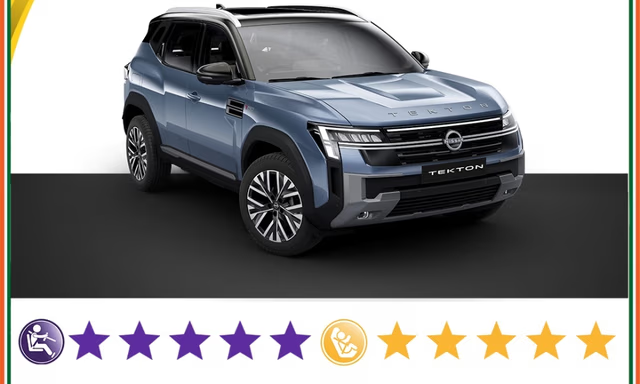 car&bike Team | Jul 9, 2026Nissan Tekton Bags 5 Stars In Bharat NCAP Crash TestsThe Tekton has essentially carried over its sibling Duster’s rating, since it shares its platform and body structure with the latter.2 mins read
 Jaiveer Mehra | Jul 9, 2026Nissan Tekton Price, Variants ExplainedThe Tekton is offered with two turbo-petrol engine options and in six variants.3 mins read
 car&bike Team | Jul 9, 2026Nissan Tekton: In PicturesOffered in six variants and two powertrain options, prices for the Nissan Tekton range between Rs 10.49 lakh and Rs 18.59 lakh (ex-showroom, introductory).3 mins read
 Jaiveer Mehra | Jul 9, 2026Nissan Tekton Makes Global Debut; Launched At Rs 10.49 LakhEssentially the sister model to the new Renault Duster, the Tekton shares much with its Renault sibling under the skin.3 mins read
 car&bike Team | Jul 9, 2026Nissan Tekton SUV India Debut Highlights: Exterior, Interior, Specifications, DetailsNissan will debut the Tekton in India today. Watch this space to get all the details firsthand.0 mins read
 car&bike Team | Jul 9, 2026Nissan Tekton SUV To Debut Today: What To ExpectBased on the Renault Duster, the Tekton gets its own design inside and out while sharing the same platform and engine options.3 mins read
 Seshan Vijayraghvan | Jul 7, 2026Tata Altroz Petrol DCA Long-Term Review: Intercity & Highway Driving ReportWe tested the Tata Altroz Petro DCA’s highway manners, intercity performance, and real-world fuel efficiency.1 min read
 Seshan Vijayraghvan | Jun 29, 2026Renault Kiger vs Toyota Urban Cruiser Taisor: Which Underdog Deserves Your Money?Both the Kiger and the Taisor promise strong performance, solid features, comfortable cabins and everyday usability, all without breaking the bank. But which of these underrated subcompact SUVs deserves your money? Let's find out.1 min read
 Seshan Vijayraghvan | Jun 29, 2026Skoda Kodiaq RS Review: The Best Kodiaq Yet?The Skoda Kodiaq RS is finally here, and it's every bit as exciting as I expected. But was it worth the wait?7 mins read
 Bilal Firfiray | Jun 28, 2026BMW X6 M60i Review: It’s Back And HOW!The BMW X6 M60i blends a 530bhp twin-turbo V8, with its unmistakable coupe-SUV styling. There’s plenty of character, but is it worth your money?6 mins read
 Janak Sorap | Jun 25, 2026350cc Bajaj Dominar 400 Review: Same Character, Lower PriceA slightly lower displacement engine, a significantly lower price tag and nearly the same performance — the Bajaj Dominar 400 aims to be smarter rather than faster.6 mins read