
Ford Endeavour Facelift Spotted Testing Undisguised

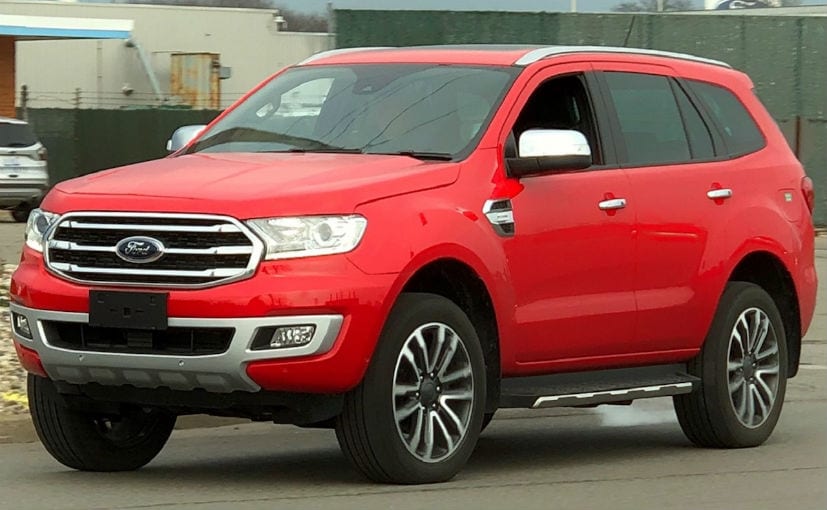
The Ford Endeavour facelift (known as Everest in other markets) is due to be launched later this year and new spy shots of the SUV have now emerged from the US. The 2018 Ford Endeavour was recently spotted in the US, near the automaker's research and engineering facilities in Dearborn, Michigan. Interestingly, the latest images reveal visual updates on the 2018 Endeavour. Without changing dramatically over the current model, the SUV gets a redesigned radiator grille, new silver frame for the lower intake.
The triple-slat chrome grille has been slightly reworked, while the test mule also features six-double spoke alloy wheels. The 2018 Ford Endeavour facelift is also expected to get new features with the update including keyless entry, engine start-stop button and engine auto start-stop function for improved fuel efficiency.
The current generation Ford Endeavour arrived globally in 2015 and arrived in India in 2016. The full-size SUV shared its underpinnings with the Ford Ranger pick-up based on the T6 platform, with the latter also set to underpin the next generation Ford Bronco SUV for the US. The new Endeavour was largely designed and engineered at Ford's R&D centre in Australia, and remains the company's popular offering across several Asian markets. Apart from the Endeavour, the Ford Ranger pick-up is also slated for an update internationally later this year.

(Changes to the exterior of the 2018 Ford Endeavour are subtle)
The current generation Ford Endeavour is offered with two diesel engines. The lower-spec 2.2-litre TDCI oil burner makes 163 bhp and 385 Nm of peak torque, while the top-spec trims get the 3.2-litre TDCi engine with 198 bhp and 470 Nm of peak torque. The 2.2 diesel is expected to get a power cut with the facelift, while the 3.2 unit will remain unchanged.
Reports also suggest that Ford will be introducing the 2.0-litre diesel motor on the Endeavour with the facelift that produces 178 bhp and 420 Nm of torque. There will be a new 2.0-litre twin turbo diesel motor as well with 210 bhp and 500 Nm of peak torque. Transmission choices will include a new 10-speed automatic unit on the 2018 Ford Endeavour facelift. The model is currently available with a 6-speed automatic gearbox in India.
The Ford Endeavour facelift appears to be launch ready and is likely to go on sale in Thailand first over the next few weeks. Ford India could bring the updated Endeavour to India towards the end of this year or by early 2019, with the SUV completing three years in the country. The SUV competes with the Toyota Fortuner, Skoda Kodiaq, Isuzu MU-X and the likes in the segment.
Images Source: The Drive
Related News
Latest Cars


Upcoming Cars


Latest News


 car&bike Team | Nov 11, 2026RTI vs Zero Depreciation: Which Car Insurance Cover Pays More?Return to Invoice (RTI) covers the gap between your car's current IDV (Insured Declared Value) and the original invoice value in case of theft or total loss. Zero Depreciation reduces deductions on replaced parts during accident repairs.1 min read
 car&bike Team | Nov 11, 2026Engine Protection vs Zero Depreciation: What's The Difference?Zero Depreciation reduces your share of accident repair costs, while Engine Protection covers certain engine and gearbox damage caused by water ingress or oil leakage.1 min read
 car&bike Team | Nov 11, 20262027 Hyundai Creta Interior Spied For The First TimeThe next-generation Creta's cabin gets a complete overhaul with a larger screen, a new steering wheel and more.2 mins read
 Amaan Ahmed | Nov 11, 2026'Fun' In Focus: How Honda Is Building ADV 160, Rebel 300 At Its Oldest India PlantFrom rolling out the first Activa, Honda's Manesar facility -- which marked its 25th anniversary this year -- is now primed to build the company's most exciting new products in years.1 min read
 car&bike Team | Nov 11, 2026Genesis GV90 SUV Design Patented In IndiaThe Genesis GV90's design has been patented in India just months after its global debut.1 min read
 car&bike Team | Nov 10, 20263.3 kW Vs 7.2 kW Vs 11 kW EV Chargers: Which Do You Need?Choosing a home EV charger depends on your car, daily driving and home power supply. A 3.3 kW charger works for smaller EVs, while 7.2 kW suits most mid-size electric cars. An 11 kW charger is meant for larger EVs that support three-phase charging.1 min read