
Logistics Giants Hedge Their Bets In Uncertain U.S. Self-Driving Truck Race


U.S. self-driving truck companies have a golden opportunity in the form of a nationwide driver shortage, but their robot drivers still are not ready and neither are their biggest potential customers.
The uncertainties surrounding autonomous trucking come at a critical time for the U.S. trucking industry, which faces a record shortage of 80,000 drivers as demand for online shopping and rapid delivery times is straining supply chains.
Private investors, who have so far poured nearly $9 billion into U.S. AV trucking companies according to data from Pitchbook, are hoping that self-driving trucks eventually catch on. Among the companies developing the technology are TuSimple Holdings Inc, Aurora Innovation Inc, Embark Technology Inc and Alphabet Inc's Waymo.
But large logistics companies, who represent the tech startups' coveted future customers, are in no rush to sign big contracts. They continue to test the technology of multiple providers in limited partnerships.
"Everybody is at a point where they're hedging their bets," said Eric Fuller, the Chief Executive of US Xpress Enterprises Inc, a carrier and trucking brokerage that manages 6,000 of its own tractors.

The company has announced partnerships with TuSimple and Aurora. Fuller, who also sits on TuSimple's advisory board, said US Xpress was working with all the other AV companies, but had yet to announce more partnerships.
The companies say they have developed technology that can safely pilot a 33,000 pound (15,000 kg) truck down a busy highway and are pushing toward commercial launches.
They provide the sensors and software, and some have partnered with truck manufacturers to incorporate their technology at the assembly line, but all rely on large logistics companies to pay for their offering.
The U.S. Southwest, primarily Texas and Arizona, where weather and regulations are favorable, has emerged as the testing ground for heavy-duty autonomous vehicle (AV) companies.
Large logistics groups such as DHL, United Parcel Service Inc and Ryder System Inc have launched pilot programs with several autonomous trucking companies.
But logistics giants also say they are still in the early stages of exploring the technology and are waiting to see which startups have the team, capital and network to survive and prove self-driving to be feasible on a large scale.
'SHAKING THINGS OUT'
While much attention has been focused on self-driving taxis, industry experts increasingly bet on driverless trucks to be the first autonomous vehicles to generate meaningful revenue due to the less complex driving environment in which they operate.
Making a meaningful dent in the U.S. market of 2.3 million trucks will take time, however, and industry experts project no more than a few hundred-thousand autonomous trucks over the next decade.
Logistics companies hope robo-trucks will one day take over monotonous long-haul tours, but not replace existing jobs.
Human drivers will prefer to spend more time on shorter, complex routes near their homes - routes that are still too difficult for self-driving technology.
Pitchbook analysts expect the global AV trucking market to balloon from around $530 million in 2023 to $167 billion in 2035.
"There's still opportunity for more players. We're not at a point where we're shaking things out," Jim Monkmeyer, president for transportation at DHL Supply Chain, said during a February visit to TuSimple's testing facility in Tucson, Arizona.
DHL Supply Chain, which operates some 1,500 trucks and manages around $3 billion of annual North American freight spend, has so far partnered with TuSimple and Embark and put in reservations for future trucks with both companies. Those orders are slated to be fulfilled in 2024.
Monkmeyer said DHL had contracted with multiple providers to reduce its risks, but added that placing truck reservations early was crucial in order to be among the first to explore the new technology.
Monkmeyer and his logistics colleagues say self-driving trucks offer the potential to increase freight capacity and reduce cost, with robots, unlike humans, not subject to a mandatory 11-hour daily driving limit.
LOWER COSTS
But the economics pan out only once the driver is out of the cabin.
So far, only TuSimple has removed its safety drivers in a handful of night-time trial runs along an 80-mile (130 km) stretch of highway between Tucson and Phoenix, Arizona.
The company is planning to present per-mile cost calculations in the next few months, Cheng Lu, TuSimple's former CEO, said in late February, just days before the company replaced him in a surprise move.
"Your cost has to either be lower than what today's costs are, or there is a clear line of sight to be lower," said Lu, who now serves as an adviser to the new CEO.
Drivers account for more than 40% of per-mile costs, according to data by the American Transportation Research Institute.
For a related graphic on Drivers and fuel account for bulk of trucking costs, click https://tmsnrt.rs/3CSvvmk
Graphic on current per-mile trucking costs: https://tmsnrt.rs/3ulCdyo
Autonomous driving could halve driver costs, with the companies planning to charge between 35 and 45 cents in per-mile subscription fees, according to two industry experts.
But the companies, three of them publicly listed, are far from generating meaningful revenue, let alone profit. Embark recorded a 2021 net loss of $124 million, TuSimple had a loss of $411 million and Aurora lost $755 million.
For the logistics partners, access to sufficient capital is crucial when determining whom to partner with, DHL's Monkmeyer and US Xpress' Fuller said.
TuSimple said it ended 2021 with some $1.3 billion left in cash, Aurora with $1.6 billion.
But the companies also confront other real-world hurdles as they try to release their technology on a larger scale.
Ryder, which operates nearly 240,000 trucks and around 800 U.S. maintenance locations, has partnered with TuSimple, Waymo and Embark to explore how self-driving trucks would fit into its network.
The logistics company wants to understand how to service the host of lidar, radar and camera sensors and whether trucks operating around the clock require different maintenance schedules.
In the long run, the tech companies also had to tackle more challenging driving conditions, such as snow, said Ryder's head of new product development, Karen Jones.
"I can't just run an autonomous business in the Southwest and Southeast, you have to figure out how to get to the Northeast," she said.
(Reporting by Tina Bellon in Tucson, Ariz.; Editing by Matthew Lewis)
(This story has not been edited by NDTV staff and is auto-generated from a syndicated feed.)
Related News


Latest Cars


Upcoming Cars


Latest News


 car&bike Team | Jun 30, 2026Delhi EV Policy 2.0: New Petrol Two-Wheeler Registration Banned in Delhi from April 2028With Delhi's new EV policy approved, new financial incentives for buyers will be introduced while setting a clear roadmap towards an all-electric future for new vehicle registrations.1 min read
 car&bike Team | Jun 30, 2026Tata Sierra EV: Variants, Features, Prices ExplainedThe Sierra EV is offered in six variants and two battery pack options.1 min read
 Hansaj Kukreti | Jun 30, 20262026 Tata Sierra EV: In PicturesThe much-awaited Tata Sierra has finally been launched in its all-electric avatar. Let's take a closer look at it.3 mins read
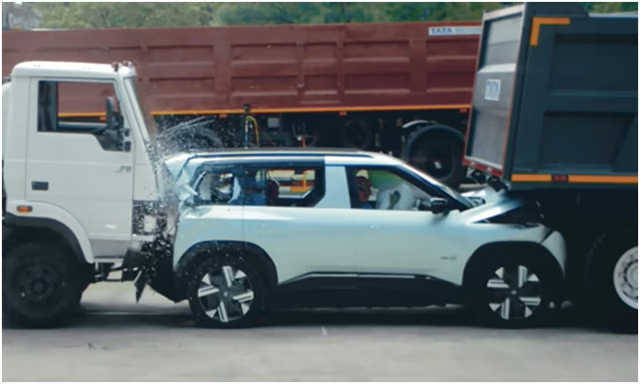 Amaan Ahmed | Jun 30, 2026Tata Sierra EV Sandwiched Between Two Trucks In Novel Crash Test: Watch VideoNobody saw Tata's latest crash test coming -- not even the Sierra EV it was conducted on2 mins read
 Jaiveer Mehra | Jun 30, 2026Tata Sierra EV Launched In India At Rs 18.79 Lakh: 5 Variants, 63 & 75 kWh Battery Options, 500+ km RangeElectric derivative of the Sierra is based on the Acti.ev+ platform and is offers over 500 km of range in real-world use.4 mins read
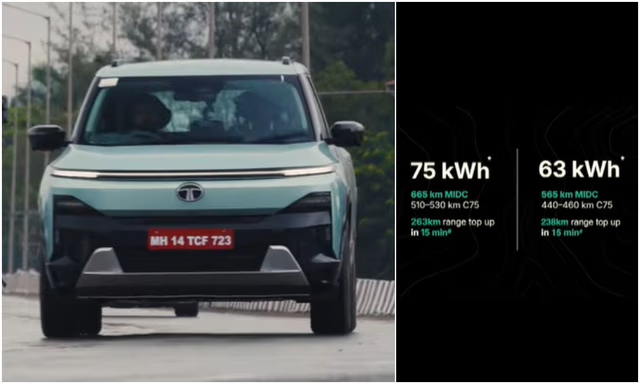 Amaan Ahmed | Jun 30, 2026Tata Sierra EV Real-World (C75) Range Figures RevealedUnlike what you may have seen on social media in recent days, the Sierra EV will not cover 700 kilometres, not even on the forgiving Indian Driving Cycle test2 mins read
 Seshan Vijayraghvan | Jun 29, 2026Renault Kiger vs Toyota Urban Cruiser Taisor: Which Underdog Deserves Your Money?Both the Kiger and the Taisor promise strong performance, solid features, comfortable cabins and everyday usability, all without breaking the bank. But which of these underrated subcompact SUVs deserves your money? Let's find out.1 min read
 Seshan Vijayraghvan | Jun 29, 2026Skoda Kodiaq RS Review: The Best Kodiaq Yet?The Skoda Kodiaq RS is finally here, and it's every bit as exciting as I expected. But was it worth the wait?7 mins read
 Bilal Firfiray | Jun 28, 2026BMW X6 M60i Review: It’s Back And HOW!The BMW X6 M60i blends a 530bhp twin-turbo V8, with its unmistakable coupe-SUV styling. There’s plenty of character, but is it worth your money?6 mins read
 Janak Sorap | Jun 25, 2026350cc Bajaj Dominar 400 Review: Same Character, Lower PriceA slightly lower displacement engine, a significantly lower price tag and nearly the same performance — the Bajaj Dominar 400 aims to be smarter rather than faster.6 mins read
 Preetam Bora | Jun 25, 20262026 Bajaj Pulsar NS400Z First Ride Review: Smaller Engine, But Should You Buy It?The Bajaj Pulsar NS400Z won our Two-Wheeler Upgrade of the Year. Then new tax slabs happened. Smaller engine, same badge – but does it still deliver?6 mins read