
What Exactly is E85 Fuel? A Complete Breakdown Of India's New Rs. 82/Litre Petrol Alternative

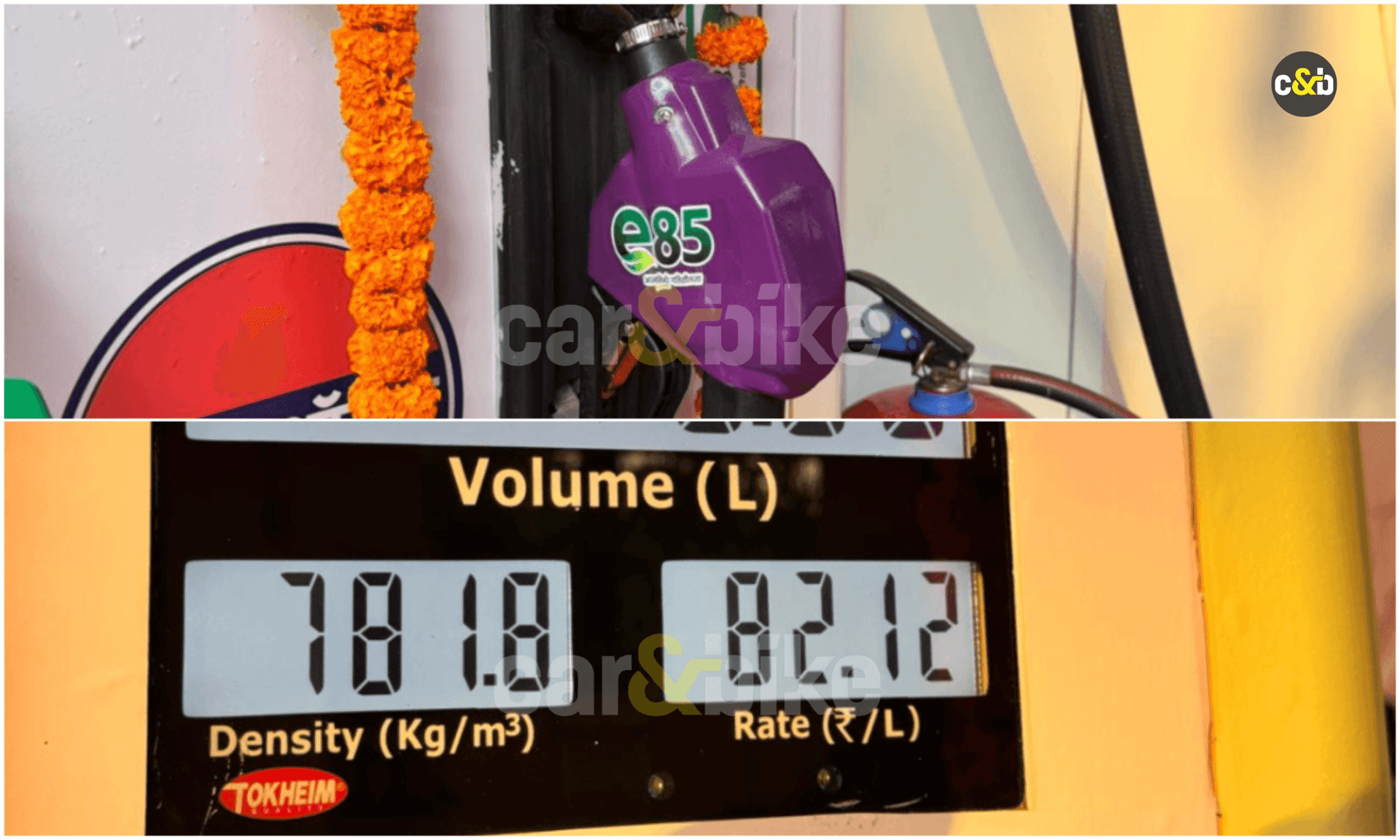
- E85 fuel is a mixture of approximately 85% ethanol and 15% petrol
- At around Rs. 82 per litre, E85 is about 20% cheaper than regular petrol
- Only flex-fuel vehicles are built to safely operate on E85 without the risk of engine damage
The fuel options in India are getting more and more varied. Ethanol fuels are now receiving more attention in addition to petrol, diesel, CNG, hybrids and electric vehicles. The newest addition is E85, a fuel mix with a much higher ethanol concentration than the E20 petrol that is available in most parts of the country.
Also Read: E85 Fuel Priced At Rs 82.12 Per Litre In Delhi; First E85 Station Inaugurated
On the surface, E85 seems like a great deal, since it is cheaper than normal petrol, it is good for the local farming industry and it is a way of reducing oil imports. However, the question of whether E85 is a good option for Indian drivers depends on a variety of factors, including fuel economy, vehicle compatibility, infrastructure, and long-term ownership.
It's important to know what E85 is and how it differs from the fuel that most cars use today before assuming it is just a cheaper version of petrol.
What Exactly Is E85 Fuel?
E85 is a fuel blend made up of approximately 85% ethanol and 15% petrol. Ethanol is an alcohol-based renewable fuel derived from crops and agricultural feedstocks like sugarcane, maize, damaged grains and agricultural residues. India is one of the biggest producers of sugarcane in the world, and ethanol has emerged as a significant component of the nation's future fuel supply.
The retail launch of E85 fuel in India started in June 2026, with the first E85 dispensing stations opened by IndianOil and a first network of public-sector fuel outlets providing E85 fuel for flex-fuel vehicles.
Compared to conventional petrol, E85 contains significantly more renewable content.
| Fuel Type | Typical Ethanol Content |
| Conventional Petrol (historically) | 0–10% |
| E10 | Up to 10% |
| E20 | Up to 20% |
| E85 | Approximately 80–85% |
This makes E85 one of the highest ethanol-content fuels currently being introduced for road vehicles in India.
Also Read: India Cuts Excise Duty On Petrol With 22%-30% Ethanol To Zero
Why Is E85 Priced Around Rs. 82 Per Litre?
One of the main reasons for E85 being in the spotlight is the price.
In many cities in India, petrol prices are still in the vicinity of or above Rs 100. The price of E85 is discussed at about Rs. 82 per litre for pilot initiatives and policy discussions.
That immediately brings up a question for the consumer:
Does E85 necessarily save on fuel costs if it is less expensive?
Not necessarily.
It's because petrol has more energy per litre than ethanol. Therefore, vehicles fueled with E85 typically use more fuel to cover the same distance. So, it’s important to know that this does not necessarily mean that lower fuel costs will result in proportionately lower running costs.
The actual savings depend on:
- Vehicle type
- Engine calibration
- Driving conditions
- Real-world fuel economy
That is why looking only at the price displayed on the fuel pump can be misleading.
Also Read: Maruti Suzuki Wagon R Flex Fuel Showcased In Delhi; Can Run On Pure Ethanol
Can Any Petrol Vehicle Use E85 Fuel?
No.
This is one of the most crucial facts that every vehicle owner should know. The majority of the petrol cars sold in India are E20 compatible and not E85.
E20 is compatible with vehicles that can use up to 20% ethanol, but E85 requires much different engineering.
Using E85 in a regular petrol vehicle can lead to:
- Fuel system damage
- Corrosion of components
- Deterioration of rubber seals and hoses
- Incorrect combustion
- Starting problems
- Long-term reliability issues
It may prove to be a costly error to simply fill an ordinary petrol car with E85 fuel just because it is cheaper.
Which Vehicles Can Run on E85 Fuel in India?
Today, E85-compatible vehicles still constitute a small fraction of the Indian market, but manufacturers are starting to introduce flex-fuel vehicles and the government is pushing for wider adoption.
There are already a number of manufacturers who have launched or demoed flex-fuel products in India. Hero MotoCorp has introduced commuter motorcycles like Hero Splendor+ Flex Fuel and Hero HF Deluxe Flex Fuel that are capable of running on E85 fuel. Maruti Suzuki has also just unveiled the Maruti Suzuki WagonR Flex Fuel. As the supporting fuel network grows, other manufacturers have also shown flex-fuel vehicle programmes.
At this time, it is not safe to assume that most of the vehicles on Indian roads are E85 compatible unless specifically labelled as such by the manufacturer.
Also Read: Hero Splendor Plus Flex Fuel, HF Deluxe Flex Fuel Launched In Delhi And Maharashtra
E85 vs Petrol: What Is the Difference?
Although both fuels can power internal combustion engines, they differ in several important ways.
| Factor | Petrol | E85 |
| Ethanol Content | Low | Very High |
| Fuel Price | Higher | Lower |
| Energy Density | Higher | Lower |
| Fuel Economy | Better | Typically Lower |
| Vehicle Compatibility | Universal | Flex-Fuel Vehicles Only |
| Renewable Content | Limited | High |
The lower E85 pump price is appealing, but there are some factors to consider, such as compatibility and fuel economy.
Advantages and Disadvantages of E85 Fuel
While E85 offers several long-term benefits, particularly from an energy security and sustainability perspective, it is not without compromises.
| Pros of E85 Fuel | Cons of E85 Fuel |
| Lower fuel price compared to regular petrol | Most existing petrol vehicles cannot use E85 safely |
| Reduces dependence on imported crude oil | Lower fuel economy than petrol |
| Supports Indian farmers and domestic ethanol production | Limited availability of E85 fuel stations |
| Higher renewable fuel content | Requires dedicated flex-fuel vehicle technology |
| Potentially lower carbon emissions | Cost savings may not always be significant in real-world use |
| Helps diversify India's fuel ecosystem | Nationwide infrastructure is still developing |
In today's India, the most challenging aspect for many drivers is not the fuel itself but whether their vehicle can safely handle the fuel. Many of these restrictions may become less important as flex-fuel vehicles and E85 fueling stations increase in use.
Will E85 Fuel Become Common in India?
The answer is dependent on two factors:
- Flex-fuel vehicle adoption
- Fuel station expansion
Over the next few years, ethanol-blended fuels may be much more prevalent if manufacturers start producing more E85-capable vehicles.
With the government continuing to focus on ethanol blending, it's clear that E85 is not an experiment. Rather, it is a part of a comprehensive plan for diversifying the fuel mix of transportation in India.
But it will take a while before it becomes widespread use. E85 infrastructure won't be built all at once, as with EV charging networks.
Related News


Latest Cars


Upcoming Cars


Latest News


 car&bike Team | Jun 18, 2026Kia Cars To Get Costlier From July 1: Prices Up By Up To 2%Come July 1, 2026, all Kia cars sold in India will become dearer by up to 2 per cent.1 min read
 car&bike Team | Jun 18, 2026Bajaj Pulsar 220F Updated With LED Headlight: Now Priced At Rs 1.36 LakhThe update is accompanied by a price increase of around Rs 8,000, taking the ex-showroom price to Rs 1.36 lakh.2 mins read
 car&bike Team | Jun 18, 2026India-UK FTA To Come Into Effect On July 15; Auto Import Duties To Fall To 10% Under Quota SystemDuties on some internal-combustion passenger vehicles will gradually fall to 10 per cent over five years. Jaguar Land Rover and McLaren have already given us an indication of price revisions.1 min read
 Bilal Firfiray | Jun 17, 2026Porsche 911 GT3 Launched In India At Rs 3.32 CroreConfigurator for the new-gen GT3 has gone live for a base price of Rs 3,32,60,000 without any optional extra.1 min read
 car&bike Team | Jun 17, 2026New-Gen Bajaj Pulsar Spotted Testing; N125 Or Pulsar 125?Two heavily camouflaged Bajaj Pulsar test mules have been spotted testing, revealing what seems to be a substantially reworked motorcycle.2 mins read
 Jaiveer Mehra | Jun 17, 2026JLR Eyes US-Specific Defender Models In Partnership With StellantisThe carmaker also said it will reveal new details on the upcoming Electrified Modular Architecture-underpinned Range Rover SUV (sub Range Rover Sport) later in the year.3 mins read
 Preetam Bora | Jun 15, 20262026 Yezdi Scrambler Review: The Update That Changes EverythingThe Yezdi Scrambler gets a comprehensive update with an updated engine, revised chassis, reduced weight and proper features list. Does it deliver? Here’s our take.10 mins read
 Preetam Bora | Jun 10, 20262026 BMW F 450 GS Review: A True GS - But Should You Buy It?The GS badge on a BMW means something and always has. Can the new made-in-India BMW F 450 GS truly live up to that legacy? We spent a few days getting familiar with the F 450 GS to see if it’s worth a buy.12 mins read
 Jaiveer Mehra | Jun 10, 20262026 Tata Altroz Long-Term Review: Initial Impressions After 45 DaysTata’s premium hatchback brings a lot to the table, but some rough edges are still apparent.4 mins read
 Seshan Vijayraghvan | Jun 9, 2026Renault Duster 1.0-Litre Turbo Review: Small Engine, More Than Enough PerformanceThe Renault Duster's TCe100 engine is the 1.0-litre turbo petrol that makes 99 bhp and 166 Nm of peak torque. And it only comes with a 6-speed manual.6 mins read
 Seshan Vijayraghvan | Jun 8, 20262026 Tata Tiago EV Review: Small EV Gets Big ImprovementsThe 2026 Tata Tiago EV promises a sharper design, segment-first features at sub-Rs. 10 lakh price point, and better real-world range. But does it deliver?1 min read