
Renault Duster 1.0-Litre Turbo Review: Small Engine, More Than Enough Performance
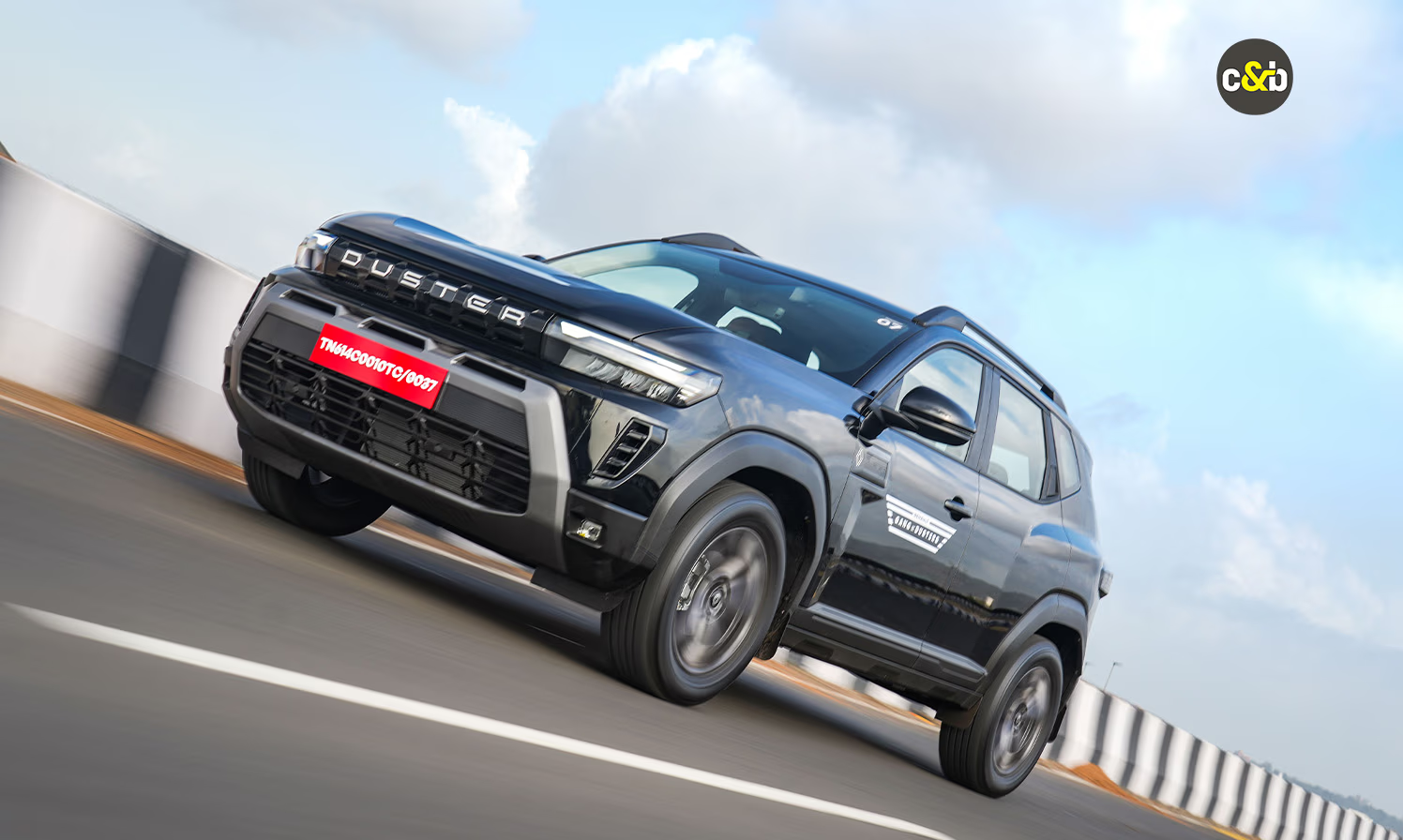
- The Duster TCe 100 is offered with 3 variants - Authentic, Evolution & Techno
- The 1.0-litre turbo petrol makes - 99 bhp and 166 Nm of peak torque
- In a nutshell, the Duster 1.0 Turbo doesn't feel like a compromise
When I first drove the new Renault Duster back in March, only the 1.3-litre version was available for us to test. I came away thoroughly impressed, so much so that I was sceptical about the smaller 1.0-litre engine offered on the lower variants. I feared it would feel underpowered and dilute the Duster's character. But after spending a day with the Duster TCe100, I'm happy to admit I was wrong.
In fact, that's the short review. But if you'd like to know why, read on.
Powertrain & Performance
Let’s start with the meat of the matter. The Duster TCe100 is powered by the same 1.0-litre, three-cylinder turbocharged petrol engine that powers the Kiger, Renault’s sub-4-metre SUV. So, you can imagine the scepticism I had going into this drive. But it didn't take long for the engine to prove me wrong.
Also Read: 2026 Renault Duster Review: The Hero Returns, But Does He Deliver?
Right from the get-go, it felt punchy and eager. On paper, the output stands at 99 bhp, which is about 63 bhp down on the 1.3-litre motor. Having said that, Renault has tuned the engine well, ensuring that a large chunk of its performance is accessible across most of the rev range. This means it has a strong mid-range and decent top-end.
Compared to the Kiger, you also get an extra 6 Nm of torque here, taking the total twisting force to 166 Nm. That translates into stronger low-end performance and better drivability in everyday conditions. Yes, there is still some turbo lag, but it's better controlled than in the Kiger, thanks to the revised engine management system.
My only complaint is refinement. It’s still a three-cylinder motor, so you have that characteristic hum in the background, and under hard acceleration, the engine does get quite noisy. You can also feel the engine vibrations inside the cabin. Renault needs to improve the NVH on this one.
Also Read: Renault Duster 1.3 Turbo DCT Road Test Review: The Solid Middle Ground
Transmission
Now, the model I am driving is the mid-spec Techno trim, and this engine is also offered with the lower two trims – Emotion and Evolution. However, no matter which one of these you get, you will only get the option for a manual gearbox. Now there is a silver lining here, though. It’s not the 5-speed unit from the Kiger, but rather the 6-speed gearbox that’s also offered with the Duster 1.3 Turbo.
It’s actually a very nice gearbox to use. The shifts are clean, the clutch is light, and even after spending hours behind the wheel, it never feels tiring. I also like the short, premium-looking gear lever, which adds to the overall driving experience.
That said, the lower gears are quite short. So in city traffic, especially in stop-go conditions, you’ll find yourself shifting between first, second, and third quite often. If you enjoy driving manuals, that won’t be a problem. But if you’re looking for convenience, it can get a bit tedious.
Which brings me to my second big gripe - there’s no automatic option with the 1.0-litre turbo engine. The Kiger offers a CVT with this motor, but the Duster doesn’t. And honestly, that feels like a missed opportunity. Especially when Renault itself says automatics are becoming increasingly popular in this segment, and a significant chunk of Duster buyers opt for the automatic with the larger turbo engine.
So Renault, if you’re listening, the 1.0-litre turbo really deserves an automatic gearbox.
Fuel Efficiency
Now, Renault has claimed that the Duster 1.0 Turbo can deliver an ARAI-tested fuel efficiency of 19.41 kmpl. Now, I did not get a chance to test that claim during this drive, so that’s a job for some other day. However, I would safely expect the engine to return a realistic mileage of around 13 kmpl.
Also Read: Renault Duster Turbo DCT Real-World Fuel Efficiency Tested
Styling & Features
Now, as I mentioned earlier, the car we drove was the mid-spec Techno variant, and visually, you’re not missing out on much. You still get the LED headlamps, LED DRLs, LED fog lamps, and of course, that bold Duster grille.
The main difference is the set of 17-inch gunmetal-finished alloy wheels, instead of the larger 18-inch wheels on the top-spec trim. And honestly, I prefer this look. It feels a bit more understated and rugged.
You also miss out on the body decals, and the roof rails don’t get the ‘Duster’ branding. But importantly, they remain fully functional, and that’s enough for me.
The cabin is a different story. Instead of the Jade Green trim and matching leatherette upholstery, the Techno trim offers brown and black interior. The seats are wrapped in matching fabric upholstery, and the front two seats offer manual adjustment. Frankly, neither of them is a deal-breaker for me. Because the seat bolstering is good, and you also get a central armrest with storage.
The Techno trim also comes with a 10.1-inch touchscreen with wireless Android Auto and Apple CarPlay. Creature comforts also include dual-zone auto climate control, wireless phone charging and a panoramic sunroof. All things that actually matter. That said, I did miss the ventilated front seats, but for the price, that’s a compromise I am willing to make.
Safety
In terms of safety, the Techno variant doesn't really feel stripped down. You still get all the key safety features as standard, including six airbags, ABS with EBD and Brake Assist, Electronic Stability Control, ISOFIX mounts, seatbelt reminders for all passengers, and a rear-view camera.
That said, the rear-view camera itself could be better. The image quality feels average at best, and the viewing angle seems a bit odd, often making me rely more on the ORVMs while parking. It's not a deal-breaker, but it's definitely an area Renault should improve.
Price & Verdict
For me, the pick of the range is the Techno variant. The 1.0-litre TCe 100 engine is available in three trims — Authentic, Evolution and Techno — priced at Rs. 10.49 lakh, Rs. 11.69 lakh and Rs. 13.49 lakh (ex-showroom), respectively. And at that price, the Techno offers the best mix of looks, features and value.
Renault has also done a good job of making this 1.0-litre turbo-petrol engine feel like a genuine alternative to the larger motor. It offers enough performance for daily commutes, sufficient grunt for highway drives, and comes paired with a manual gearbox that is genuinely enjoyable to use. The only thing missing is an automatic option, which would make the package even more compelling.
So, in a nutshell, the Duster 1.0 Turbo doesn't feel like the compromise choice. If you're considering it over the 1.3-litre engine because of budget or efficiency concerns, you're still getting a capable, practical and enjoyable SUV that should satisfy most buyers.
Photos: Vaibhav Dhanawade
Related News


Learn more about


Popular Models


Latest Cars


Upcoming Cars


Latest News


 car&bike Team | Sep 9, 2026Royal Enfield Himalayan 440 vs Himalayan 411: Differences ExplainedThe OG Royal Enfield Himalayan has made a comeback with a bigger 443 cc engine and a six-speed gearbox, but with the same silhouette and proportions as the Himalayan 411. How different is the new Himalayan 440?5 mins read
 Sarthak Mahajan | Sep 8, 2026Porsche Cayenne Electric India Launch On September 30: All You Need To KnowIt will be offered with a 113 kWh battery paired with two electric motors, with the Turbo Electric model producing up to 1,140 bhp and 1,150 Nm of peak torque.1 min read
 car&bike Team | Sep 8, 2026Royal Enfield Himalayan 440: Top Five HighlightsWith the launch of the Himalayan 440 here are the top five highlights of the motorcycle.1 min read
 car&bike Team | Sep 8, 2026Kinetic DX+ Electric Scooter Gets 3.1 kWh Battery, 132 km RangeThe upgraded Kinetic DX+ gets a larger LFP battery, 3.8 kW motor and features such as Park Assist, Reverse and regenerative braking.1 min read
 Jaiveer Mehra | Sep 8, 2026Next-Gen Kwid EV Arrives In Europe As All-New Dacia Spring EVSecond-gen city car is underpinned by the Renault Group’s RGEV Small platform and offers up to 250 km of range.3 mins read
 car&bike Team | Sep 8, 2026MT Thunder 4 SV Helmet Launched In India At Rs 13,699; Gets 5-Star SHARP RatingReiseMoto has launched the MT Thunder 4 SV full-face helmet in India, priced from Rs 13,699, with ECE 22.06, DOT and ISI certifications along with a five-star SHARP safety rating.1 min read
 Shams Raza Naqvi | Sep 8, 20262026 Maruti Suzuki Baleno Review: Heart Matters, Or Does It?The updated Maruti Suzuki Baleno is here and it gets some significant changes some of which have got the opinion divided. We drive it.7 mins read
 Abhishek Nigam | Sep 7, 2026Simple Wave First Ride Review: Space, Pace And More SpaceThe Simple Wave is here to rewrite the rules of the family EV scooter segment. We scoot around to tell you whether it will create waves or not!7 mins read
 Janak Sorap | Sep 4, 20262026 Ducati Monster V2 Review: Raising The BarWith the fifth iteration, the Ducati Monster gets a lighter chassis, a new 890cc V2 engine, sophisticated electronics and tweaks to the suspension, all to make the 2026 version so compelling.7 mins read
 Shams Raza Naqvi | Sep 4, 20262026 Lexus ES 350h And Lexus ES 500e Review: Luxury Meets CapabilityWe got behind the wheels of the new Lexus ES twins which were launched in India earlier this year. Which one suits you more? Lets find out1 min read
 Amaan Ahmed | Sep 2, 2026Konarc Is The Rizta That Works For Everyone -- Including Ather Energy | FIRST RIDE REVIEWFor the slow-but-sure Ather, the Rizta was the foot in the door -- the similarly-capable Konarc, purpose-built to win over every Indian family, is built to kick that very door down.10 mins read