
How Automatic Emergency Braking Works

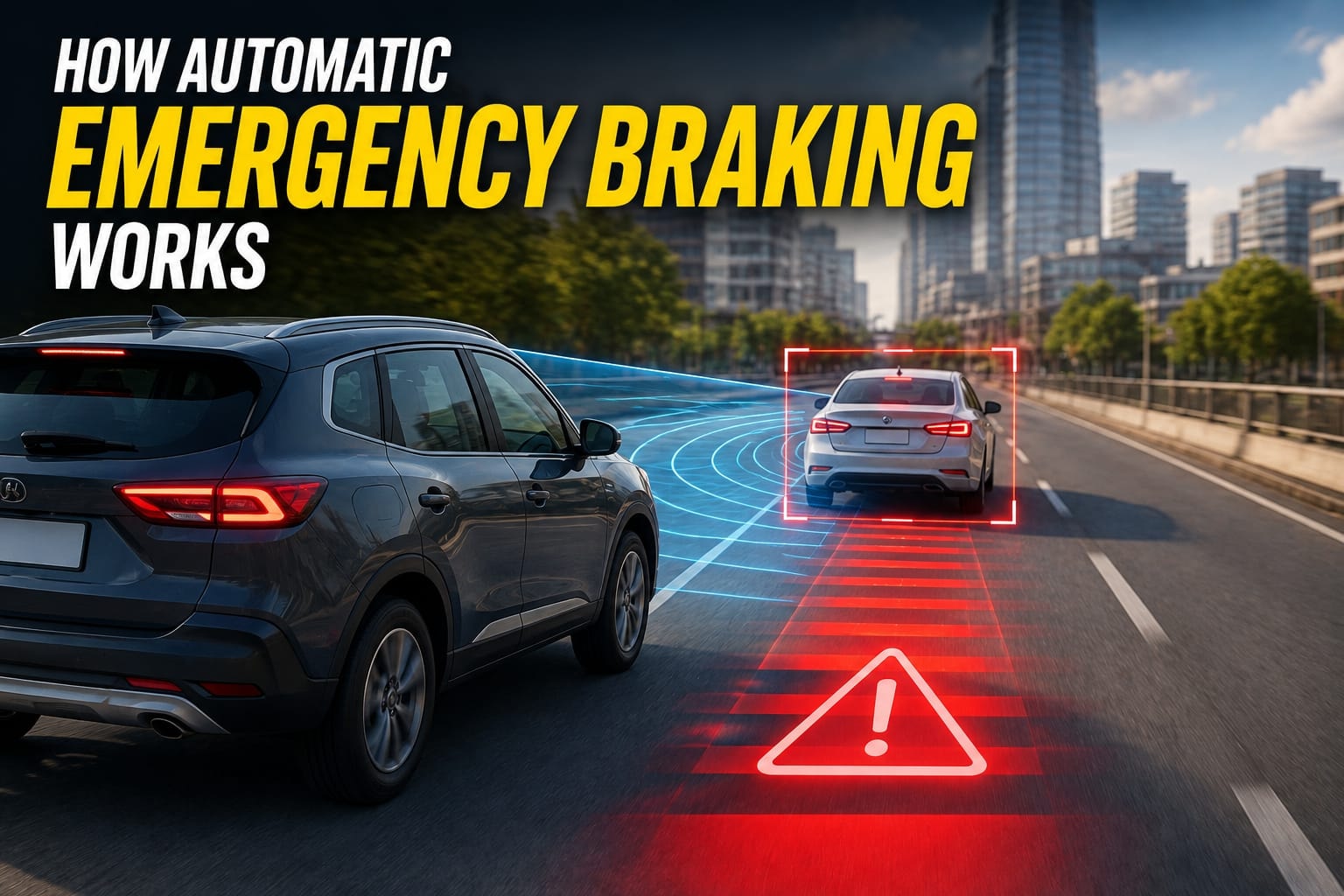
- AEB uses cameras, radar or both to detect potential collisions
- It can warn the driver and automatically apply the brakes
- AEB is a safety aid, not a replacement for an attentive driver
Introduction
Automatic Emergency Braking, or AEB, is one of the most useful safety features nowadays, making its way into many cars in India. It is designed to help prevent a crash, or at least reduce its severity, when the driver cannot react in time. But how does it actually work? And can it bring a car to a complete stop? Here is a simple explanation.
What Is Automatic Emergency Braking?
Automatic Emergency Braking is an active safety system that monitors the road ahead and looks for obstacles that could possibly result in a collision. If and when the system detects a potential crash and at the same time concludes that the driver has not taken corrective action, it can first warn the driver and then automatically apply the brakes. AEB is one of the most crucial features of the new-age ADAS (Advanced Driver Assistance System) package that modern cars come equipped with.
How Does AEB Detect an Obstacle?
Depending on the car and the system it is using, a typical AEB can use a combination of cameras, radar, sensors or all of them together in a split-second time frame. A front-facing camera can identify objects such as cars, pedestrians, jaywalkers, animals, and cyclists or even any stationary object in front of the car.
The front-mounted radar can measure the distance and relative speed of objects ahead. Using this information, the car's computer continuously calculates whether the vehicle is approaching an obstacle too quickly. For example, if a car ahead suddenly brakes and you don't react quickly accordingly, and quickly enough, the AEB system can recognise the rapidly closing gap.
What Happens When AEB Detects a Crash?
AEB generally works in stages.
1. Monitoring The Road Ahead
The sensors continuously scan the area in front of the vehicle.
2. Identifies A Potential Collision
The system calculates the distance, speed and direction of an object.
3. Warns The Driver
If a collision appears likely, the car may issue a visual (on the MID) or audible (through the speakers) warning. Some cars may also provide a vibration through the steering wheel or brake pedal.
4. Applies The Brakes
If the driver still does not react, the system can automatically take over the responsibility of applying the brakes. Depending on the situation and vehicle, it may apply partial braking and let go. Or apply strong braking force to come to a complete halt.
Can AEB Stop the Car Completely?
Yes, most of the time. But it should not be treated as a guaranteed automatic stopping system that can be relied on instead of the driver doing the braking duties. Its effectiveness depends on several factors, including the vehicle's speed, the type and position of the obstacle, road conditions, visibility and the technology used by that particular car.AEB is primarily an emergency backup. The driver remains responsible for always controlling the vehicle.
Does AEB Work at All Speeds?
No, AEB does not work at All Speeds. Every AEB system has operating limits. Some systems are designed mainly for low-speed urban driving, while more advanced systems can operate at higher speeds. The exact speed range and objects that can be detected depend on the manufacturer and the specific ADAS system used.
What Are the Limitations of AEB?
Like any new technology, AEB is helpful but not foolproof. Heavy rain, fog, dirt covering sensors, poor visibility, and unusual road situations can affect its performance. AEB may also struggle with objects that are difficult for the system to identify or situations where another vehicle suddenly cuts across the car's path.
Indian traffic presents another challenge. Two-wheelers, pedestrians, animals, and vehicles often move unpredictably, so drivers should never rely entirely on AEB.
Thirdly, there’s also the risk of AEB bringing the vehicle to a sudden stop when it detects an obstacle. But the same car can be rear-ended by another road user who couldn’t brake in time to avoid a collision with a car that’s suddenly stopped on the road.
Is AEB Useful on Indian Roads?
Yes. Indian roads have a mix of cars, motorcycles, pedestrians, cyclists and other road users. A momentary distraction or delayed reaction can sometimes be enough to cause an accident. So AEB can act as a second line of defence when the driver fails to react quickly enough. However, it should be viewed as assistance rather than autonomous driving. The technology can support the driver, but it cannot replace the driver.
Conclusion
Automatic Emergency Braking is essentially a safety net. It watches the road, identifies a potential collision and can brake automatically when the driver does not respond quickly enough. It may prevent some low-speed crashes and can reduce the severity of others. But its capabilities vary from one car to another, apart from a million other factors.


Latest News


 Bilal Firfiray | Sep 24, 2026Seven-Seater Nissan Tekton Spied; Gets Distinct Headlamps And TaillampsAfter the debut of the Renault Duster seven-seater, the Nissan Tekton’s seven seater version will follow soon after.1 min read
 Sarthak Mahajan | Sep 24, 2026Indian Supercross Racing League Season 3 Provisional Calendar ConfirmedThe third season of the Indian Supercross Racing League (ISRL) will feature three race weekends between December 2026 and February 2027.1 min read
 car&bike Team | Sep 24, 2026Nissan Pixo Micro EV Unveiled: Gets Pixelated Styling, 259 km RangeThe Nissan Pixo shares its underpinnings with the Renault Twingo and wraps them in a much squarer, pixel-inspired design.2 mins read
 car&bike Team | Sep 24, 2026Bajaj Pulsar NS200, NS400Z TFT Variants Reach Dealerships Ahead Of LaunchBoth performance-focused Pulsars get Bajaj’s new 5-inch TFT display with connected features, while the NS200 also gets updated front suspension.1 min read
 Jafar Rizvi | Sep 24, 2026Bentley Torcal Revealed As Brand’s First EV With 600 Km RangeThe Torcal makes 875 bhp in its S Guise and goes from 0-100 kmph in 2.9 seconds.4 mins read
 Sarthak Mahajan | Sep 24, 2026Tata Aeris Launch Tomorrow: What To Expect?Tata Aeris will replace the Tata Tigor and is expected to bring a host of new features.3 mins read
 Bilal Firfiray | Sep 19, 2026MG Hector Tomahawk EV Review: Play It SafeMG’s new electric SUV has one of the coolest names ever, and the coolest temperament amongst its peers. But is it worth buying?7 mins read
 Preetam Bora | Sep 16, 2026Royal Enfield Himalayan 440 Review: Better Than the 450?The new Himalayan 440 with an upsized engine and gearbox has certainly improved as a touring machine and at an extremely attractive price of Rs. 2.29 Lakh. Is it the better Himalayan to choose for many riders?9 mins read
 Seshan Vijayraghvan | Sep 15, 2026BMW i5 LWB Review: Not The M60, This Is The Proper Electric 5 SeriesThe BMW i5 LWB takes the electric 5 Series formula and puts a stronger focus on rear-seat comfort and long-distance luxury. With a 669 km claimed range, 268 bhp and a more relaxed character, is this the i5 that makes the most sense for India?7 mins read
 Preetam Bora | Sep 14, 2026Ladakh Uncharted: Himalayan Basecamp Off-Road Ride ExperienceA day-long off-road excursion from Royal Enfield’s Himalayan Basecamp event in Ladakh, the Ladakh Uncharted ride by Alpinestars was all about re-discovery!6 mins read
 Janak Sorap | Sep 12, 2026New Bajaj Pulsar 125 First Ride Review: More Tech, Less Weight, Same Pulsar DNAThe new Bajaj Pulsar 125 retains the familiar Pulsar identity but gets a new engine, lighter construction, more features and a sharper riding experience.5 mins read