
ADAS vs Non-ADAS Cars: Is the Additional Cost Justified?

- ADAS is most useful on highways and long-distance drives
- City traffic in India limits the usefulness of some ADAS features
- ADAS cars usually cost more to repair after certain accidents
There was a time when ADAS (Advanced Driver Assistance Systems) was limited to expensive luxury cars. Today, you can find it on models like the Hyundai Verna, Honda City, Mahindra XUV 7XO, Tata Safari and several other mainstream cars. That also means buyers are facing a new question while choosing a variant. Is it worth spending extra for ADAS, or is a regular non-ADAS variant the smarter buy?
The answer is not the same for everyone. ADAS can genuinely improve safety, especially on highways, but many of its features are used far less often in everyday city driving. Understanding where it helps and where it has limitations can make that decision much easier.
What Is the Difference Between ADAS and Non-ADAS Cars?
The biggest difference comes down to who is responsible for spotting hazards.
In a non-ADAS car, the driver does everything. You judge traffic, maintain distance, brake, steer and react to sudden situations on your own.
An ADAS-equipped car adds another layer of assistance. Using cameras, radar sensors or both, it constantly monitors the road ahead and can warn the driver or even step in to avoid an accident in certain situations.
| Non-ADAS Car | ADAS Car |
| Driver handles everything | Assists the driver during certain situations |
| Manual braking | Can warn or brake automatically |
| Conventional cruise control (if available) | Adaptive Cruise Control |
| No lane assistance | Lane Departure Warning and Lane Keep Assist |
| Lower purchase price | Higher purchase price |
It's important to remember that ADAS is exactly what its name suggests: a driver assistance system, not a self-driving system. You still need to remain fully alert behind the wheel.
What Are You Actually Paying Extra For?
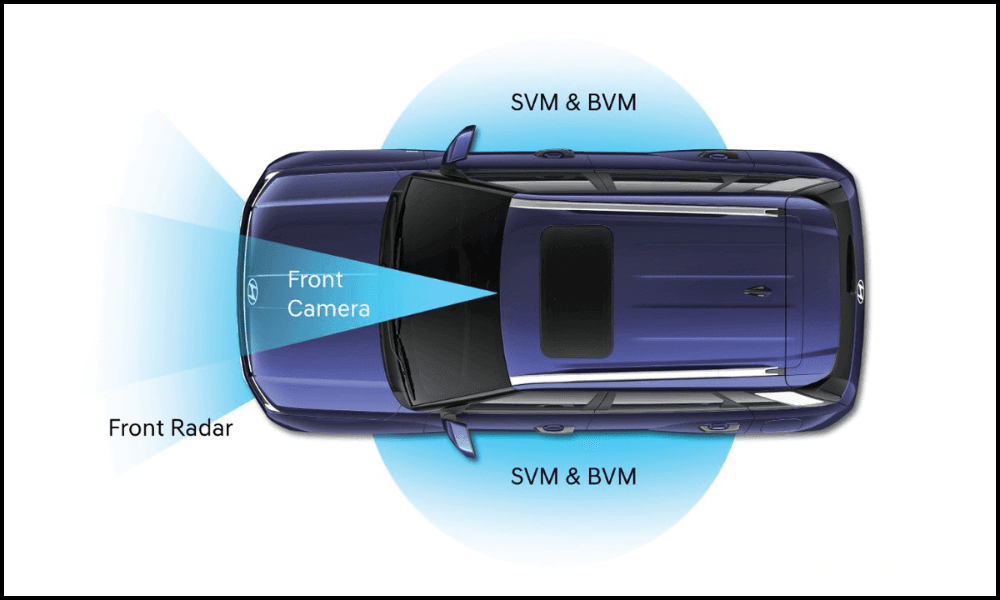
Depending on the car, ADAS can include several safety features that actively monitor your surroundings.
ADAS features on the Hyundai Venue.
Some of the most common ones include:
- Automatic Emergency Braking (AEB)
- Adaptive Cruise Control (ACC)
- Lane Keep Assist
- Lane Departure Warning
- Blind Spot Monitoring
- Forward Collision Warning
- Driver Attention Alert
- Rear Cross Traffic Alert
- Auto High Beam
Higher variants generally offer a more complete ADAS package known as ADAS Level 2 or Level 2+, while entry-level versions may only include a few of these features.
Does ADAS Actually Work Well in India?
Yes, but it depends on where you're driving. Most ADAS systems are designed around well-marked roads and predictable traffic. Indian roads can be far more unpredictable, especially inside cities.
Where ADAS Works Really Well
ADAS is at its best when road conditions are organised and traffic flows more predictably.
It can be particularly useful for:
- Long highway drives
- Expressways
- Night driving
- Long-distance touring
- Reducing driver fatigue
- Maintaining a safe following distance
Features like Adaptive Cruise Control can automatically maintain distance from the vehicle ahead, while Forward Collision Warning provides an extra layer of protection if your attention slips.
Where It Can Have Limitations
City driving presents a completely different challenge.
Indian traffic often involves:
- Auto-rickshaws cutting into small gaps
- Motorcycles filtering between vehicles
- Pedestrians crossing unexpectedly
- Unmarked roads
- Roadworks and temporary diversions
- Stray animals
- Potholes that require sudden steering inputs
In these situations, some ADAS features may become overly cautious or temporarily stop working if road markings aren't visible.
For example, Lane Keep Assist relies on clearly marked lanes. If there are no lane markings, the system may simply switch itself off until it can recognise them again.
Similarly, Automatic Emergency Braking may occasionally issue warnings in situations that experienced drivers would comfortably handle themselves. Because of this, some owners prefer adjusting or temporarily disabling certain ADAS functions while driving in dense city traffic.
Camera-Based vs Radar-Based ADAS: What's the Difference?
Not all ADAS systems work the same way.
Camera-Based ADAS
Some cars rely mainly on a camera mounted near the rear-view mirror.
It can identify:
- Lane markings
- Vehicles
- Pedestrians
- Traffic signs
These systems work well in normal conditions but may become less effective during heavy rain, thick fog or poor visibility.
Radar + Camera ADAS
More advanced systems combine a front camera with a radar sensor. The radar measures the distance and speed of vehicles ahead, while the camera identifies what those objects are. Together, they deliver more accurate results in difficult conditions such as rain, fog or at night. You'll generally find these systems on higher variants and more premium models.
When Is ADAS Worth Paying Extra?
For many buyers, the answer depends entirely on how they use their car.
ADAS Is Worth It If You:
- Frequently drive on highways
- Cover long distances every month
- Often travel at night
- Spend hours behind the wheel
- Want an extra layer of safety for your family
- Plan to keep the car for several years
If this sounds like your driving pattern, the additional cost can be well worth it.
You Can Skip ADAS If You:
- Mostly drive within the city
- Cover short daily commutes
- Rarely use highways
- Are working within a strict budget
- Prefer complete manual control
In these situations, spending the extra money on a higher trim with more comfort or convenience features may offer better value.
The Hidden Cost of Owning an ADAS Car
The purchase price isn't the only extra expense. Many ADAS components need recalibration or replacement after a collision. For example:
- Replacing a cracked windshield may require the front camera to be recalibrated.
- Repairing or replacing a front bumper may require a new radar sensor to be installed.
Suzuki Fronx ADAS tech testing by the ANCAP crash test agency.
This can be an added burden on the wallet as replacing tech such as radar sensors can get expensive, particularly if the manufacturer imports the parts. Even recalibrations can take up time and money, as it generally entails specialist work.
This doesn't mean ADAS is expensive to own, but it's something buyers should be aware of before making their decision.
So, Is the Extra Cost of ADAS Worth Paying?
There isn't a single answer that fits every buyer. If you regularly drive on highways, take long road trips or spend several hours behind the wheel, ADAS is a worthwhile investment. Features like Adaptive Cruise Control, Forward Collision Warning and Automatic Emergency Braking can reduce fatigue and provide an extra layer of safety when you need it most.
However, if your driving is limited to daily city commutes, school runs or short office trips, you'll use many of these features far less often. In that case, saving the money or choosing a better-equipped non-ADAS variant may be the more sensible decision.
At the end of the day, ADAS shouldn't be seen as a replacement for good driving. It's simply another safety tool that works best when combined with an alert and responsible driver.
Related News


Latest Cars


Upcoming Cars


Latest News


 car&bike Team | Sep 3, 2026Simple Wave Electric Scooter Full Prices Announced: 5 kWh Variant Priced At Rs 1.90 LakhThe Wave is offered with four battery pack options with prices starting at Rs 1.10 lakh (ex-showroom).2 mins read
 car&bike Team | Sep 3, 2026Kia Sorento India Launch Tomorrow: What To Expect?Prices for the Sorento SUV will be announced tomorrow along with India-spec details.2 mins read
 Jaiveer Mehra | Sep 3, 2026Tata Curvv Series X Launched At Rs 9.99 lakh; Variants, Powertrains ReshuffledUpdates to the powertrain include the deletion of a manual gearbox for the 1.2 Hyperion T-GDI engine; the top trim level is now available with an automatic gearbox only.3 mins read
 car&bike Team | Sep 2, 2026Simple Wave vs Ather Konarc: Battery, Range, Performance, Features ComparedThe Simple Wave packs more range, power and storage than the Ather Konarc, but Ather counters with a longer list of useful everyday features and a lower starting price.5 mins read
 Sarthak Mahajan | Sep 2, 2026Simple Wave: In PicturesSimple has launched the Wave at Rs 1.10 lakh, making it the brand’s most affordable electric scooter.3 mins read
 car&bike Team | Sep 2, 2026Simple Wave Electric Scooter Launched At Rs 1.10 Lakh; Up To 243 Km RangeSimple Energy has entered the family electric scooter segment with the new Wave, offered in six configurations with up to 243 km of claimed IDC range.2 mins read
 Amaan Ahmed | Sep 2, 2026Konarc Is The Rizta That Works For Everyone -- Including Ather Energy | FIRST RIDE REVIEWFor the slow-but-sure Ather, the Rizta was the foot in the door -- the similarly-capable Konarc, purpose-built to win over every Indian family, is built to kick that very door down.10 mins read
 Seshan Vijayraghvan | Sep 1, 2026Volvo EX90 Review: Understated Luxury Meets Electric PerformanceThe Volvo EX90 is a massive, fully electric luxury SUV that combines understated design, a tech-heavy cabin, plenty of comfort, and a capable electric powertrain. But does it get everything right?1 min read
 Preetam Bora | Aug 25, 20262026 Hero Xoom 160 Review: Maxi-mum Potential!With styling and proportions that goes into actual maxi-scooter territory, a liquid-cooled engine and large 14-inch wheels, the Hero Xoom 160 holds a lot of promise. But should you buy it?9 mins read
 Seshan Vijayraghvan | Aug 19, 20262026 BMW X1 Long-Wheelbase Review: Is This The X1 To Buy?Along with the extra rear legroom, the new BMW X1 LWB offers more features, more safety tech, and a more powerful petrol engine. But do these updates actually make it a better SUV?1 min read
 Janak Sorap | Aug 17, 2026Bajaj Pulsar N160 SS First Ride Review: The Most Tech-Loaded Pulsar Yet?The Bajaj Pulsar N160 SS brings more power, new-age electronics and sharper styling to the familiar 160cc Pulsar formula.5 mins read