
BSA Bantam 350 Vs Jawa 42 FJ: Differences Explained

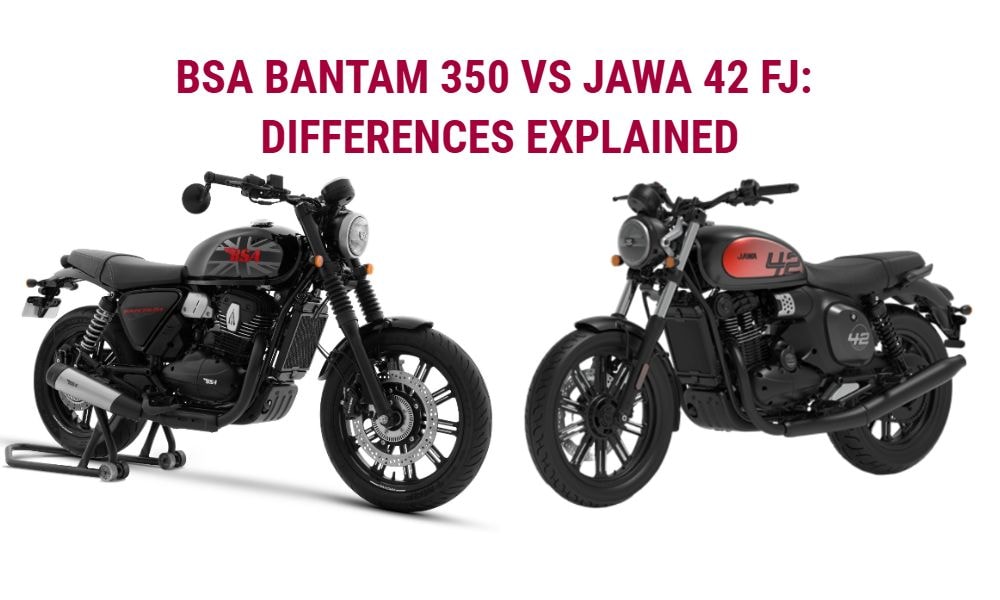
- - Both bikes are powered by the same 334 cc single-cylinder liquid-cooled mill
- - The Bantam is heavier by a kilogram compared to the 42 FJ
- - Currently BSA has no plans of launching the Bantam in India
BSA recently resurrected an iconic model from its history books that played a significant role post the Second World War, the legendary Bantam. And now, the hallowed name has made a comeback in a modern form christened the Bantam 350. Built on the same underpinnings as the Jawa 42 FJ sold in India, both brands are owned Classic Legends Pvt. Limited, which is primarily owned by Mahindra & Mahindra with majority stake and two external investors. Both machines are very similar to each other yet notably different too. While the 42 FJ is sold in India, the Bantam will be offered in European and other global markets. While mechanical similarities are plenty, there are subtle styling, ergonomic and market positioning that have a distinct differentiation. Here’s everything that is difference between the BSA Bantam 350 and Jawa 42 FJ.
BSA Bantam 350 Vs Jawa 42 FJ: Design and Styling
The first thing that differentiates both the motorcycle from each other is the styling. The Jawa 42 FJ follows a neo-retro design theme with a muscular teardrop-shaped fuel tank, twin exhausts, bold graphics, and a wide variety of the colour options in matte and gloss finishes. The BSA Bantam 350, on the other hand, adopts a more subtle British retro look packing a single-sided exhaust, sleeker bodywork, retro bar-end mirrors, minimalist tail lamp, minimalistic body panels and classic heritage cues tied to the iconic Bantam name. The contouring of the fuel tank and seat along with the size of the headlamp is slightly different compared to the Jawa. Lastly, BSA is offering the Bantam 350 in total of five colour options.
Also Read: BSA Scrambler 650 vs Gold Star 650: Differences Explained
BSA Bantam 350 Vs Jawa 42 FJ: Dimension and Weight
Closely matched in terms of dimensions and weight, the differences between the two are small yet present. The Jawa 42 FJ has a kerb weight of 184 kg, seat height of 790 mm, fuel tank capacity of 12 litres and a ground clearance that measures at 175 mm. In comparison to Jawa, the BSA Bantam 350 tips the scale at 185 kg kerb, a kilogram more than the 42 FJ, meanwhile, seat height measures 100 mm more at 800 mm and a slightly larger fuel tank capacity of 13 litres. Ground clearance for the Bantam 350 hasn’t been revealed but expect it to a marginally more than the 42 FJ.
BSA Bantam 350 Vs Jawa 42 FJ: Cycle Parts
Stripped down to the bare chassis and cycle parts, both bikes are fundamentally the same. Both are built using the same double-cradle chassis with suspension duties handled by a telescopic fork up front and dual rear shocks with 5-step preload adjustment. Notably, while the 42 FJ has a front suspension travel of 130 mm, the Bantam 350 offers 5 mm more at 135 mm. Rear suspension travel for both bikes is the same at 100 mm.
As for the brakes, both bikes come with a 320 mm disc up front and a 240 mm disc at the rear. Both bikes come equipped with dual-channel ABS. The motorcycles rides are 18-17 alloy wheel setup and while the first tyre profile is the same at 100/90-R18, the Bantam 350 get a slightly wide rear tyre. For reference, the 42 FJ rear tyre size is 140/70-R17 and on the Bantam 350 is 150/70-R17.
Also Read: BSA Bantam 350 Unveiled
BSA Bantam 350 Vs Jawa 42 FJ: Features
In the features department, both motorcycles feature a full-digital circular instrument console with tell-tale lamps located around the bezel. While the unit is mounted in an off-set format on the 42 FJ, it is centrally mounted on the Bantam 350. You get digital readouts for the speed, tachometer, fuel gauge, odometer, trip meter, service indicator and some more. Both motorcycle feature LED lighting for the headlamp and tail lamp, and a USB charging port.
BSA Bantam 350 Vs Jawa 42 FJ: Engine
On paper, both the BSA Bantam 350 and Jawa 42 FJ share the same powertrain, the 334 cc single-cylinder liquid-cooled Alpha-2 DOHC motor mated to a six-speed gearbox. In terms of power figures, there is marginal difference in the max power while peak torque is the same for both. The 42 FJ churns out 28.77 bhp and 29.62 Nm while the Bantam 350 puts out 29 bhp and 29.62 Nm.
Also Read: Jawa 42 FJ Review: ‘Simply The Best’ Jawa?
BSA Bantam 350 Vs Jawa 42 FJ: Price
Jawa currently sells the 42 FJ in India carrying a sticker price of Rs 1.99 lakh for the base colour variant going up to Rs 2.21 lakh for the top spec colour option. Meanwhile, the Bantam 350 is exported from India to UK and sold at a price of 3,499 pounds which roughly converts to Rs 3.3 to 3.4 lakh, which is mainly because of import fees applicable. Currently, BSA has no plans to launching the Bantam 350 in India anytime soon considering the brand-positioning.
Related News


Learn more about

Popular Models


Latest Cars


Upcoming Cars


Latest News


 car&bike Team | Sep 23, 2026ChargeIndia Brings 40+ EV Charging Networks Under One AppThe new platform allows EV owners to find chargers, check availability, start charging and pay through UPI without using multiple charging apps1 min read
 car&bike Team | Sep 23, 2026McLaren Reveals New Brand Identity, Marks New ChapterThe refreshed identity brings McLaren Automotive and McLaren Racing under a more unified visual language while retaining key elements of its heritage.1 min read
 Sarthak Mahajan | Sep 22, 20262027 Mahindra Thar 3-Door Facelift: In PicturesThe facelifted Mahindra Thar has been renamed the Mahindra ‘Thar OG’.1 min read
 car&bike Team | Sep 22, 2026Amkette Launches AirPulse Tyre Inflator Range In India; Prices Start At Rs 1,399With five AirPulse models, ranging from a compact wired inflator to a 4-in-1 emergency device with a jump starter.1 min read
 Amaan Ahmed | Sep 22, 20262027 Mahindra Thar 3-Door Facelift Launched As 'Thar OG', Priced From Rs 10.32 LakhWith a midlife update, the ever-popular 3-door Thar gains structural reinforcements, new rear suspension, larger wheels, more powerful engines and a slew of additional features.3 mins read
 car&bike Team | Sep 22, 20262027 Mahindra Thar Facelift Launch Highlights: Price, Images, Specifications, DetailsMahindra will launch the 2027 Thar 3-door in India today. Watch this space to get all the information first-hand.0 mins read
 Bilal Firfiray | Sep 19, 2026MG Hector Tomahawk EV Review: Play It SafeMG’s new electric SUV has one of the coolest names ever, and the coolest temperament amongst its peers. But is it worth buying?7 mins read
 Preetam Bora | Sep 16, 2026Royal Enfield Himalayan 440 Review: Better Than the 450?The new Himalayan 440 with an upsized engine and gearbox has certainly improved as a touring machine and at an extremely attractive price of Rs. 2.29 Lakh. Is it the better Himalayan to choose for many riders?9 mins read
 Seshan Vijayraghvan | Sep 15, 2026BMW i5 LWB Review: Not The M60, This Is The Proper Electric 5 SeriesThe BMW i5 LWB takes the electric 5 Series formula and puts a stronger focus on rear-seat comfort and long-distance luxury. With a 669 km claimed range, 268 bhp and a more relaxed character, is this the i5 that makes the most sense for India?7 mins read
 Preetam Bora | Sep 14, 2026Ladakh Uncharted: Himalayan Basecamp Off-Road Ride ExperienceA day-long off-road excursion from Royal Enfield’s Himalayan Basecamp event in Ladakh, the Ladakh Uncharted ride by Alpinestars was all about re-discovery!6 mins read
 Janak Sorap | Sep 12, 2026New Bajaj Pulsar 125 First Ride Review: More Tech, Less Weight, Same Pulsar DNAThe new Bajaj Pulsar 125 retains the familiar Pulsar identity but gets a new engine, lighter construction, more features and a sharper riding experience.5 mins read