
Tata Motors Announces Demerger Of Commercial And Passenger Vehicle Businesses

- Tata Motors board greenlights proposal for demerger of CV and PV businesses.
- Demerger to be carried out through an NCLT scheme of arrangement.
- Process estimated to take 12 to 15 months.
In a strategic move, the Board of Directors of Tata Motors Limited (TML) has given the green light to the proposal to demerge its vehicle businesses, splitting the company into two distinct entities. This decision, approved at today's board meeting, marks a significant restructuring effort within the company. Under the approved plan, Tata Motors Ltd will be divided into two separate listed companies. The first entity will house the commercial vehicles (CV) business and its related investments, while the second will incorporate the passenger vehicles (PV) businesses, including PV, EV, and JLR (formerly Jaguar Land Rover), along with their associated investments.
Also Read: Auto Sales February 2024: Tata Motors Pips Hyundai To No 2 Spot In Domestic Sales
The demerger process will be carried out through an NCLT (National Company Law Tribunal) scheme of arrangement. All shareholders of TML will retain identical shareholding in both listed entities, ensuring continuity and fairness in ownership structure, the company said in a media statement.
Tata had announced the subsidiarisation of its PV and EV businesses back in 2022.
The demerger scheme will now undergo scrutiny by the TML Board of Directors for approval in the coming months. Following this, it will be subject to necessary shareholder, creditor, and regulatory approvals, a process estimated to take an additional 12-15 months. Importantly, Tata Motors assured stakeholders that the demerger will have no adverse impact on employees, customers, or business partners.
Since 2021, Tata Motors' CV, PV + EV and JLR businesses have been operating independently under their respective CEOs, showcasing their capability for autonomy and efficiency, read a statement from the company.
Also Read: Tata Nexon, Nexon EV Dark Edition Launched
Commenting on the approval for the demerger, Chairman N Chandrasekaran said, “Tata Motors has scripted a strong turnaround in the last few years. The three automotive business units are now operating independently and delivering consistent performance. This demerger will help them better capitalise on the opportunities provided by the market by enhancing their focus and agility. This will lead to a superior experience for our customers, better growth prospects for our employees and enhanced value for our shareholders.”
The demerger, as per Tata, represents a logical progression from the previous subsidiarisation of PV and EV businesses in 2022. While synergies between its CV and PV businesses are limited, significant synergies exist across PV, EV, and JLR, particularly in areas such as electric vehicles, autonomous technology, and vehicle software, the company added in its statement.
Related News


Popular Tata Models


Latest Cars


Upcoming Cars


Latest News


 car&bike Team | Jun 30, 2026Delhi EV Policy 2.0: New Petrol Two-Wheeler Registration Banned in Delhi from April 2028With Delhi's new EV policy approved, new financial incentives for buyers will be introduced while setting a clear roadmap towards an all-electric future for new vehicle registrations.1 min read
 car&bike Team | Jun 30, 2026Tata Sierra EV: Variants, Features, Prices ExplainedThe Sierra EV is offered in six variants and two battery pack options.1 min read
 Hansaj Kukreti | Jun 30, 20262026 Tata Sierra EV: In PicturesThe much-awaited Tata Sierra has finally been launched in its all-electric avatar. Let's take a closer look at it.3 mins read
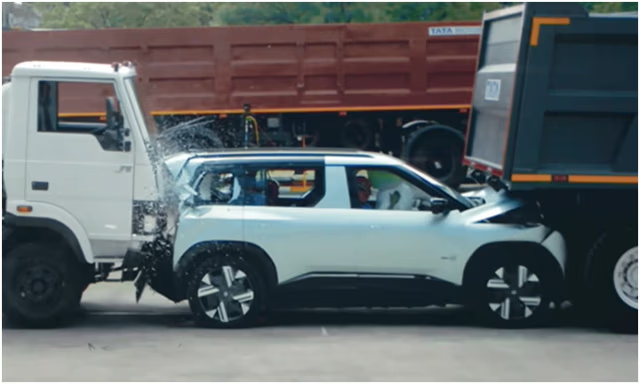 Amaan Ahmed | Jun 30, 2026Tata Sierra EV Sandwiched Between Two Trucks In Novel Crash Test: Watch VideoNobody saw Tata's latest crash test coming -- not even the Sierra EV it was conducted on2 mins read
 Jaiveer Mehra | Jun 30, 2026Tata Sierra EV Launched In India At Rs 18.79 Lakh: 5 Variants, 63 & 75 kWh Battery Options, 500+ km RangeElectric derivative of the Sierra is based on the Acti.ev+ platform and is offers over 500 km of range in real-world use.4 mins read
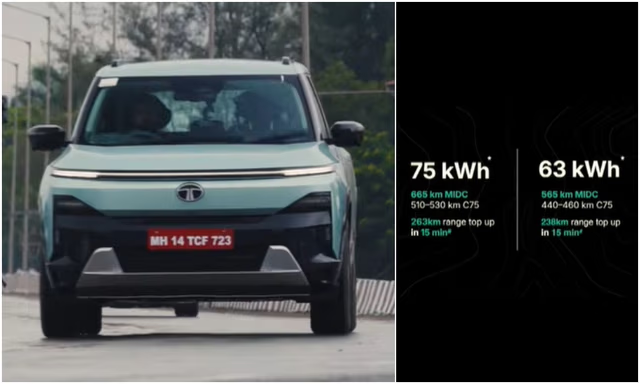 Amaan Ahmed | Jun 30, 2026Tata Sierra EV Real-World (C75) Range Figures RevealedUnlike what you may have seen on social media in recent days, the Sierra EV will not cover 700 kilometres, not even on the forgiving Indian Driving Cycle test2 mins read
 Seshan Vijayraghvan | Jun 29, 2026Renault Kiger vs Toyota Urban Cruiser Taisor: Which Underdog Deserves Your Money?Both the Kiger and the Taisor promise strong performance, solid features, comfortable cabins and everyday usability, all without breaking the bank. But which of these underrated subcompact SUVs deserves your money? Let's find out.1 min read
 Seshan Vijayraghvan | Jun 29, 2026Skoda Kodiaq RS Review: The Best Kodiaq Yet?The Skoda Kodiaq RS is finally here, and it's every bit as exciting as I expected. But was it worth the wait?7 mins read
 Bilal Firfiray | Jun 28, 2026BMW X6 M60i Review: It’s Back And HOW!The BMW X6 M60i blends a 530bhp twin-turbo V8, with its unmistakable coupe-SUV styling. There’s plenty of character, but is it worth your money?6 mins read
 Janak Sorap | Jun 25, 2026350cc Bajaj Dominar 400 Review: Same Character, Lower PriceA slightly lower displacement engine, a significantly lower price tag and nearly the same performance — the Bajaj Dominar 400 aims to be smarter rather than faster.6 mins read
 Preetam Bora | Jun 25, 20262026 Bajaj Pulsar NS400Z First Ride Review: Smaller Engine, But Should You Buy It?The Bajaj Pulsar NS400Z won our Two-Wheeler Upgrade of the Year. Then new tax slabs happened. Smaller engine, same badge – but does it still deliver?6 mins read