
Nitrogen vs Regular Air in Tyres: Is It Actually Worth Paying Extra?
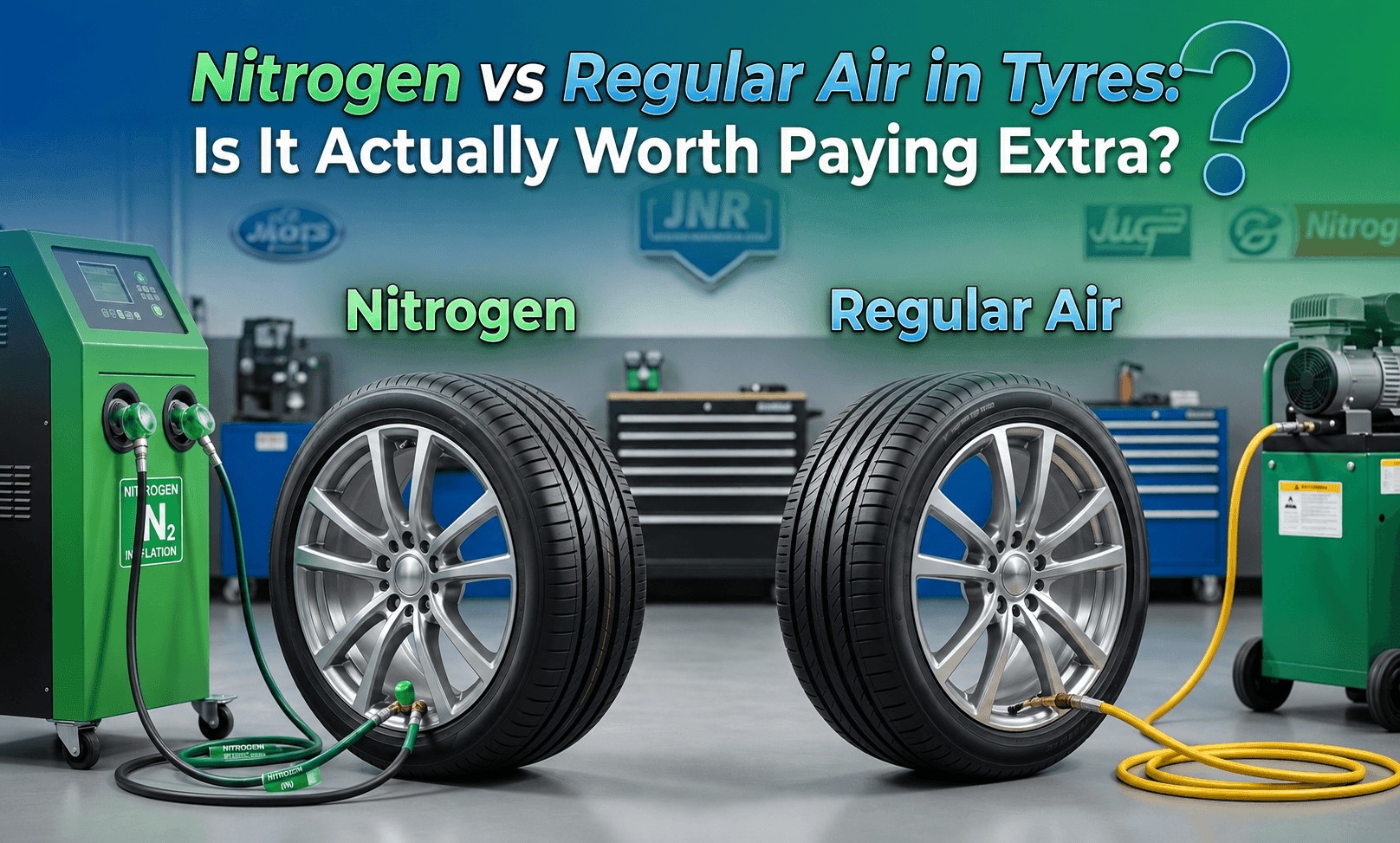
- Nitrogen-filled tyres lose pressure much slower than regular air-filled tyres.
- Biggest advantage are benefits during long highway drives and hot conditions.
- For most daily city users, regular pressure checks matter more than nitrogen itself.
Tyre shops across India increasingly push nitrogen filling as a premium upgrade. In some places, even new cars are delivered with green nitrogen valve caps for it and marketed on the basis of its added benefits. The claims usually sound convincing too: better mileage, longer tyre life, improved ride quality, and more stable pressure.
Technically, some of these claims are true. Nitrogen does behave differently from regular compressed air. But the bigger question is whether those differences are large enough to matter in normal Indian driving conditions. For most drivers, the answer depends more on usage habits than the gas inside the tyre.
What Is Actually Inside Regular Air?
Many people assume that regular air and nitrogen are completely different. In reality, normal compressed air already contains around 78% nitrogen, along with oxygen, moisture, and trace gases. Nitrogen filling simply increases the nitrogen concentration inside the tyre, usually to around 93-95%, while reducing oxygen and moisture content.
That difference affects:
- Pressure stability
- Heat expansion
- Moisture buildup
- Long-term rubber ageing
However, the effects are gradual rather than dramatic.
Why Nitrogen Became Popular in the First Place?
Nitrogen filling originally became common in aviation, motorsport, and commercial trucking. Aircraft tyres experience massive temperature changes during take-off and landing, while racing cars generate extreme heat at high speeds. Nitrogen helps maintain more predictable pressure in those conditions.
That same idea later entered the passenger vehicle market.
In India, the concept gained popularity mainly because:
- Highway speeds increased
- SUV usage grew
- Premium tyre chains showing Nitrogen as a value-added service.
Today, many dealerships also recommend it during vehicle delivery.
The Real Benefits of Nitrogen-filled Tyres
Nitrogen does offer genuine advantages, especially under demanding conditions.
Slower Pressure Loss
Nitrogen molecules escape through tyre rubber slightly more slowly than oxygen molecules. That means nitrogen-filled tyres generally maintain pressure longer between top-ups.
In Indian conditions, where many owners forget monthly pressure checks entirely, this can help maintain safer tyre pressure for longer periods.
Better Stability During Highway Heat
Long highway drives during Indian summers generate significant tyre heat, especially on concrete expressways.
Nitrogen contains less moisture than regular compressed air, which means pressure fluctuation during heating and cooling cycles tends to remain more stable. This becomes more noticeable during:
- Long-distance highway driving
- Heavy SUV usage
- Fully loaded vehicles
Reduced Internal Moisture
Moisture inside tyres can contribute to gradual wheel corrosion over time, particularly in steel wheels. Since nitrogen filling systems remove much of the moisture content, the internal corrosion risk becomes slightly lower.
That benefit matters more for:
- Commercial vehicles
- Long-term tyre storage
- High-mileage users
Where the Marketing Gets Exaggerated?
This is where expectations often become unrealistic.
Nitrogen Will Not Suddenly Improve Mileage Dramatically
Some tyre shops claim nitrogen improves fuel efficiency significantly. In reality, the difference is usually extremely small.
What actually improves mileage is maintaining correct tyre pressure consistently. Nitrogen only helps hold that pressure slightly longer.
A properly inflated, regular-air tyre will usually perform almost identically to a nitrogen-filled tyre in normal city driving.
Ride Quality Differences Are Minimal
Many drivers expect an immediate change in comfort after nitrogen filling. In practice, ride quality differences are usually too small for most people to notice consistently.
If a ride suddenly feels smoother after nitrogen filling, it is often because the tyres were finally inflated to the correct pressure during the refill itself.
Tyre Life Improvements Are Gradual
Nitrogen may reduce long-term oxidation inside the tyre slightly, but it does not double tyre life or prevent wear caused by:
- Poor alignment
- Potholes
- Hard braking
- Incorrect pressure
Indian road conditions still remain the biggest factor affecting tyre lifespan.
The Practical Problem Most Owners Ignore
Nitrogen only works properly when the tyre remains mostly nitrogen-filled.
However, during emergencies or pressure drops, many owners top up with normal air anyway because nitrogen stations are not always nearby. Once regular air mixes in, the purity level decreases gradually.
That means maintaining “pure nitrogen” becomes inconvenient unless:
- You frequently visit the same tyre chain
- Regularly drive near nitrogen filling stations.
For many people, the convenience advantage of regular air simply outweighs the small technical benefits of nitrogen.
Nitrogen vs Regular Air: Real-World Comparison
On paper, nitrogen does offer a few technical advantages over regular air. But in everyday Indian driving conditions, the gap between the two is usually smaller than most marketing claims suggest.
| Factor | Nitrogen | Regular Air |
| Pressure Retention | Slightly better | Normal |
| Availability | Limited in smaller towns | Easily available everywhere |
| Cost | Usually paid | Usually free or inexpensive |
| Highway Heat Stability | Better | Good enough for most users |
| Moisture Content | Lower | Higher |
| City Driving Difference | Minimal | Minimal |
| Maintenance Importance | Still necessary | Still necessary |
So, Is Nitrogen Actually Worth Paying Extra?
Nitrogen in tyres is not a scam, but it is also not the revolutionary upgrade it is sometimes marketed as. The benefits are real, especially for highway users and high-temperature driving, but they remain relatively modest for most daily commuters.
For Indian drivers, regular pressure checks, healthy tread, and proper maintenance will almost always make a bigger difference to safety, comfort, and tyre life than whether the tyre contains nitrogen or regular air.

carandbike is not merely another name in the world of automotive web sites. We bring together the best from the world of both, cars and bikes. New cars, used cars, new bikes, - we endeavour to help you with all of that. Additionally, carandbike also strives to keep its users updated with the latest from the global automotive industry. car price, car reviews, car dealers, new bikes, and everything in between, carandbike is happy to help!
Read all latest news and reviews from car&bike Team →


Related News


Latest Cars


Upcoming Cars


Latest News


 car&bike Team | Oct 8, 2026Harley-Davidson Sprint 440 Teased; Will Be Based On The X440Harley-Davidson has teased its upcoming Sprint 440, suggesting the new motorcycle will be a much more on the lines of a traditional cruiser than the X440.1 min read
 car&bike Team | Oct 8, 2026River Indie Electric Scooter Now Available On FlipkartRiver Mobility is the latest two-wheeler brand in India to list its two-wheeler on Flipkart.2 mins read
 car&bike Team | Oct 8, 2026Mahindra XUV 3XO CNG Launch On October 15The 3XO will be the third subcompact SUV to offer a factory-fitted CNG kit.1 min read
 car&bike Team | Oct 8, 2026Suzuki GSX-8R Gets Rs. 80,000 Discount; Price Drops To Rs. 9.08 LakhSuzuki is offering an Rs. 80,000 discount on the GSX-8R, bringing the price of its middleweight faired motorcycle down to Rs. 9.08 lakh.1 min read
 car&bike Team | Oct 8, 2026VinFast To Open Two-Wheeler Showrooms In Over 30 Indian CitiesAfter its electric cars which made its India debut in 2025, VinFast is gearing up to bring its electric two-wheeler portfolio to the country, most likely at the start of 2027.1 min read
 Janak Sorap | Oct 8, 2026Triumph Bonneville T40 Vs Speed 400: Which Triumph is for you?Triumph now has two very different takes on its small-capacity modern-classic formula, the Speed 400 and the new Bonneville T40. So, which Triumph is better suited to you and why?1 min read
 Bilal Firfiray | Oct 8, 2026Tata Aeris Review: New And Improved, But Is It Good Enough?Tata has replaced the Tigor with the new Aeris and improved it in every aspect. We drove the CNG AMT and Petrol MT derivatives to find out how much it improved over its predecessor.4 mins read
 Seshan Vijayraghvan | Oct 4, 20262026 Skoda Slavia Facelift Review: Upgrades That Matter And A Better AutomaticThe new Skoda Slavia brings a handful of visual and mechanical changes, most notably a new 8-speed automatic for the volume-selling 1.0-litre TSI variants.5 mins read
 Bilal Firfiray | Oct 3, 2026Kia Sorento Review: Is Bigger Always Better?The Kia Sorento has arrived to our shores at the right time. But does it have what it takes to take the market by a storm?7 mins read
 Abhishek Nigam | Oct 2, 2026MINI Countryman C Review: Has MINI Finally Grown Up Without Losing Its Personality?The new Countryman C is bigger, more practical and packed with technology, but its quirky appeal comes with a few compromises.1 min read
 Preetam Bora | Oct 3, 2026ViaTerra Spencer Riding Jacket Review: The Ideal Jacket For Indian Summers?The ViaTerra Spencer mesh riding jacket makes a strong case as a well-built, street-focussed riding jacket, combining good airflow with Level 2 protection and a snug, secure fit. Is it perfect? Read on.6 mins read