
Run-Flat Tyres vs Regular Tyres: Are They Worth It In India?

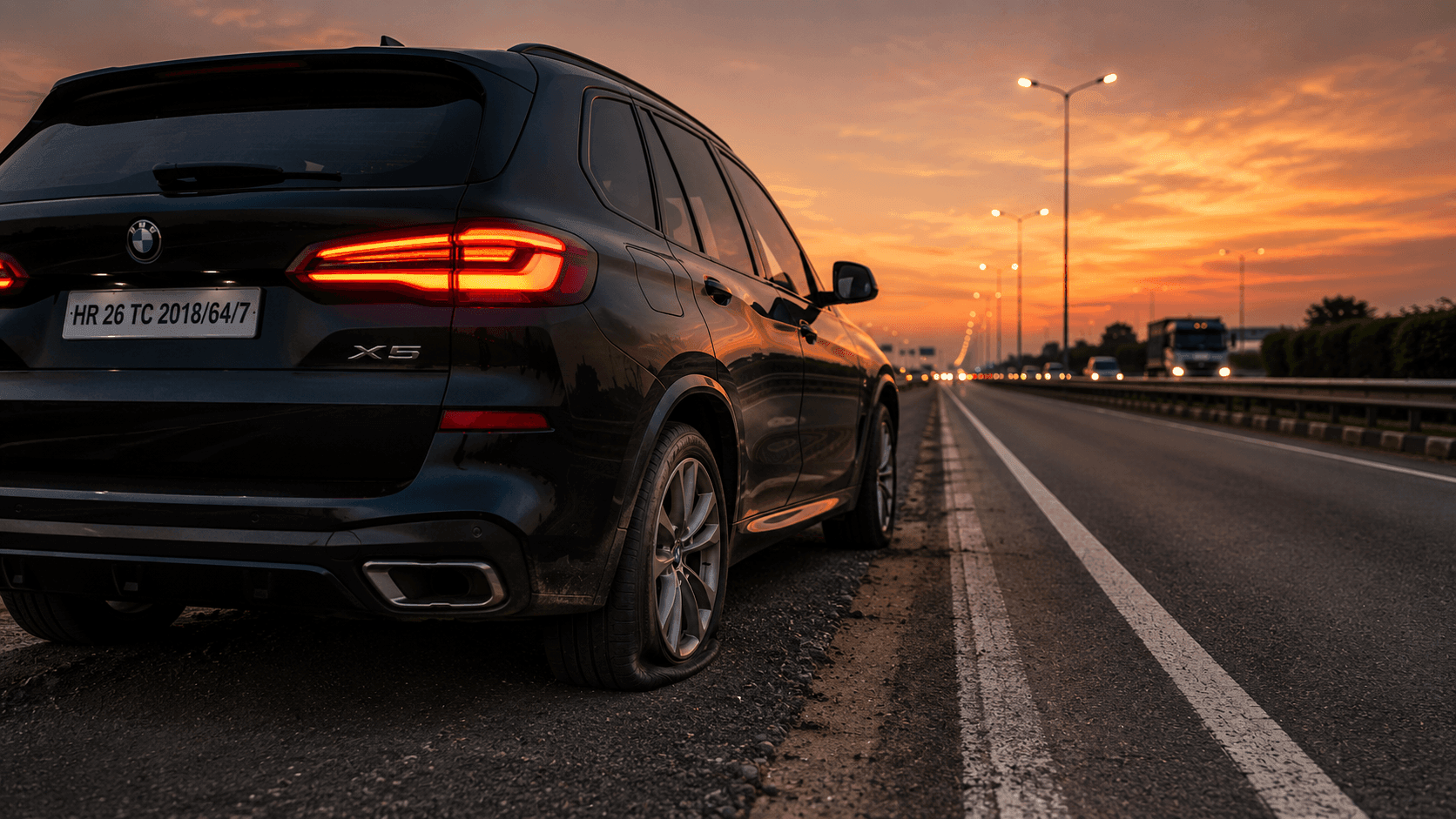
- Run-flat tyres let you drive even after a puncture
- RFTs cost up to twice as much as conventional tubeless tyres
- For most Indian buyers, quality tubeless tyres remain the practical choice
A flat tyre is one of the biggest inconveniences a driver can face, especially if it happens on a highway or a deserted road late at night. But what if, instead of pulling over immediately, you could keep driving safely until you reached the nearest service station? That's exactly what run-flat tyres (RFTs) are designed to do. Once limited to premium and luxury cars, they're now available in several mass-market sizes too.
However, they can cost nearly twice as much as conventional tubeless tyres and may also compromise ride comfort. So, are run-flat tyres worth the premium for Indian road conditions, or are conventional tyres still the better choice?
Also Read: Opinion: Why A Spare Wheel Must Be Standard, And Not An Option, In India
What Are Run-Flat Tyres?
Before getting into the pros and cons, here's how run-flat tyres (RFTs) work. Unlike conventional tyres, RFTs feature reinforced sidewalls that can support the vehicle's weight even after a complete loss of air pressure.
This allows the car to continue driving after a puncture, typically at speeds of up to 60 kmph, and in some cases 80 kmph. The idea isn't to complete your journey but to get you safely to the nearest workshop or tyre repair shop.
Since a run-flat tyre doesn't visibly deflate after a puncture, it is designed to work with a Tyre Pressure Monitoring System (TPMS), which alerts the driver to the loss of air pressure. That's also why many luxury carmakers fit run-flat tyres as standard, offering added safety and convenience.
Also read: Car Tyre Pressure: How To Check & How To Maintain
Pros: Why They're Popular
Safety
Run-flat tyres reduce the chances of losing control after a sudden puncture or blowout, particularly at highway speeds. Their reinforced sidewalls help keep the vehicle stable, allowing you to safely drive to the nearest workshop.
Convenience
The biggest advantage of RFTs is that you don't have to stop immediately to change a tyre or wait for roadside assistance. Instead, you can continue driving to the nearest workshop or tyre repair shop. This can be invaluable on highways, isolated roads or during late-night drives.
More Practical Packaging
In most cases, cars equipped with run-flat tyres don't come with a spare wheel. Eliminating it frees up valuable boot space, which can be used for extra luggage capacity or to accommodate hybrid battery packs in HEVs. In fact, several newer cars, including some in the mass-market segment, now replace the spare wheel with a puncture repair kit instead.
Also Read: Nitrogen In Tyres: The Real Pros and Cons Explained
Cons: What's The Catch?
Replacement Cost
Compared to conventional tubeless tyres, run-flat tyres are substantially more expensive. Depending on the manufacturer and size, RFTs in India cost between Rs. 12,000 and Rs. 30,000 per tyre. That's around 50 to 100 per cent more than an equivalent conventional tubeless tyre, which typically costs between Rs. 6,000 and Rs. 15,000.
Ride Quality
The reinforced sidewalls make the ride noticeably firmer, something that's especially evident over potholes and broken roads. Luxury cars that come with RFTs from the factory usually have their suspension tuned to compensate for this. However, fitting aftermarket RFTs on a mass-market SUV like the Hyundai Creta or Tata Harrier will almost certainly result in a stiffer ride. If rough roads are part of your daily commute, that's a compromise worth considering.
Availability
Run-flat tyres aren't as widely available as conventional tyres. While replacement options are relatively easy to find in metro cities, sourcing the right size in smaller towns or remote areas can be difficult, often leading to longer wait times or the need to order one from another city.
Also read: Top 10 Must-Have Car Care Products For Every Car Owner
Repairs
Unlike conventional tyres, repairing a run-flat tyre isn't always straightforward. If the tyre has been driven for too long after losing pressure, the reinforced sidewalls could suffer irreversible damage, making replacement the only option. Even when a repair is possible, many tyre shops in India are either unequipped or unwilling to work on run-flat tyres, adding to the ownership cost and inconvenience.
Are They Worth It In India?
They're worth considering if:
- You spend a lot of time on highways.
- You frequently travel long distances.
- Safety and convenience outweigh replacement costs.
Regular tyres may make more sense if:
- Most driving is within the city.
- Ride comfort is a priority.
- You're conscious of ownership costs.
- You live in an area where run-flat replacements aren't easily available.
In fact, it's not uncommon for owners of luxury cars to replace their factory-fitted run-flat tyres with conventional tubeless tyres once the originals wear out. Many also carry a spare wheel or puncture repair kit. Personally, I'd happily give up a bit of boot space for the reassurance of having a spare wheel.
Verdict
Run-flat tyres solve a genuine problem, but they don't eliminate the inconvenience of a puncture altogether. They simply buy you enough time and distance to reach a safe location. Whether that benefit outweighs the higher ownership costs depends entirely on how and where you drive.
If your journeys mostly involve highways, long-distance travel or late-night driving, the added peace of mind can justify the premium. But for the majority of Indian motorists, conventional tubeless tyres paired with a spare wheel or puncture repair kit remain the more practical and cost-effective solution. They offer lower running costs, better ride comfort and are far easier to repair or replace, making them better suited to the realities of Indian roads.
Related News



Latest Cars


Upcoming Cars


Latest News


 car&bike Team | Sep 21, 2026Updated Honda 350cc Range Launched: Prices Start At Rs 1.95 LakhHonda has updated its 350cc motorcycle range in India with new colourways and graphics, with prices starting at Rs 1.95 lakh across the CB350, CB350C and CB350RS.1 min read
 Seshan Vijayraghvan | Sep 21, 2026Stellantis Takes Full Ownership Of Tamil Nadu Plant; Aims To Produce 43,000 Units By 2028Stellantis is targeting a production ramp-up of over 160 per cent, growing from 16,000 units in 2026 to more than 43,000 units annually by 2028.1 min read
 Sarthak Mahajan | Sep 21, 2026World Car Awards 2027 Season CommencesThe 23rd edition will see 100 international automotive journalists evaluate eligible models before the winners are announced in New York in March 2027.2 mins read
 Sarthak Mahajan | Sep 21, 2026Maruti Suzuki Baleno, Dzire And Swift CNG AGS Variant-Wise Prices UnveiledThe Swift and Dzire cost Rs 35,000 more than their standard petrol-manual variants.1 min read
 Jafar Rizvi | Sep 21, 2026Honda CB500 Launched In India At Rs 2.75 LakhThe CB500 is offered in three variants with prices topping out at Rs 3.02 lakh (ex-showroom).2 mins read
 car&bike Team | Sep 21, 20262027 Mahindra Thar 3-Door Facelift Launch Tomorrow: What To Expect?This will be the second update for the 3-door SUV, and we expect some feature additions to play a key role in this update.2 mins read
 Bilal Firfiray | Sep 19, 2026MG Hector Tomahawk EV Review: Play It SafeMG’s new electric SUV has one of the coolest names ever, and the coolest temperament amongst its peers. But is it worth buying?7 mins read
 Preetam Bora | Sep 16, 2026Royal Enfield Himalayan 440 Review: Better Than the 450?The new Himalayan 440 with an upsized engine and gearbox has certainly improved as a touring machine and at an extremely attractive price of Rs. 2.29 Lakh. Is it the better Himalayan to choose for many riders?9 mins read
 Seshan Vijayraghvan | Sep 15, 2026BMW i5 LWB Review: Not The M60, This Is The Proper Electric 5 SeriesThe BMW i5 LWB takes the electric 5 Series formula and puts a stronger focus on rear-seat comfort and long-distance luxury. With a 669 km claimed range, 268 bhp and a more relaxed character, is this the i5 that makes the most sense for India?7 mins read
 Preetam Bora | Sep 14, 2026Ladakh Uncharted: Himalayan Basecamp Off-Road Ride ExperienceA day-long off-road excursion from Royal Enfield’s Himalayan Basecamp event in Ladakh, the Ladakh Uncharted ride by Alpinestars was all about re-discovery!6 mins read
 Janak Sorap | Sep 12, 2026New Bajaj Pulsar 125 First Ride Review: More Tech, Less Weight, Same Pulsar DNAThe new Bajaj Pulsar 125 retains the familiar Pulsar identity but gets a new engine, lighter construction, more features and a sharper riding experience.5 mins read