
Why Your Car's AC Cools Better While Driving Than At Idle

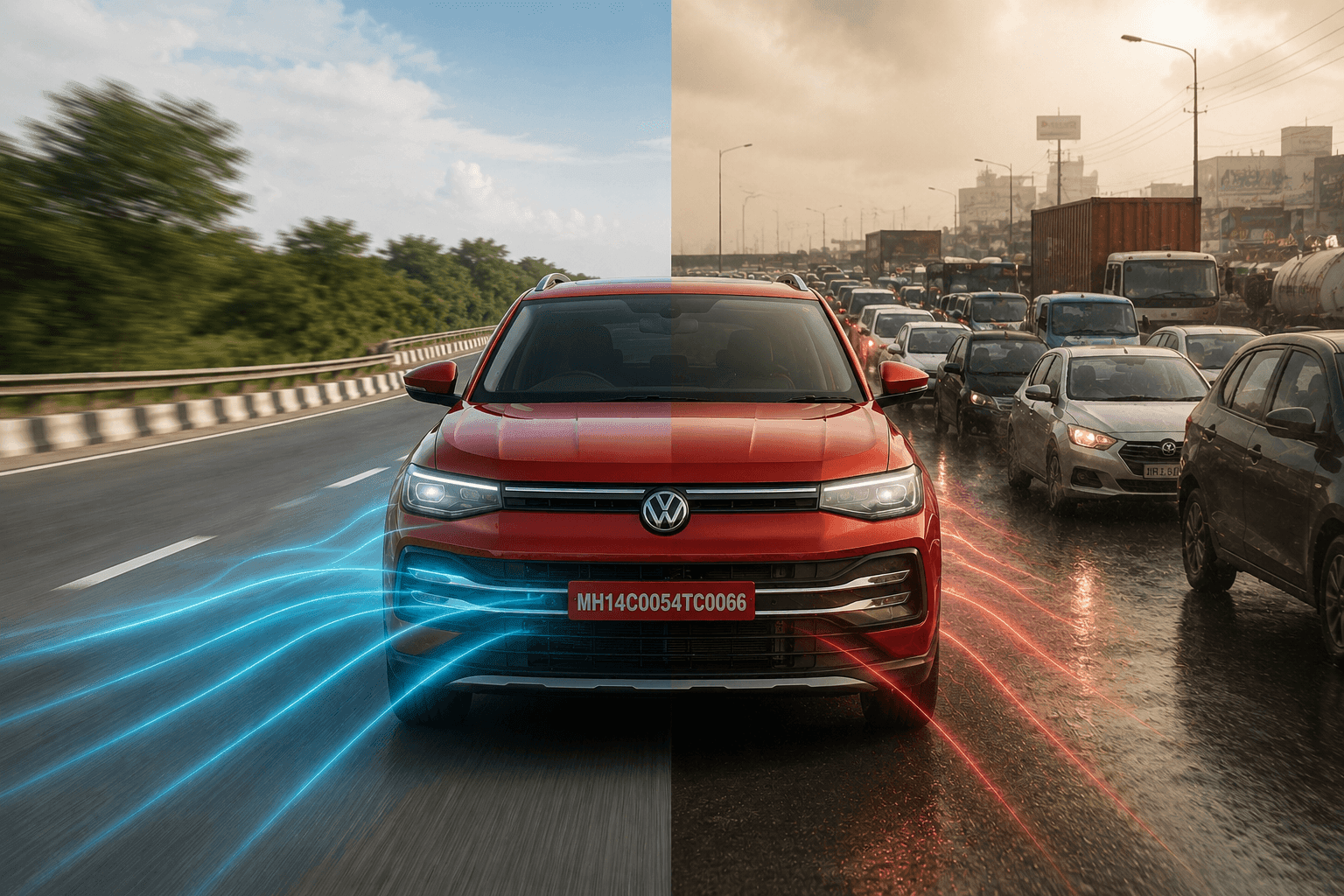
- Car AC systems usually cool more effectively while driving because of increased airflow through the condenser
- Heavy traffic, extreme heat, and low engine speeds can make cooling feel weaker at idle
- Significant cooling loss while stationary may indicate problems such as a faulty condenser fan or low refrigerant
On a hot summer afternoon, many drivers notice the same thing. The cabin feels comfortably cool while cruising along, but after a few minutes in slow-moving traffic, the air coming from the vents does not feel quite as cold. As soon as the road opens up again, the cooling seems to improve.
This often leads people to assume there is something wrong with the air conditioner. In many cases, however, the system is behaving exactly as designed. Understanding why this happens can help you tell the difference between normal AC behaviour and a problem that needs attention.
Also Read: Extended Car Warranties Explained: When They Make Sense and When They Don't
How Your Car's AC Actually Cools the Cabin
Most people think an air conditioner creates cold air. In reality, its job is to remove heat from inside the cabin and release that heat outside the vehicle.
The process starts with the refrigerant absorbing heat from the air inside the cabin. The heated refrigerant then travels to the condenser, which is usually located behind the front grille. The condenser's job is to release that heat into the outside air. The faster the condenser can get rid of heat, the more efficiently the system can cool the cabin. That is where driving speed starts making a noticeable difference.
Why Driving Makes the AC Feel Colder
When your vehicle is moving, a large volume of air flows naturally through the front grille and across the condenser. This constant airflow helps the condenser cool the refrigerant more effectively. As a result, the AC system can remove heat from the cabin faster and maintain lower vent temperatures.
At highway speeds, the amount of airflow passing through the condenser is often far greater than what the cooling fan can create while the vehicle is standing still.
This is why drivers commonly notice:
- Faster cabin cooling after starting a journey
- Colder air on highways
- Better cooling once traffic clears
- More consistent AC performance at higher speeds
In most cases, this difference is completely normal.
Also Read: Regenerative Braking Explained: How EVs Recover Energy While Driving
Why Cooling Feels Worse in Heavy Traffic
The effect becomes much more noticeable during traffic jams. When a vehicle is crawling through traffic, natural airflow through the grille drops dramatically. At the same time, several factors increase the amount of heat the AC system must handle.
These include:
- Heat radiating from surrounding vehicles
- High road surface temperatures
- Continuous engine heat buildup
- Strong sunlight is entering through the windows
The AC system is effectively fighting more heat while receiving less airflow to help remove it. That combination often makes cooling feel weaker during prolonged stop-and-go driving.
This is especially common during Indian summers when outside temperatures regularly exceed 40°C in many regions.
Why Newer Cars Handle Idling Better Than Older Ones
In electric vehicles and many hybrids, the AC compressor is usually powered by electricity rather than directly by engine speed, so cooling performance may be less affected by whether the vehicle is moving or idling. However, condenser airflow still plays an important role in overall cooling efficiency.
Many drivers who upgrade to newer vehicles notice that the AC remains more consistent in traffic than it did in older cars. That is because modern vehicles often use:
- Variable-displacement compressors
- More efficient condensers
- Improved electric cooling fans
- Smarter climate control systems
- Better engine temperature management
Also Read: Top Cars In India with Most Comfortable Rear Seats Under Rs 15 lakh
Does Weak Cooling at Idle Always Mean Low AC Gas?
Not necessarily. One of the most common misconceptions is that weak cooling in traffic automatically means the refrigerant level is low. While low refrigerant can certainly reduce cooling performance, it is only one possible cause. Several other issues can produce similar symptoms, including:
- A weak condenser fan
- Dirt or debris blocking the condenser
- A worn compressor
- Engine cooling problems
- Electrical faults affecting fan operation
This is why repeatedly topping up refrigerant without proper diagnosis often fails to solve the problem permanently.
When Reduced Cooling at Idle Is Completely Normal
A slight drop in cooling performance while stationary is usually nothing to worry about. Your AC is probably functioning normally if:
- The air remains reasonably cool at traffic signals
- Cooling improves gradually once the vehicle starts moving
- The cabin eventually reaches the selected temperature
- Engine temperature remains within the normal range
- The radiator and condenser fans operate correctly
Most vehicles show at least some variation between cooling performance at idle and while driving.
When It May Be a Sign of a Problem
The difference should not be dramatic. If the AC becomes noticeably weak or warm every time the vehicle stops, there may be an underlying issue that requires attention.
Faulty Condenser Fan
The condenser fan becomes the primary source of airflow when the vehicle is stationary. If the fan is weak, intermittent, or completely inoperative, cooling performance can drop significantly in traffic.
Low Refrigerant
Insufficient refrigerant reduces the system's ability to absorb and release heat efficiently, often making idle performance noticeably worse.
Dirty Condenser
Dust, leaves, insects, and road debris can restrict airflow through the condenser. This is particularly common in Indian driving conditions.
Ageing Compressor
A worn or inefficient compressor may struggle to maintain the pressure difference needed for effective cooling. These symptoms often become more noticeable at idle, where the system has less airflow and lower compressor speed to compensate for declining performance.
Engine Cooling Problems
When engine temperatures rise excessively, some vehicles automatically reduce AC performance to prioritise engine cooling.
Also Read: Plug-in Hybrid vs Strong Hybrid in India: Understanding the Difference
A Quick Self-Check Before Visiting a Workshop
Before assuming the AC system needs major repairs, pay attention to a few simple observations.
If you notice that:
- Cooling improves immediately once the vehicle starts moving
- The engine temperature remains normal
- The condenser fan can be heard running
- Vent air remains cool rather than completely warm
The issue may simply be the normal difference between idle and driving conditions.
However, if:
- The AC blows warm air whenever the vehicle stops
- Cooling disappears completely in traffic
- Engine temperature rises unusually high
- The cooling fan does not operate
A professional inspection is usually worthwhile.
Simple Ways to Improve AC Performance
A few maintenance habits can help the system perform more consistently throughout the year.
- Keep the condenser clean during servicing
- Replace the cabin air filter at recommended intervals
- Ensure cooling fans are functioning properly
- Check refrigerant levels when cooling performance declines
- Use windshield shades when parking in direct sunlight
- Vent hot air from the cabin before switching the AC to maximum
These small steps can reduce strain on the system and improve cooling performance during hot weather.
What Your AC Is Trying to Tell You
If your car's AC cools better while driving than when sitting at a traffic signal, the most common reason is increased airflow through the condenser, which allows the system to remove heat more efficiently. In some vehicles, higher engine speeds can also improve compressor operation, although airflow remains the primary factor in most cases. In fact, a mild difference between driving and idling is normal in most vehicles.
The key is understanding how much of a difference is acceptable. If the cabin remains reasonably comfortable while stationary, the system is likely working as intended. But if cooling drops sharply every time the vehicle stops, it may be time to inspect the condenser fan, refrigerant level, or overall health of the AC system before the next heatwave arrives.
Related News



Latest Cars


Upcoming Cars


Latest News


 Sarthak Mahajan | Sep 16, 2026New Hyundai Bayon Design Previewed In Sketches Ahead Of India LaunchHyundai Bayon’s first sketch reveals the SUV’s fascia and other design elements.1 min read
 Abhishek Nigam | Sep 16, 2026New Bajaj Pulsar 150 vs Honda Unicorn: Which Makes More Sense?The new Pulsar 150 takes the fight to the Honda Unicorn with more power, a lighter-feeling chassis and significantly more technology. But the Unicorn counters with a bigger engine, a comfortable package and Honda's tried-and-tested commuter formula5 mins read
 Sarthak Mahajan | Sep 15, 2026Checking Pending Challans On Pre-Owned Cars To Get Easier With New 'Rosmart' Digital PlatformRDSL has signed an MoU with FADA through Rosmart, allowing customers to access challan-related and other vehicle compliance services.1 min read
 Sarthak Mahajan | Sep 15, 2026Volvo XC60 and XC90 Long-Range Plug-In Hybrid RevealedThe XC60 offers up to 200km of electric range, while the XC90 offers up to 160km. Their combined ranges stand at up to 1,240km and 1,100km, respectively.1 min read
 Seshan Vijayraghvan | Sep 15, 2026Mahindra XUV 7XO Scores 5 Stars In Bharat NCAP Crash TestThe Mahindra XUV 7XO has scored 5 stars for both adult and child occupant protection.1 min read
 Sarthak Mahajan | Sep 15, 2026Honda Amaze Prices Hiked By Up To Rs 15,210: Check Updated Price ListHonda Cars India has hiked the prices of the Amaze for the second time this year, with the mid-spec variant receiving the highest price increase.1 min read
 Seshan Vijayraghvan | Sep 15, 2026BMW i5 LWB Review: Not The M60, This Is The Proper Electric 5 SeriesThe BMW i5 LWB takes the electric 5 Series formula and puts a stronger focus on rear-seat comfort and long-distance luxury. With a 669 km claimed range, 268 bhp and a more relaxed character, is this the i5 that makes the most sense for India?7 mins read
 Preetam Bora | Sep 14, 2026Ladakh Uncharted: Himalayan Basecamp Off-Road Ride ExperienceA day-long off-road excursion from Royal Enfield’s Himalayan Basecamp event in Ladakh, the Ladakh Uncharted ride by Alpinestars was all about re-discovery!6 mins read
 Janak Sorap | Sep 12, 2026New Bajaj Pulsar 125 First Ride Review: More Tech, Less Weight, Same Pulsar DNAThe new Bajaj Pulsar 125 retains the familiar Pulsar identity but gets a new engine, lighter construction, more features and a sharper riding experience.5 mins read
 Bilal Firfiray | Sep 10, 2026Mahindra XEV 9S Review: 3 Reasons To Buy It, And 3 Reasons To AvoidEveryone keeps telling me that the Mahindra XEV 9S is not the electric XUV 7XO. I disagree.1 min read
 Abhishek Nigam | Sep 12, 2026New Bajaj Pulsar 150 Review: Is The New Pulsar, Pulsar Enough?The new Pulsar 150 gets a major mechanical and technological makeover, but does it retain the easy-going performance, familiar character and hooligan streak that made the original an icon? We ride the latest iteration to find out.8 mins read