
Regenerative Braking Explained: How EVs Recover Energy While Driving

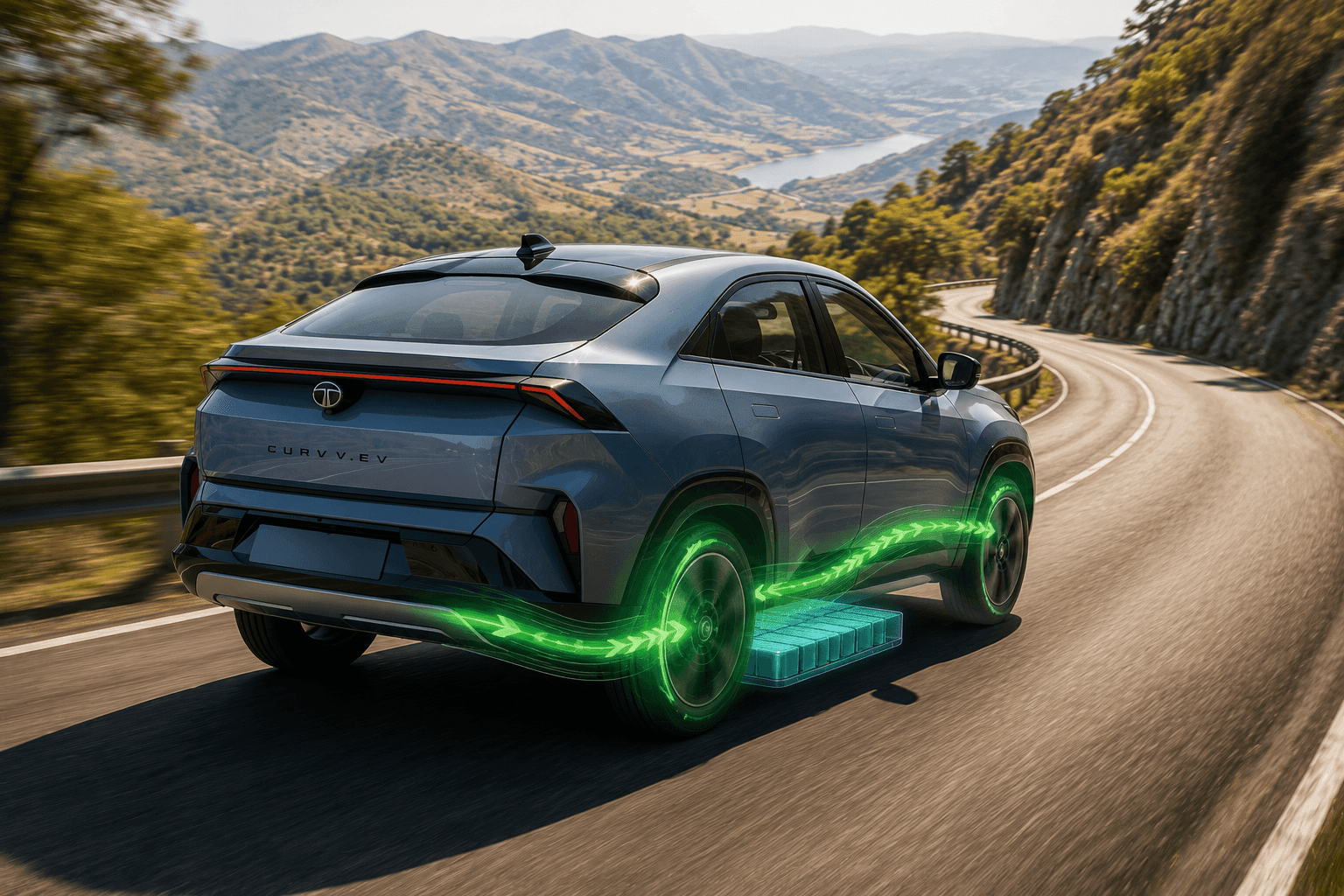
- Regenerative braking converts vehicle momentum into electricity
- It can improve driving efficiency and extend range
- EVs use a combination of regenerative and traditional braking systems
In a petrol or diesel car, every time you press the brake pedal, energy is lost as heat. The brake pads clamp onto the discs, the car slows down, and that energy simply disappears.
Electric vehicles work differently. Instead of wasting all that energy, they can recover a portion of it and send it back to the battery. This process is known as regenerative braking, and it is one of the key reasons why EVs are often more efficient in city traffic than on open highways. While it may sound complicated, the concept is surprisingly simple once you understand what's happening behind the scenes.
Also Read: How Extreme Indian Summers Affect EV Battery Performance
What Is Regenerative Braking?
Regenerative braking is a system that allows an EV to recover energy while slowing down. When the vehicle is moving, it carries kinetic energy. In a traditional car, that energy is wasted during braking. In an EV, part of that energy can be converted into electricity and stored back in the battery.
The result is:
- Improved efficiency
- Better driving range
- Reduced brake wear
This is why many EV drivers notice the battery percentage dropping more slowly in city traffic than expected.
Also Read: EV-Specific Tyres Explained: Why Electric Cars Need Different Rubber
How Does Regenerative Braking Work?
The easiest way to understand regenerative braking is to think about a windmill.
- Normally, electricity spins a motor to move the wheels.
- During regenerative braking, the process works in reverse.
As the wheels continue spinning while the vehicle slows down, they force the electric motor to rotate. Instead of consuming electricity, the motor now acts like a generator and produces electricity.
That electricity is then sent back to the battery for future use.
In simple terms:
Battery → Motor → Wheels when accelerating.
Wheels → Motor → Battery when slowing down.
Why EVs Feel Different When You Lift Off the Accelerator
Many EVs start slowing down the moment you release the accelerator pedal. This is regenerative braking at work.
Instead of allowing the car to coast freely, the motor begins recovering energy and creates a gentle braking effect. The stronger the regenerative setting, the more noticeable this effect becomes.
Some EVs even allow drivers to adjust the level of regeneration through steering-mounted paddles or infotainment settings.
What Is One-Pedal Driving?
One-pedal driving is an extension of regenerative braking. In this mode, lifting your foot off the accelerator creates enough braking force that you rarely need to touch the brake pedal in normal city driving.
This can be especially useful in:
- Traffic jams
- Urban commuting
- Stop-and-go conditions
Many EV owners quickly get used to the system because it reduces driver effort while improving efficiency.
Also Read: Fast Charging vs Slow Charging: Which Is Better for Long-Term Battery Health?
How Much Energy Can Be Recovered?
Regenerative braking does not create free energy. There are always losses during the conversion process. However, modern EV systems can recover a significant portion of energy that would otherwise be wasted.
| Driving Situation | Energy Recovery Potential |
| Traditional braking | 0% |
| Light regenerative braking | 20-35% |
| Strong regenerative braking | 60-70% |
The biggest benefits are usually seen in city traffic, where vehicles constantly accelerate and slow down.
Why Regenerative Braking Helps Brake Pads Last Longer
One hidden benefit of regenerative braking is reduced wear on conventional brakes. During gentle and moderate deceleration, many EVs rely primarily on the electric motor to slow the vehicle.
The traditional brake pads and discs only step in when:
- Strong braking is required
- Emergency stops occur
- The vehicle comes to a complete halt
As a result, EV brake pads often last significantly longer than those on comparable petrol or diesel vehicles.
Also Read: Battery-as-a-Service (BaaS) Explained: How EV Subscription Batteries Actually Work
When Does Regenerative Braking Work Best?
Regenerative braking is most effective when:
- Driving in city traffic
- Descending hills
- Approaching traffic signals
- Driving in stop-start conditions
These situations provide frequent opportunities to recover energy. On long highway journeys where speeds remain constant, regenerative braking has fewer chances to contribute.
Why Regen Sometimes Feels Weaker or Stops Working
Many EV owners notice regenerative braking behaving differently under certain conditions. This is completely normal.
Battery Fully Charged
If the battery is already at or near 100%, there is very little room left to store recovered energy. To protect the battery, the vehicle may reduce or temporarily disable regenerative braking.
Extreme Temperatures
Very high or very low battery temperatures can also limit regeneration. The battery management system may reduce energy recovery to protect battery health.
Slower Speeds
Regenerative braking becomes less effective as vehicle speed drops. That is why traditional friction brakes are still needed when bringing the vehicle to a complete stop.
Regenerative Braking vs Traditional Braking
Both systems help slow the vehicle down, but regenerative braking recovers energy while traditional brakes rely entirely on friction.
| Feature | Regenerative Braking | Traditional Braking |
| Energy Recovery | Yes | No |
| Battery Charging | Yes | No |
| Brake Pad Wear | Very low | Higher |
| Efficiency Benefit | Yes | No |
| Emergency Stopping Power | Limited | Essential |
| Best Use Case | Daily driving | Hard braking situations |
How To Get the Most Out of Regenerative Braking
A few simple habits can maximise energy recovery:
Anticipate Traffic Ahead
Lifting off the accelerator earlier gives the system more time to recover energy.
Use Higher Regen Settings in the City
Stronger regenerative modes generally work better in stop-start traffic.
Avoid Sudden Braking
Smooth deceleration allows the vehicle to rely more heavily on regeneration before the friction brakes step in.
Why Regenerative Braking Is One of an EV's Biggest Advantages
Regenerative braking is one of the smartest features found in modern electric vehicles. It improves efficiency, extends driving range, reduces brake wear, and makes city driving more relaxing through features such as one-pedal driving.
While it cannot completely replace conventional brakes, it helps recover energy that would otherwise be lost every time the vehicle slows down. For many EV owners, it becomes one of the most useful and satisfying technologies they experience during everyday driving.


Latest News


 Jafar Rizvi | Jul 24, 20262026 Maruti Brezza Facelift: Variants, Features, Engine Options ExplainedThe 2026 Maruti Suzuki Brezza is offered in four trim levels: LXi, VXi, ZXi and ZXi+ and with two engine options.5 mins read
 Jafar Rizvi | Jul 24, 20262026 Maruti Brezza Facelift Launches With Three Major FirstsThe 2026 Maruti Suzuki Brezza has arrived, and along with carrying a five-star Bharat NCAP rating, the model brings three firsts for both the Brezza and, in one case, Maruti itself.2 mins read
 Jaiveer Mehra | Jul 24, 20262026 Maruti Suzuki Brezza Facelift Launched; Price Starts At Rs 7.40 LakhUpdated Brezza arrives with a new turbo-petrol engine option and a new 6-speed manual gearbox aside from new features.2 mins read
 car&bike Team | Jul 24, 20262026 Maruti Brezza Facelift Launch Highlights: Price, Specifications, Details, ImagesMaruti will launch the 2026 Brezza today. Stay tuned to this space to get all the details firsthand.0 mins read
 Jafar Rizvi | Jul 24, 2026Honda XR 300L, XR 300 Rally Unveiled In IndiaBoth motorcycles are made in India and will launch before the end of FY20272 mins read
 Janak Sorap | Jul 24, 2026Honda Unveils QC3 Electric Scooter; Claims 145 km IDC RangeHonda has expanded its electric scooter portfolio in India with the launch-ready QC3, positioned above the QC1 and Activa-e.1 min read
 Bilal Firfiray | Jul 24, 2026Honda ZR-V Review: Who Is It For?Honda has brought the new ZR-V to India as their current flagship offering. It’s a CBU, it’s a hybrid, and it’s here for a limited few. Who is it for though?1 min read
 Shams Raza Naqvi | Jul 15, 2026Ferrari 849 Testarossa Spider Driven: Rs. 11.25 Crore Meets 1,000 bhpWe got behind the wheel of the most powerful convertible from Ferrari. What makes the 849 Testarossa Spider Special? We tell you.1 min read
 Bilal Firfiray | Jul 12, 2026Tata Sierra EV Review: Reborn In The Electric AgeThe Tata Sierra EV isn’t drastically different from its ICE counterpart when it comes to design. But being the seventh electric offering from the Indian brand, it has gotten a few things right, and very few things wrong. But is it a compelling package to buy?5 mins read
 Jafar Rizvi | Jul 13, 2026TVS Orbiter Long-Term Review (Report 1): Settling In Takes TimeFirst impressions weren't the strongest, but the Orbiter has made a mark in its first month in the car&bike garage.5 mins read
 Seshan Vijayraghvan | Jul 7, 2026Tata Altroz Petrol DCA Long-Term Review: Intercity & Highway Driving ReportWe tested the Tata Altroz Petro DCA’s highway manners, intercity performance, and real-world fuel efficiency.1 min read