
Battery-as-a-Service (BaaS) Explained: How EV Subscription Batteries Actually Work

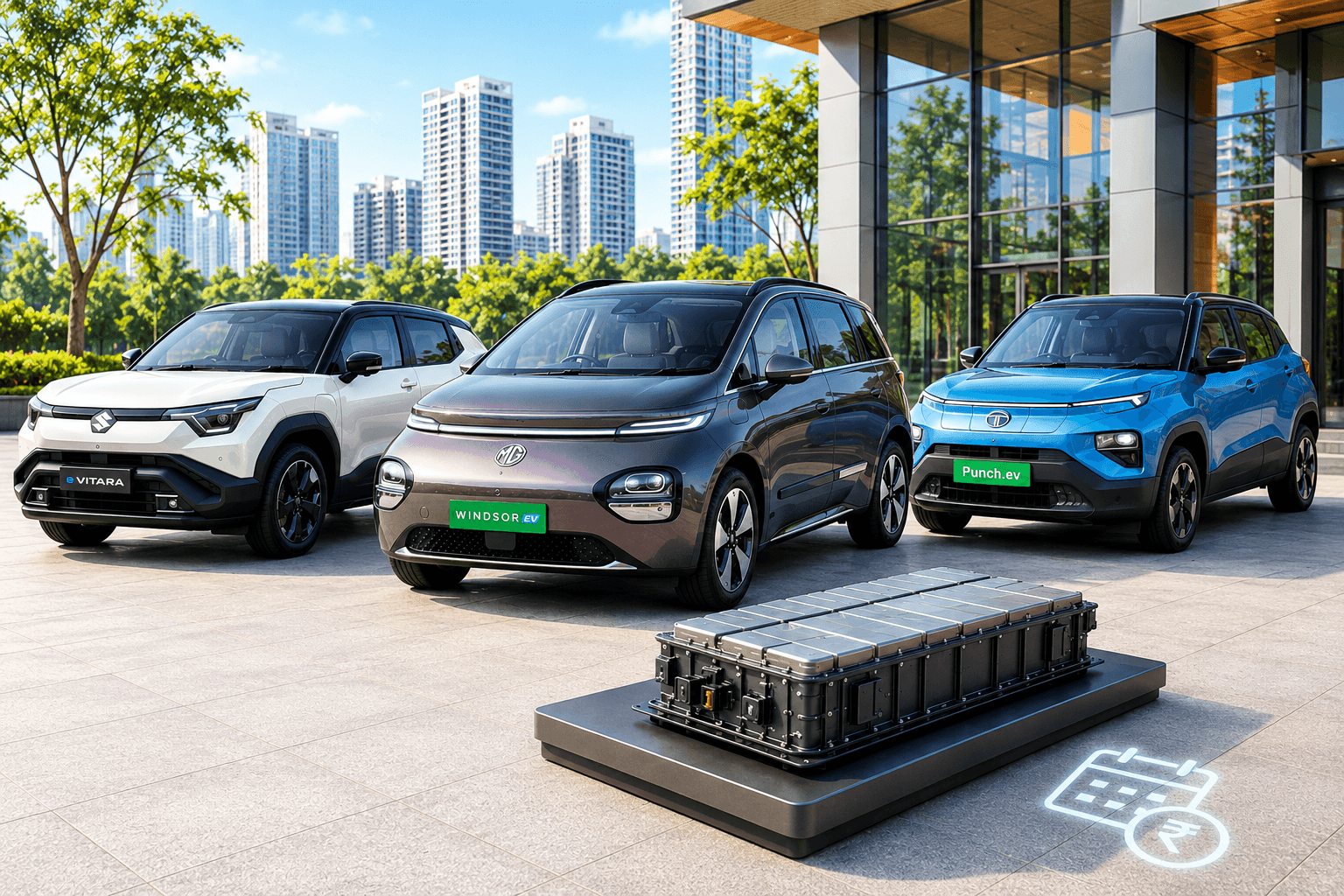
- BaaS reduces the initial expense of purchasing an EV
- Owners pay a monthly battery subscription fee rather than buying the battery outright
- It may be a good option for some drivers, but not all
The battery pack is one of the primary reasons for the higher cost of EVs compared to petrol vehicles. The battery is a major component of the EV's cost in most EVs. Battery-as-a-Service, or BaaS, is an attempt to address that issue by separating the battery from the car purchase.
The buyer buys the car, and the battery is leased to them on a monthly or usage basis. This reduces the upfront cost significantly, making EVs more affordable. As with any subscription service, however, there are pros, cons, and future expenses to consider before subscribing.
Also Read: Why Low-Profile Tyres Are Not Always Ideal for Indian Roads
What Exactly Is Battery-as-a-Service?
The simplest way to think about BaaS is this: You buy the car, but you do not buy the battery.
The car is still registered in your name, just as with any other car. The battery, however, is owned by the manufacturer or a financial partner, and you pay a recurring fee to use it.
This creates two separate agreements:
- Vehicle ownership
- Battery subscription
The result is a much-reduced showroom price and an ongoing battery payment during the life of the vehicle.
Also Read: Best Automatic SUVs For City Traffic In India
How Does BaaS Actually Work?
The current passenger EVs in India are mostly based on the fixed-battery subscription model.
The battery remains permanently in the vehicle and is charged like any other battery at home or public charging stations. The difference is that you don't own the battery; you subscribe to it or pay per kilometre.
In commercial two-wheelers and fleet vehicles, a second model is more prevalent, in which discharged batteries are swapped for fully charged ones at designated swapping stations.
The fixed-battery model is what most car buyers today will come across.
Also Read: Green Tax in India Explained: Who Pays It and How Much Does It Cost?
EVs in India Offered With BaaS and Their Pricing
The primary benefit is straightforward: reduced initial costs. Check out how BaaS affects showroom prices for some of the most well-known EVs in India.
| EV Model | Standard Price | BaaS Price | Upfront Saving |
| Tata Tiago EV | ₹6.99 lakh | ₹4.69 lakh | ₹2.30 lakh |
| MG Comet EV | ₹6.99 lakh | ₹4.99 lakh | ₹2.00 lakh |
| Tata Punch EV | ₹9.69 lakh | ₹6.49 lakh | ₹3.20 lakh |
| MG Windsor EV | ₹14.00 lakh | ₹9.99 lakh | ₹4.01 lakh |
| Maruti Suzuki e Vitara | ₹15.66 lakh | ₹10.99 lakh | ₹4.67 lakh |
| MG ZS EV | ₹17.99 lakh | ₹13.00 lakh | ₹4.99 lakh |
| Kia Carens Clavis EV | ₹17.99 lakh | ₹12.84 lakh | ₹5.15 lakh |
For many buyers, that reduction alone can make an EV financially accessible.
What Happens After You Buy the Car?
The lower purchase price comes with a recurring battery fee.
Depending on the manufacturer, this may be:
- A per-kilometre charge
- A monthly subscription
- A minimum usage plan
You also continue paying for the electricity used to charge the vehicle.
For example, if a battery plan charges ₹3.90 per kilometre and you drive 1,500 km every month, the battery fee alone could exceed ₹5,800 per month, excluding charging costs.
That is why understanding your monthly driving pattern becomes extremely important.
Also Read: Engine Lugging vs High Revving: Which Habit Causes More Long-Term Engine Damage
When Does BaaS Make Sense?
BaaS can be a good option for buyers who:
Want Lower Upfront Costs
A lower purchase price means:
- Smaller down payment
- Lower EMIs
- Easier loan approval
This is often the biggest reason people consider BaaS.
Drive Regularly
Drivers covering over 1,200-1,500 km per month often extract better value from subscription models because they actively use the vehicle.
Worry About Battery Degradation
Since the battery remains the provider's asset, the responsibility for maintaining battery performance typically stays with them. This reduces concerns around expensive battery replacement costs later in the vehicle's life.
When Might BaaS Not Be Worth It?
Like any financial product, BaaS is not ideal for everyone.
Low-Mileage Users
If you only drive a few hundred kilometres per month, some plans may still charge minimum usage fees. In such cases, you may end up paying for battery usage you never actually consume.
Long-Term Owners
With a traditional car loan, your payments eventually stop. With BaaS, the subscription continues for as long as you use the vehicle. Someone planning to keep a car for 10 years may end up paying substantially more than they initially expected.
Resale Can Be More Complicated
Selling a BaaS vehicle involves more than transferring vehicle ownership. The battery subscription agreement must also move to the next owner. Depending on the provider's rules and eligibility checks, this can sometimes add extra steps to the resale process.
Also Read: How Interstate Vehicle Transfers Work In India: NOC, Re-registration And Road Tax Explained
BaaS vs Traditional EV Ownership
BaaS lowers the initial investment cost, but with traditional EV ownership, there are no recurring battery subscription fees, and the car is yours from day one.
| Factor | BaaS EV | Traditional EV |
| Purchase Price | Lower | Higher |
| Monthly Battery Fee | Yes | No |
| Battery Ownership | Provider | Vehicle Owner |
| Battery Replacement Risk | Lower | Owner Responsibility |
| Long-Term Running Cost | Can be higher | More predictable |
| Resale Simplicity | Slightly more complex | Simpler |
A Simple Rule Before Choosing BaaS
Don't be tempted by the lower showroom price until you have worked out how much you drive each month. BaaS can be a viable option for those who use EVs extensively and are looking to cut initial expenses. In the long run, the purchase of the battery may be more cost-effective if the vehicle is not driven often or is to be kept for a very long time.
Is Battery-as-a-Service the Future of EV Ownership?
By reducing one of the most significant hurdles to EV adoption, the cost of the vehicle itself, Battery-as-a-Service is helping to make EVs more accessible. It enables customers to enter the EV market with a lower upfront cost and mitigate battery degradation worries.
But it's not all about the lower showroom price. The subscription fees, length of time owned, and driving frequency are all equally significant. BaaS can be a great option for certain buyers who plan to own the vehicle for a few years. A traditional EV purchase might still be the better financial option for those who plan to keep the EV for a long time.
Related News


Latest Cars


Upcoming Cars


Latest News


 Jafar Rizvi | Sep 5, 20262026 Maruti Suzuki Baleno Facelift Fuel Efficiency Figures RevealedThe Baleno facelift borrows the Z-series 1.2 litre 3-cylinder engine from the Swift and Dzire.3 mins read
 car&bike Team | Sep 5, 20262026 Maruti Suzuki Baleno Facelift: In PicturesThe Suzuki Baleno facelift gets a new face, Level 2 ADAS, and a new three-cylinder Z-Series engine.2 mins read
 Sarthak Mahajan | Sep 5, 20262026 Maruti Suzuki Baleno Facelift Launched At Rs 6.10 LakhGets first-in-segment Level 2 ADAS and a new Z-Series 1.2-litre three-cylinder engine.2 mins read
 Jafar Rizvi | Sep 5, 2026Royal Enfield Himalayan 750 Showcased In India; Gets Cruise Control, TPMSThis test mule appears to be very close to the final production-spec Himalayan 750.3 mins read
 car&bike Team | Sep 5, 20262026 Maruti Suzuki Baleno Facelift Launch LIVE Updates: Prices, Specifications, Images And MoreMaruti Suzuki will launch the new Baleno in India today. Watch this space to get all the information first-hand.0 mins read
 Sarthak Mahajan | Sep 5, 2026Royal Enfield Himalayan 440: In PicturesGets a new 443cc engine with increased torque, a strengthened chassis and a new six-speed gearbox.3 mins read
 Janak Sorap | Sep 4, 20262026 Ducati Monster V2 Review: Raising The BarWith the fifth iteration, the Ducati Monster gets a lighter chassis, a new 890cc V2 engine, sophisticated electronics and tweaks to the suspension, all to make the 2026 version so compelling.7 mins read
 Shams Raza Naqvi | Sep 4, 20262026 Lexus ES 350h And Lexus ES 500e Review: Luxury Meets CapabilityWe got behind the wheels of the new Lexus ES twins which were launched in India earlier this year. Which one suits you more? Lets find out1 min read
 Amaan Ahmed | Sep 2, 2026Konarc Is The Rizta That Works For Everyone -- Including Ather Energy | FIRST RIDE REVIEWFor the slow-but-sure Ather, the Rizta was the foot in the door -- the similarly-capable Konarc, purpose-built to win over every Indian family, is built to kick that very door down.10 mins read
 Seshan Vijayraghvan | Sep 1, 2026Volvo EX90 Review: Understated Luxury Meets Electric PerformanceThe Volvo EX90 is a massive, fully electric luxury SUV that combines understated design, a tech-heavy cabin, plenty of comfort, and a capable electric powertrain. But does it get everything right?1 min read
 Preetam Bora | Aug 25, 20262026 Hero Xoom 160 Review: Maxi-mum Potential!With styling and proportions that goes into actual maxi-scooter territory, a liquid-cooled engine and large 14-inch wheels, the Hero Xoom 160 holds a lot of promise. But should you buy it?9 mins read