
Ford To Buy Cheaper CATL EV Batteries To Catch Tesla

Ford Motor Co on Thursday said it will import lower-cost lithium iron batteries for its North American electric pickup trucks and SUVs from Chinese battery champion CATL, as it works on a broader alliance with CATL and an array of separate deals to secure battery and battery materials into the next decade.
Ford Vice President Lisa Drake said the automaker plans to secure lithium-iron, or LFP, batteries from a new 40 GWh factory in North America starting in 2026. Drake would not say if that factory would be built by CATL. Reuters reported in May that CATL was looking at U.S. sites to build EV batteries to serve Ford and BMW.
Ford's decision to use lithium-iron batteries in its best-selling North American EVs is the latest sign that lithium iron's lower cost - Ford said the chemistry can cut material costs by 10-15% - is worth the trade-off in range. Tesla is offering LFP batteries in some lower-priced Model 3 sedans sold in the United States. Electric truck and van maker Rivian also has said it intends to use LFP batteries.
Drake said Ford wants to secure more batteries and battery materials from North America, but cautioned: "I wouldn't say that we have 100% confidence that all of these can be localized...It's hard work."
Ford said it also has agreed with CATL to explore using the Chinese company's batteries in Ford vehicles sold in the United States, Europe and China.
CATL said in a statement "the two companies plan to leverage their respective strengths to jointly explore new business opportunities worldwide," involving lithium-iron and other battery technologies.
The CATL agreements are part of a series of deals Ford disclosed to show that it is speeding up efforts to secure battery capacity and raw materials. Among them was an agreement to explore buying lithium from Australian mining giant Rio Tinto, and nickel from Vale SA's units in Canada and Indonesia, China's Huayou Cobalt and BHP. [nL4N2Z231K]
Some of the metals agreements are linked to projects that likely will not be producing until the later part of the decade. The Rio and Compass Minerals deals involve so-called direct lithium extraction technologies that have never worked at commercial scale.
Investors are concerned that supplies of battery materials and battery-making capacity will not keep up with demand for electric vehicles, leaving some automakers short in the later years of this decade.
Ford said it has now sourced about 70% of the battery capacity it needs to support its goal of building more than 2 million EVs worldwide by late 2026.
U.S. government officials are increasingly concerned about the auto industry's reliance on China as the dominant source for battery materials and battery cells.
Ford's decision to use CATL's lithium iron phosphate batteries for the Mustang Mach-E starting next year, and the F-150 Lightning in 2024, marks a significant win for the Chinese battery maker, and a shift in U.S. marketing strategy for Ford.
Lithium-iron batteries typically deliver less driving range than comparable batteries that use nickel and cobalt, and until recently, automakers had stuck with more expensive nickel-cobalt chemistries for the U.S. market, where longer driving range is a key competitive measure.
"We know battery material costs is where the war will be won," Drake said during a call Thursday. "LFP will give the biggest step function down" in costs.
Lower-cost batteries could allow Ford to drop prices for the Lightning and Mach-E, or boost profit margins.
Ford said it is aiming for 8% pretax profit margins on its EVs by 2026. The company has said its EV business currently is not profitable. Even an 8% margin would be short of the 14.6% operating margin Tesla Inc reported Wednesday for the second quarter.
Ford is aiming to expand its annual EV production rate to 600,000 vehicles globally by late 2023, and more than 2 million by the end of 2026. It expects the compound annual growth rate for EVs to top 90% through 2026, more than doubling the forecast industry growth rate.
In March, Ford boosted its planned spending on EVs through 2026 to $50 billion from its prior target of $30 billion, and reorganized its operations into separate units focused on EVs and gasoline-powered vehicles with Ford Model e and Ford Blue, respectively.
The company is also working with LG Energy Solution and its long-time battery partner SK Innovation.
(Reporting by Joseph White and Ben Klayman in Detroit, additional reporting by Ernest Scheyder in Houston; Editing by Bernadette Baum and Andrea Ricci)
Related News




Latest Cars


Upcoming Cars


Latest News


 car&bike Team | Jul 30, 2026Maruti Suzuki's Hansalpur Plant Hits 10 Lakh Annual Production Capacity; First For Suzuki GloballyWith production beginning at its fourth plant, the Hansalpur facility can now build one million cars a year, making it the largest passenger vehicle manufacturing site at a single location in India.1 min read
 Amaan Ahmed | Jul 30, 2026Made-In-India Honda Rebel 500 Set To Wear Sub-Rs 4 Lakh Price TagRegional BigWing dealer websites incorrectly listed a price of Rs 5.50 lakh for the Rebel 500, but that's not the price at which the locally-built model will be launched.1 min read
 Janak Sorap | Jul 30, 2026Yezdi Adventure Gets Tubeless Spoke Wheels; Scrambler, Roadster Receive New ColoursYezdi has updated its motorcycle lineup with tubeless spoke wheels for the Adventure and fresh colour options for the Roadster and Scrambler.1 min read
 car&bike Team | Jul 30, 2026JSW Motor To Offer AWD Option on Chery iCar V23-Based SUVTest mules of the electric SUV have been spotted testing in India on multiple occasions.1 min read
 car&bike Team | Jul 30, 2026All-New 2026 Bajaj Pulsar Launching SoonBajaj Auto is getting ready to launch the next-generation Pulsar across segments, and the first one is likely to be the new Pulsar 150 or an updated Pulsar N160.1 min read
 Seshan Vijayraghvan | Jul 29, 2026Kia Sorento India Arrival Confirmed With New Teaser: Launch This Festive SeasonThe Kia Sorento has already been spotted testing in India, and it's expected to arrive this festive season.1 min read
 Bilal Firfiray | Jul 30, 2026Kia Syros EV Review: Best EV To Buy Under Rs 20 Lakh?The Kia Syros EV comes into the game with a modern design, spacious cabin, strong performance, decent range and an aggressive pricing. But could it become the new benchmark under Rs 20 lakh?5 mins read
 Jaiveer Mehra | Jul 27, 20262026 Maruti Suzuki Brezza Facelift Review: Bestseller Joins The Turbo ClubWhile Maruti’s facelifts have always tended to bring subtle updates over the outgoing models, the latest Brezza brings some heavy updates under the skin, including a new 6-speed manual gearbox and, for the first time, a turbocharged petrol engine option.1 min read
 Bilal Firfiray | Jul 24, 2026Honda ZR-V Review: Who Is It For?Honda has brought the new ZR-V to India as their current flagship offering. It’s a CBU, it’s a hybrid, and it’s here for a limited few. Who is it for though?1 min read
 Girish Karkera | Jul 29, 2026Mercedes-AMG E53 4MATIC+ PHEV First Drive Review: Just What The Doctor OrderedThere are luxury cars and there are high-performance cars. But what if you want both for the price of one? Mercedes-Benz has a recommendation that promises to tread a fine line between the two – the second generation E53 with a twist.7 mins read
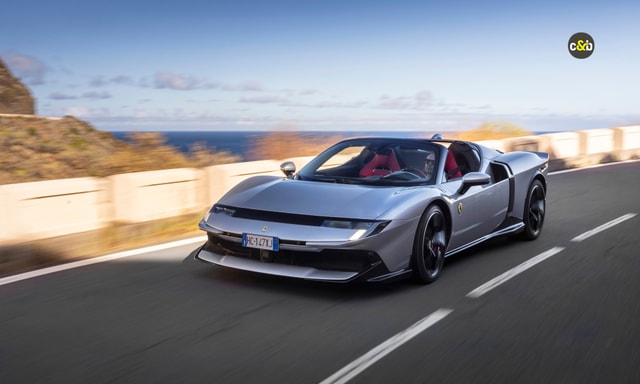 Shams Raza Naqvi | Jul 15, 2026Ferrari 849 Testarossa Spider Driven: Rs. 11.25 Crore Meets 1,000 bhpWe got behind the wheel of the most powerful convertible from Ferrari. What makes the 849 Testarossa Spider Special? We tell you.1 min read