
G7 Coalition Agrees $60 Per Barrel Price Cap For Russian Oil


The Group of Seven (G7) nations and Australia on Friday said they had agreed a $60 per barrel price cap on Russian seaborne crude oil after European Union members overcame resistance from Poland and hammered out a political agreement earlier in the day.
The EU agreed the price after holdout Poland gave its support, paving the way for formal approval over the weekend.
The G7 and Australia said in a statement the price cap would take effect on Dec. 5 or very soon thereafter.
The nations said they anticipated that any revision of the price would include a form of grandfathering to allow compliant transactions concluded before the change.
"The Price Cap Coalition may also consider further action to ensure the effectiveness of the price cap," the statement read. No details were immediately available on what further actions could be taken.
The price cap, a G7 idea, aims to reduce Russia's income from selling oil, while preventing a spike in global oil prices after an EU embargo on Russian crude takes effect on Dec. 5.
Warsaw had resisted the proposed level as it examined an adjustment mechanism to keep the cap below the market price. It had pushed in EU negotiations for the cap to be as low as possible to squeeze revenues to Russia and limit Moscow's ability to finance its war in Ukraine.
Polish Ambassador to the EU Andrzej Sados on Friday told reporters Poland had backed the EU deal, which included a mechanism to keep the oil price cap at least 5% below the market rate. U.S. officials said the deal was unprecedented and demonstrated the resolve of the coalition opposing Russia's war.
A spokesperson for the Czech Republic, which holds the rotating EU presidency and oversees EU countries' negotiations, said it had launched the written procedure for all 27 EU countries to formally greenlight the deal, following Poland's approval.
Details of the deal are due to be published in the EU legal journal on Sunday.
EU SEES SIGNIFICANT HIT TO RUSSIAN REVENUES
European Commission President Ursula von der Leyen said the price cap would significantly reduce Russia's revenues.
"It will help us stabilise global energy prices, benefiting emerging economies around the world," von der Leyen said on Twitter, adding that the cap would be "adjustable over time" to react to market developments.
The G7 price cap will allow non-EU countries to continue importing seaborne Russian crude oil, but it will prohibit shipping, insurance and re-insurance companies from handling cargoes of Russian crude around the globe, unless it is sold for less than the price cap.
Because the most important shipping and insurance firms are based in G7 countries, the price cap would make it very difficult for Moscow to sell its oil for a higher price.
U.S. Treasury Secretary Janet Yellen said the cap will particularly benefit low- and medium-income countries that have borne the brunt of high energy and food prices.
"With Russia’s economy already contracting and its budget increasingly stretched thin, the price cap will immediately cut into Putin’s most important source of revenue," Yellen said in a statement.
A senior U.S. Treasury Department official told reporters on Friday that the $60 per barrel price cap on Russian seaborne crude oil will keep global markets well supplied while "institutionalizing" discounts created by the threat of such a limit.
The chair of the Russian lower house's foreign affairs committee told Tass news agency on Friday the European Union was jeopardising its own energy security.
The initial G7 proposal last week was for a price cap of $65-$70 per barrel with no adjustment mechanism. Since Russian Urals crude already traded lower, Poland, Lithuania and Estonia pushed for a lower price.
Russian Urals crude traded at around $67 a barrel on Friday.
EU countries have wrangled for days over the details, with those countries adding conditions to the deal - including that the price cap will be reviewed in mid-January and every two months after that, according to diplomats and an EU document seen by Reuters on Thursday.
The document also said a 45-day transitional period would apply to vessels carrying Russian crude that was loaded before Dec. 5 and unloaded at its final destination by Jan. 19, 2023.
Related News


Latest Cars


Upcoming Cars


Latest News


 car&bike Team | Jun 30, 2026Delhi EV Policy 2.0: New Petrol Two-Wheeler Registration Banned in Delhi from April 2028With Delhi's new EV policy approved, new financial incentives for buyers will be introduced while setting a clear roadmap towards an all-electric future for new vehicle registrations.1 min read
 car&bike Team | Jun 30, 2026Tata Sierra EV: Variants, Features, Prices ExplainedThe Sierra EV is offered in six variants and two battery pack options.1 min read
 Hansaj Kukreti | Jun 30, 20262026 Tata Sierra EV: In PicturesThe much-awaited Tata Sierra has finally been launched in its all-electric avatar. Let's take a closer look at it.3 mins read
 Amaan Ahmed | Jun 30, 2026Tata Sierra EV Sandwiched Between Two Trucks In Novel Crash Test: Watch VideoNobody saw Tata's latest crash test coming -- not even the Sierra EV it was conducted on2 mins read
 Jaiveer Mehra | Jun 30, 2026Tata Sierra EV Launched In India At Rs 18.79 Lakh: 5 Variants, 63 & 75 kWh Battery Options, 500+ km RangeElectric derivative of the Sierra is based on the Acti.ev+ platform and is offers over 500 km of range in real-world use.4 mins read
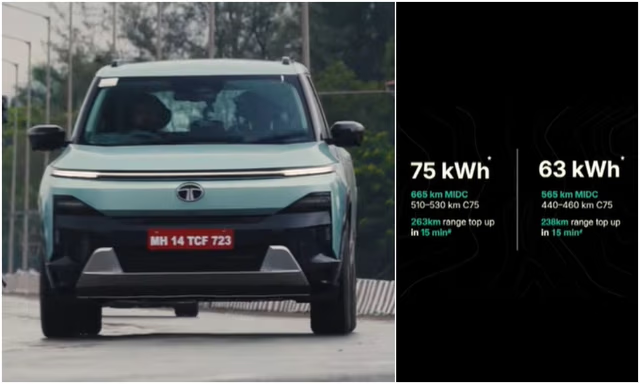 Amaan Ahmed | Jun 30, 2026Tata Sierra EV Real-World (C75) Range Figures RevealedUnlike what you may have seen on social media in recent days, the Sierra EV will not cover 700 kilometres, not even on the forgiving Indian Driving Cycle test2 mins read
 Seshan Vijayraghvan | Jun 29, 2026Renault Kiger vs Toyota Urban Cruiser Taisor: Which Underdog Deserves Your Money?Both the Kiger and the Taisor promise strong performance, solid features, comfortable cabins and everyday usability, all without breaking the bank. But which of these underrated subcompact SUVs deserves your money? Let's find out.1 min read
 Seshan Vijayraghvan | Jun 29, 2026Skoda Kodiaq RS Review: The Best Kodiaq Yet?The Skoda Kodiaq RS is finally here, and it's every bit as exciting as I expected. But was it worth the wait?7 mins read
 Bilal Firfiray | Jun 28, 2026BMW X6 M60i Review: It’s Back And HOW!The BMW X6 M60i blends a 530bhp twin-turbo V8, with its unmistakable coupe-SUV styling. There’s plenty of character, but is it worth your money?6 mins read
 Janak Sorap | Jun 25, 2026350cc Bajaj Dominar 400 Review: Same Character, Lower PriceA slightly lower displacement engine, a significantly lower price tag and nearly the same performance — the Bajaj Dominar 400 aims to be smarter rather than faster.6 mins read
 Preetam Bora | Jun 25, 20262026 Bajaj Pulsar NS400Z First Ride Review: Smaller Engine, But Should You Buy It?The Bajaj Pulsar NS400Z won our Two-Wheeler Upgrade of the Year. Then new tax slabs happened. Smaller engine, same badge – but does it still deliver?6 mins read