
Opinion: India’s Ethanol Blending Policy Needs More Clarity & Transparency

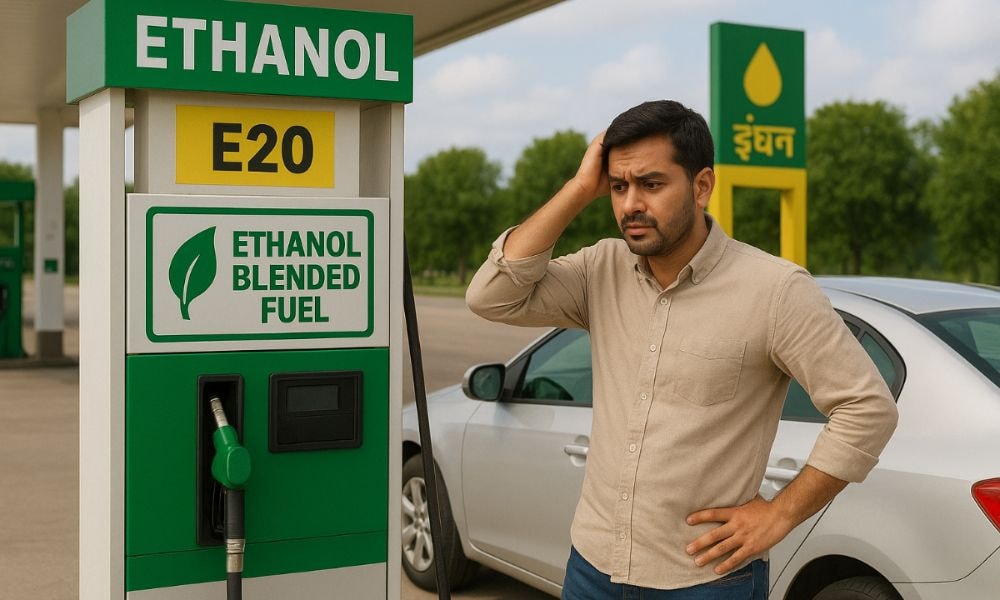
- India's E20 policy turns into a consumer trust issue
- Owners report real-world fuel efficiency drops of 10-15%
- Indian consumers see no cost benefit and no future policy clarity
At the heart of the growing public frustration over India's ethanol blending policy is a simple, damning fact: the government's own case for E20's safety rests on a study nobody outside the government has been allowed to read.
The government and vehicle manufacturers have repeatedly pointed to a 2021 report by the Automotive Research Association of India (ARAI) to refute claims that E20 damages vehicles. The report is said to conclude there's no significant damage or corrosion to components, though rubber parts in fuel systems may need replacing.
Also Read: E20 Petrol May Damage Rubber Components In Older Vehicles
But when motorists and transparency advocates filed Right to Information (RTI) requests to actually see the findings, ARAI declined, claiming the study is confidential and legally exempt from public scrutiny.
That refusal is what turns a fuel-efficiency debate into a trust problem. A government citing a study as proof of safety, while denying the public access to that same study, raises more questions than it builds confidence. In a word, it’s not transparency, it’s an instruction to take the government’s word for it. And that's precisely what a growing number of vehicle owners are no longer willing to do.
The Policy So Far
India rolled out 20 per cent ethanol blended petrol in phases before it became the standard default fuel nationwide on April 1, 2026, ahead of the earlier 2030 target. Every litre of petrol sold at every fuel station in the country since April 2026 is E20.
The government had been considering pushing blending even higher, and the Bureau of Indian Standards (BIS) has already notified fuel standards for E22, E25, E27 and E30. But the public outcry appears to have forced a pause. Officials now say any further increase in blending will only follow proper research and consultation with stakeholders. But then, no timeline, methodology, or independent body for that research has been named publicly.
Why Owners Are Angry
There are a couple of problems with regard to India’s ethanol policy when it comes to consumers. The first is that millions of older vehicles on Indian roads simply weren't built for E20, and there's no fuel choice for their owners. There’s no option to buy 100 per cent petrol, or even E10, which was the default blend before April 2026. Only vehicles sold after April 2023 are fully E20-compliant, which means someone who bought a new car or two-wheeler in early 2023, with no warning that compliance would become an issue months later, is now stuck.
That raises an obvious question few officials have answered directly - if E20-compliant vehicles had to be specifically engineered, why is the same fuel described as safe for E10-compliant vehicles too?
The second problem is running costs. Owners report real-world drops in fuel efficiency well above what the government acknowledges. Officials call the impact "marginal," in the range of 2–6 per cent. Many drivers say it's closer to 10–15 per cent.
Also Read: SIAM Assures Warranties of Non-E20 Compliant Vehicles Will Be Honoured
"My impeccably maintained Suzuki Swift has seen a drop of around 15% fuel efficiency since switching to E20. There is no cost advantage even when opting for what is mandatory E20 now. While fuel prices have increased, so have my monthly fuel expenses," said Abhishek Das.
“Why should I choose to invest much more in a new E20 compliant vehicle, when my current car is otherwise serving me well. Even if I go for an E20 vehicle, the future is uncertain regarding E25, E30 etc. So, no point in thinking about purchasing a new vehicle unless the policy becomes clearer,” adds Das.
Also Read: The E20 Fuel Insurance Trap - Will Your Policy Cover Ethanol-Related Engine Damage?
"We have an old Hyundai Grand i10 which sometimes struggles when it's not driven regularly. After refuelling and starting up after a while, the car almost starts limping. This never used to happen earlier. I guess it's because water would have separated out from the blended fuel while sitting for long," said Debidutt Acharya.
Underlying both complaints is a fair question - what does the Indian consumer gain from switching to E20? Globally, blended fuel is typically priced below pure gasoline. In India, E20 is the only base petrol on sale, with no discount attached to it.
Also Read: Govt Issues Clarification On Performance of Ethanol-Blended Petrol
What Experts Say
"It's primarily an implementation issue. If the pros and cons of ethanol-blended petrol had been laid out right at the onset, it wouldn't have snowballed into what it is right now," said Raj Kapoor, a senior automobile expert and former rally driver. "If there was some cost benefit using blended fuel, and some assurance from major auto manufacturers that nothing major is likely to break down, people would have gone along."
On the technical side, Kapoor doesn't dismiss the complaints. "The energy density of blended fuel is low, so you will end up using more fuel for the same amount of work. Deterioration of rubber and plastic components is an issue which will happen over time. Over a longer period of, say, five to seven years, there could be some damage when compared to pure gasoline."
He adds that in nearly two years of blended-fuel use, including E10, there haven't been major failures reported yet. On pricing, Kapoor is blunt.
"The world over, blended fuel is cheaper than regular gasoline. If the perception in India were that there's some kind of saving, and that emissions are better controlled, there would have been wider acceptance."
There's also an unresolved infrastructure question, and one which is being raised by many observers and critics. Ethanol is hygroscopic, meaning it attracts water more readily than pure petrol. Owners like Acharya are already describing symptoms consistent with this. Whether India's storage and transport infrastructure has been adapted to handle that risk hasn't been publicly addressed.
What Real Transparency Would Look Like
None of this makes the case for reversing course on ethanol blending. The climate and import-substitution arguments for it are real. But policy legitimacy depends on the public being able to check the government's homework, and right now they can't.
Three things would change that:
- Publishing the ARAI findings or commissioning a fresh independent study open to public review.
- Reinstating E10 or E5 as a choice at the pump, at least for pre-2023 vehicles, rather than mandating E20 as the only option.
- Pricing that actually reflects the cost savings ethanol blending is supposed to deliver, rather than leaving consumers to absorb higher fuel bills for a fuel they didn't choose.
Labelling consumer concerns as "vested interests" hasn't worked, and it isn't going to. Calling every question on government policy as being “anti-national” will make it even worse. Until the government treats scrutiny as part of the policy's legitimacy rather than a threat to it, the public outcry over E20 isn't going anywhere.
Related News

Latest Cars


Upcoming Cars


Latest News


 Preetam Bora | Aug 28, 2026Yamaha YZF-R2: Everything You Need to KnowThe new Yamaha YZF-R2 is available in three variants and sits above the R15 in the brand’s India line-up and is built on an all-new platform.6 mins read
 Carandbike Team | Aug 28, 20262027 Mahindra 3 Door Thar Facelift Spotted Testing Ahead Of LaunchThe facelift could get the Thar Roxx-inspired fascia with LED projector headlights and a new grille.1 min read
 car&bike Team | Aug 28, 2026Hero MotoCorp To Invest 1,758 Crore More In Ather EnergyHero MotoCorp will invest up to Rs 1,758 crore to increase its stake in Ather Energy from 29.88 per cent to 32.8 per cent.2 mins read
 Abhishek Nigam | Aug 28, 20262027 Kawasaki Versys 650 Launched In India At Rs 8.63 LakhThe MY27 Kawasaki Versys 650 continues with its 649cc parallel-twin engine, long-travel suspension and 21-litre fuel tank, with deliveries set to begin by the end of August.1 min read
 Sarthak Mahajan | Aug 27, 2026Tata Motors Passenger Vehicles Reveals New ‘TATA.CARS’ Brand IdentityLegal name continues to remain Tata Motors Passenger Vehicles Ltd.1 min read
 Sarthak Mahajan | Aug 27, 2026Yamaha YZF-R2: In PicturesYamaha Motor India has launched the YZF-R2 at Rs 2.30 lakh, positioned above the Yamaha R15 V4.2 mins read
 Preetam Bora | Aug 25, 20262026 Hero Xoom 160 Review: Maxi-mum Potential!With styling and proportions that goes into actual maxi-scooter territory, a liquid-cooled engine and large 14-inch wheels, the Hero Xoom 160 holds a lot of promise. But should you buy it?9 mins read
 Seshan Vijayraghvan | Aug 19, 20262026 BMW X1 Long-Wheelbase Review: Is This The X1 To Buy?Along with the extra rear legroom, the new BMW X1 LWB offers more features, more safety tech, and a more powerful petrol engine. But do these updates actually make it a better SUV?1 min read
 Janak Sorap | Aug 17, 2026Bajaj Pulsar N160 SS First Ride Review: The Most Tech-Loaded Pulsar Yet?The Bajaj Pulsar N160 SS brings more power, new-age electronics and sharper styling to the familiar 160cc Pulsar formula.5 mins read
 Jaiveer Mehra | Aug 16, 2026Honda Amaze CVT Long Term First Report: 1800 Km InThe Amaze is the first sedan to join our long term feet in a year, and while on paper it lacks some of the features offered in its rivals, there’s plenty of promise in the package.1 min read
 Preetam Bora | Aug 12, 2026Royal Enfield Himalayan 440 Custom Review: Beating RE to the PunchDelhi-based custom motorcycle shop TNT Motorcycles introduces packages to convert existing Himalayan 411 adventure bikes to Himalayan 440. Is it worth the expense?8 mins read