
TVS Apache RTR 310 Vs TVS Apache RR 310: Differences Explained

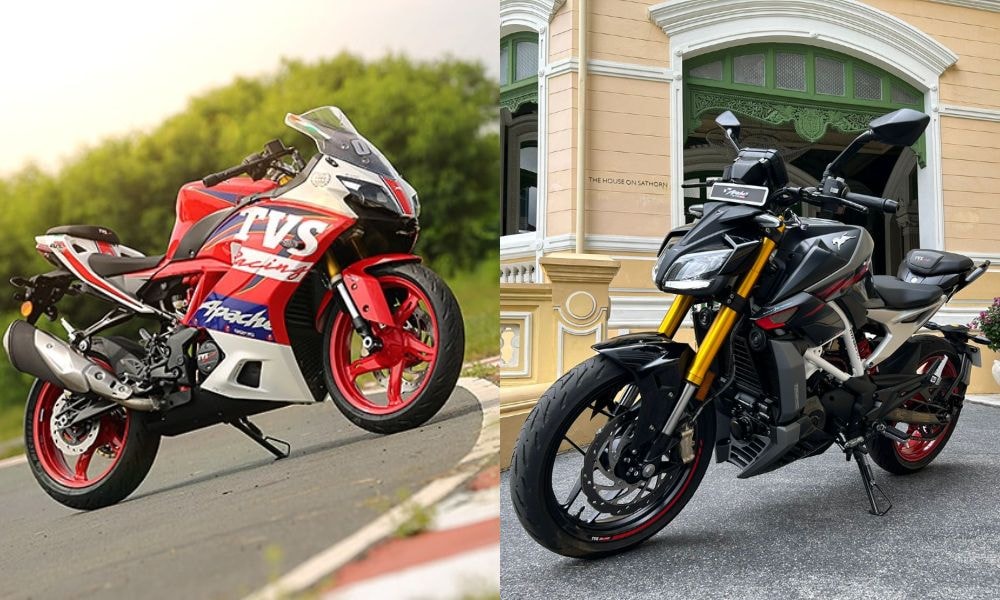
- Apache RR 310 and Apache RTR 310 are flagship in TVS’s portfolio
- Both bikes are powered by the same 312cc single-cylinder unit with different power outputs
- Apache RTR 310 gets additional features over the RR 310
TVS Motor Company has launched the new TVS Apache RTR 310, and the new streetfighter is based on the flagship TVS Apache RR 310, but the RTR 310 gets several noteworthy changes, including segment-first features. With optional Built to Order kits offering a long list of features, the Apache RTR 310 is one of the most feature-packed motorcycles available in the Indian market. And it has several differences from its sibling the Apache RR 310 as well. Here’s a look at the key differences between the RTR 310 and the RR 310.
Same 312 cc Engine, But Different
The 312.12 cc, single-cylinder, liquid-cooled engine of the RTR 310 is the same as the RR 310’s but there are some changes in the state of tune. The intake and airbox have been changed, and some changes have been carried out in the internals of the exhaust as well. So, the RTR 310 not just sounds different, but also makes slightly more power and torque than the RR 310.
The Apache RTR 310’s engine makes 35.1 bhp at 9,700 rpm and 28.7 Nm of peak torque at 6,650 rpm. Comparatively, the TVS Apache RR 310’s engine makes maximum power of 33.5 bhp at 9,700 rpm and 27.3 Nm at 7,700 rpm. Maximum power of the Apache RTR 310 is up 1.6 bhp from the RR 310’s, while peak torque is up 1.4 Nm.
The RTR 310’s engine has been tuned for better low and mid-range performance. The RTR 310 has a 0-60 kmph claimed acceleration time of 2.81 seconds, compared to the RR 310’s 2.93 seconds, but in the 0-100 kmph acceleration time, the RTR 310 has a claimed time of 7.19 seconds, compared to the RR 310’s 0-100 kmph acceleration time of 7.17 seconds.
Also Read: TVS Apache RTR 310 Launched At Rs 2.43 Lakh
TVS Apache RTR 310 Gets Additional Supermoto Mode
The RTR 310 gets five riding modes (Urban, Rain, Sport, Track and Supermoto), with power restricted to 26.7 bhp at 7,500 rpm in Urban and Rain mode, and peak torque restricted to 27.3 Nm at 6,600 rpm in Urban and Rain modes. The RTR 310 also gets an additional Supermoto mode where the rear ABS can be turned off in Urban and Sport modes.
Chassis & Dimensions
The TVS Apache RTR 310 has the same steel trellis frame as the RR 310, but the bolt-on aluminium rear subframe is different. The RTR 310 also is the lighter bike with a kerb weight of 169 kg, compared to the RR 310’s kerb weight of 174 kg.
The RTR 310 also gets full adjustable KYB suspension as part of the Built to Order customisation program, where customers can select two kits with more features. The Dynamic kit costs Rs. 18,000 and the Dynamic Pro kit will cost Rs. 22,000 extra. The RTR 310 has a slightly lower saddle height of 800 mm, while the RR 310 has a saddle height of 810 mm. The RTR 310 also has a shorter wheelbase of 1358 mm, compared to the RR 310’s 1365 mm wheelbase.
TVS Apache RTR 310 Instrument Console
The Apache RTR 310 gets a new 5-inch full-colour TFT instrument console which is packed with features. The console enables the rider to change and tune settings like the traction control, cruise control, headlamp brightness and even music for a Bluetooth connected device. The SmartXonnect app offers smartphone connectivity displays a long list of telemetry and data, including post ride analysis, and also offers a tyre pressure monitoring system and built-in controls for a GoPro camera.
Electronics
The Dynamic kit and Dynamic Pro kits, also open up other features, like the adjustable front and rear suspension on the Dynamic kit. The Dynamic Pro kit included a 6-axis IMU powered lean-sensitive ABS, traction control and cruise control systems, through the Race-Tuned Dynamic Stability Control (RTDSC). The RTDSC also offers wheelie control, stoppie control and slope dependent control systems, which are offered as optional safety equipment.
Design & Other Features
The TVS RTR 310 features a completely different design language, with its sharp and sporty silhouette. The bodywork features sharp creases and the bike has a sport stance which underscores its streetfighter appeal. The split LED headlight automatically controls throw and brightness depending on the speed of the bike and ambient light conditions. The sharp tail section features a dynamic twin tail light which adapts to the intensity of braking, flashing red during rapid deceleration as a warning to those behind.
Prices
The base variant of the TVS Apache RTR 310 is priced at Rs. 2.43 lakh (Ex-showroom), which is around Rs. 28,000 less expensive than the base variant TVS Apache RR 310, priced at Rs. 2.72 lakh (Ex-showroom). But the base variant doesn't get the bi-directional quickshifter, which is only available a variant above, priced at Rs. 2,57,990 (Ex-showroom). And for the Fury Yellow colour variant, the price goes up to Rs. 2,63,990.
But then, the adjustable suspension is only available in the Dynamic kit, priced at Rs. 18,000 and for those looking at availing of the 6-axis IMU powered electronics, which include lean-sensitive ABS, traction control and ABS, the price will be a further addition of Rs. 22,000 pushing up the price of the RTR 310 BTO to Rs. 3,03,990 (Ex-showroom). And if one has to choose the Sepang Blue colour option, the price further shoots up to Rs. 3,13,990 (Ex-showroom).
The RR 310, on the other hand, with just the Dynamic Kit (with adjustable suspension) costs Rs. 2,87,000 (Ex-showroom), and even with the Race Kit added on (with lowered handlebar, and raised footpegs), it's still shy of the 3 lakh mark at Rs. 2,97,000 (Ex-showroom).
Related News


Learn more about


Popular Models


Latest Cars


Upcoming Cars


Latest News


 Sarthak Mahajan | Sep 8, 2026Porsche Cayenne Electric India Launch On September 30: All You Need To KnowIt will be offered with a 113 kWh battery paired with two electric motors, with the Turbo Electric model producing up to 1,140 bhp and 1,150 Nm of peak torque.1 min read
 car&bike Team | Sep 8, 2026Royal Enfield Himalayan 440: Top Five HighlightsWith the launch of the Himalayan 440 here are the top five highlights of the motorcycle.1 min read
 car&bike Team | Sep 8, 2026Kinetic DX+ Electric Scooter Gets 3.1 kWh Battery, 132 km RangeThe upgraded Kinetic DX+ gets a larger LFP battery, 3.8 kW motor and features such as Park Assist, Reverse and regenerative braking.1 min read
 Jaiveer Mehra | Sep 8, 2026Next-Gen Kwid EV Arrives In Europe As All-New Dacia Spring EVSecond-gen city car is underpinned by the Renault Group’s RGEV Small platform and offers up to 250 km of range.3 mins read
 car&bike Team | Sep 8, 2026MT Thunder 4 SV Helmet Launched In India At Rs 13,699; Gets 5-Star SHARP RatingReiseMoto has launched the MT Thunder 4 SV full-face helmet in India, priced from Rs 13,699, with ECE 22.06, DOT and ISI certifications along with a five-star SHARP safety rating.1 min read
 car&bike Team | Sep 8, 2026Jawa 42 Bobber All Stars Edition Launched At Rs 2.09 LakhThe Jawa 42 Bobber gets the Global Chess League-inspired All Stars treatment, with five colour options and cosmetic updates.1 min read
 Shams Raza Naqvi | Sep 8, 20262026 Maruti Suzuki Baleno Review: Heart Matters, Or Does It?The updated Maruti Suzuki Baleno is here and it gets some significant changes some of which have got the opinion divided. We drive it.7 mins read
 Abhishek Nigam | Sep 7, 2026Simple Wave First Ride Review: Space, Pace And More SpaceThe Simple Wave is here to rewrite the rules of the family EV scooter segment. We scoot around to tell you whether it will create waves or not!7 mins read
 Janak Sorap | Sep 4, 20262026 Ducati Monster V2 Review: Raising The BarWith the fifth iteration, the Ducati Monster gets a lighter chassis, a new 890cc V2 engine, sophisticated electronics and tweaks to the suspension, all to make the 2026 version so compelling.7 mins read
 Shams Raza Naqvi | Sep 4, 20262026 Lexus ES 350h And Lexus ES 500e Review: Luxury Meets CapabilityWe got behind the wheels of the new Lexus ES twins which were launched in India earlier this year. Which one suits you more? Lets find out1 min read
 Amaan Ahmed | Sep 2, 2026Konarc Is The Rizta That Works For Everyone -- Including Ather Energy | FIRST RIDE REVIEWFor the slow-but-sure Ather, the Rizta was the foot in the door -- the similarly-capable Konarc, purpose-built to win over every Indian family, is built to kick that very door down.10 mins read