
2024 Citroen Basalt Turbo Petrol AT Review: India’s Most Affordable SUV Coupe


- Fourth model on the C Cubed made-for-India platform by Stellantis
- Shares a lot of design and feature elements with C3 Aircross SUV
- Two engines, three transmission options. 18-19.5 kmpl claimed
Five years ago, at the brand launch in 2020, Citroën had assured that it would bring at least one new model to India every year for the next few years. It all began with the C5 Aircross SUV which was a full import. Then came the first of the C Cubed platform-based C3 hatch, which was the first time that a Citroen was made outside of France. In less than a year since that launch came its electric version, the eC3 and last year saw the launch of the C3 Aircross SUV. For the new one on the same platform though it has junked the C3 nomenclature and gave this rather unique body style a different name to stand out than rest of its range.
Also Read: Citroen Basalt Launched In India; Priced At Rs 7.99 Lakh
Design & Styling
Unlike its SUV sibling, Basalt gets smaller 16-inch wheels with 205/60 rubber.
The Basalt is 4352 mm long, 1765 mm wide (without mirrors) and 1593 mm tall. Proportions wise it is marginally longer than a C3 Aircross. Interestingly, the wheelbase is shorter by roughly 20 mm at 2651 mm. Ground clearance is also lower by a similar number and amounts to 180 mm.
Also Read: Citroen Basalt Coupe-SUV Debuts: Dimensions, Features, Engine Options Detailed
The signature Citroen split DRLs continue on the Basalt.
The design looks fresh, just like the new body style but that is something Citroen hasn’t faltered much with during its stint so far. The proportions with a fairly long boot, high waistline, sloping roof and chunky C-pillar give it a classic coupe-like look despite the higher stance. The front looks rounded but smart with its elaborate headlamp assembly and large air intakes encompassing most of the front bumper. In what has become the norm, the turn indicators and DRLs stay above the front lamps.
No connected lamp bars in action here.
While no figure was given, Citroen claims the coupe silhouette and underbody layout offer a much lower coefficient of drag (lower resistance to air while in motion), much closer to regular sedans. The rear hatch looks muscular too with an elaborate wraparound taillamp set-up. Citroen designers have kept it clean with the only embellishment being the Double Chevron logo.
Interior & Cabin Styling
Most of the plastics are hard but a nicer texture belies this fact.
The Basalt is a five-seater. Despite it packing lesser room between its front and rear axles than a C3 Aircross, you might find it tough to perceive the change in legroom both at the front and rear. The only noticeable difference is the headroom at the rear. While Citroen claims it is good enough, we do feel some passengers – those with a taller torso – may find their heads brushing the roof.
Also Read: Citroen Basalt Coupe-SUV: Top Five Highlights
The 2nd row gets 2 adjustable headrests.
Seat cushioning is on the softer side especially the ones on the side, at the rear. No ventilated or power seats are being offered. However, Citroen has tried to add comfort for rear passengers by introducing a 3-step adjustable under-thigh support mechanism.
A unique thigh support adjuster in the rear row is a helpful feature.
Only two headrests but both are angled to allow passengers to rest their heads – helpful if asleep. The centre tunnel is high though and the AC vent unit protrudes out too much which could be discomforting to the central passenger.
The dashboard is dominated by a 10.5-inch touchscreen.
Citroen will offer the Basalt in two interior colour options. The theme here is predominantly white, which looks rich but will need extra attention to keep it clean. Also, fit and finish look really good. They have tried to make it look upmarket. The C-shaped air vents are classic Citroen design cues.
Also Read: Citroen C3, C3 Aircross Updated With New Features: LED Headlights, Auto AC, 6 Airbags And More
A small steering wheel goes well with the sportier intentions of an SUV coupe.
Steering buttons, steering column stalks and buttons have a nice tactile feel. Basalt gets automatic climate control. There is a wireless phone charger with an anti-skid pad and a USB charger as well along with the usual storage areas such as cup holders at the centre and bottle holders on the doors. There is also a centre armrest for the front passengers with storage space.
There is a wireless phone charger with anti-skid pad.
The dashboard is dominated by a 10.5-inch touchscreen which is borrowed from its siblings. However, this has been slightly updated for colours and display. Citroen will offer these updated screens in the MY25 C3 Aircross too. The interface is clean and neat with three inter-changeable modes. Touch feel could be better but is acceptable. The system allows wireless Android Auto and Apple CarPlay connectivity.
The new Auto Climate control feature has been passed on to C3 Aircross as well.
Citroen will also be offering the whole gamut of Citroen Connect features via its app with the Basalt. These include remote door lock/unlock, remote engine start and geo fencing. The instrument cluster is a new 7-inch coloured TFT display. We feel it looks a tad small for the overall expanse of the dashboard however it does display a reasonable amount of useful information in it.
Also Read: Citroen C3 Aircross 7 Dhoni Edition Launched At Rs 11.82 Lakh
Boot is quite big at 470 litres.
There are some misses though. Even in this top variant, Basalt does get auto headlamps or speed-sensing wipers. A bigger sore sight for most of you might be that it still uses classic turn-key ignition, which most cars are shying away from. The rear seat backrest doesn’t get the useful 60:40 split so if you need a bit more boot space than normal then you will have to fold the entire thing. However, Basalt offers a bit more than what is normal for most cars its size with a standard boot size of 470 litres.
Safety
The 7-inch digital cluster has a TPMS display.
While no crash test results are available yet, Citroen maintains the use of high tensile strength steel for the Basalt which gives it adequate robustness to meet the safety norms. Apart from this, they are also offering six airbags alongside three-point seatbelts as standard for all five passengers. Basalt continues to get ventilated disc brakes at the front and drum brakes at the rear, similar to its SUV sibling. ESP, Hill Hold, TPMS, Child Seats mount are also included. Rear parking sensors and camera are also available.
Engine & Performance
There are two engine options from the same Puretech family.
The base Basalt variant gets an 1198 cc, 3-cylinder petrol unit that churns out 80 bhp and 115 Nm of peak torque. This will be mated to a five-speed manual transmission. The combination is similar to the one in a C3 hatchback. Only difference being that in the Basalt, this will return a lower claimed fuel efficiency of around 18 kmpl. We have yet to test this engine on the Basalt but it seemed just about adequate in the smaller C3, which may fall a bit short in the bigger and heavier Basalt.
Citroen claims fuel efficiency of up to 19.5 kmpl.
The second engine is also a 1.2-litre but a turbo petrol unit that makes a higher 109 bhp. This is also used in the C3 Aircross. In the Basalt too this is available in two transmission options. It is available with either a 6-speed manual where torque peaks at 190 Nm or a 6-speed torque convertor automatic which offers a higher 205 Nm of torque. Citroen claims fuel efficiency figures of 19.5 and 18.7 kmpl, respectively.
The claimed 0-100kph figure for the Basalt turbo petrol AT is 9.95s.
What we have reviewed is the top turbo petrol variant. By nature, this 3-cylinder unit doesn’t sound as great as a normal four-cylinder. However vibrations are well controlled. The Basalt feels smooth and refined at the start. The automatic’s response is instantaneous from a standstill. In slow-moving traffic - if you try to keep a constant speed it tends to get fidgety as if it is not sure whether to change or stay where it is.
Ride & Handling
Basalt isn’t too heavy a car so the power seems enough to build speed.
The steering weighs well and there is adequate power assist at most speeds. What is most noteworthy is the ride quality. The suspension set up includes a Macpherson strut at the front and rear twist beam - both with coil springs – to keep things stable and calm. We reckon this is the best suspension set-up so far on any of the C-Cubed models. The settings are different from even the nicely sprung C3 Aircross because of a difference in front and rear weight distribution here.
The Basalt is good at absorbing road irregularities.
Minor potholes and bumps don’t hamper it although it feels a bit light. Body roll peeks out only under extreme cornering. Quick lane changes are met with minimal resistance. Under braking it feels stable although it could do with more bite. Grip, otherwise, seems fine. We tested the car under mostly slippery conditions and there were no hairy moments. Sitting slightly higher than sedans helps on our kind of roads and traffic conditions.
Verdict
Citroen has brought the SUV Coupe style to Compact SUV space.
SUV Coupes were once operating only in the luxury car segment. It is aimed at someone who wants an even more car-like driving SUV. One that will not roll much around twisty roads and not be overwhelmed by bad roads. On that front, the Basalt does pretty well. While it has a relatively more modern interior, many features such as button start, cruise control, automatic headlamps/wipers are missing, which will impact the overall brand experience for many.
The trump card that Citroen hopes will turn the tide in its favour is the price.
The Basalt will start at an extremely aggressive Rs 8 lakh onwards. Which means a fully-specced variant could well be under Rs 15 lakh on road. While we would have loved to see Citroen go all out with the Basalt, at this price it does look like a unique value proposition unless someone else can match it.
Editors’ Rating: 8/10


Latest News


 car&bike Team | Jul 21, 2026Mahindra Scorpio Classic Prices Hiked By Up To Rs 40,000Mahindra has begun rolling out its latest price revision across the lineup, with the Scorpio Classic becoming up to Rs 40,000 more expensive1 min read
 Janak Sorap | Jul 21, 2026Royal Enfield 350cc Bikes Manufactured Post Aug 25 To Get Free Gear Position IndicatorRoyal Enfield has resumed fitment of the Gear Position Indicator on select 350cc models manufactured after August 2025, following the resolution of a parts supply issue.1 min read
 car&bike Team | Jul 21, 2026Citroen Basalt X Comfort Edition Launched At Rs 8.75 LakhThis edition comes with ‘Comfort AXS Packs’, which essentially introduces some of the top-end variant's features to lower, more accessible variants.1 min read
 Jaiveer Mehra | Jul 20, 2026Hyundai Boulder Sport Incoming? New Off-Roader Revealed In Design PatentA new design patent filed under the Hyundai & Kia brands previews a Boulder concept-inspired SUV.2 mins read
 car&bike Team | Jul 20, 2026MG M9, Cyberster Prices Hiked By Up To Rs 5 LakhThe Cyberster now costs over Rs 5 lakh more than before, while the M9 electric MPV has become Rs 4.04 lakh dearer.2 mins read
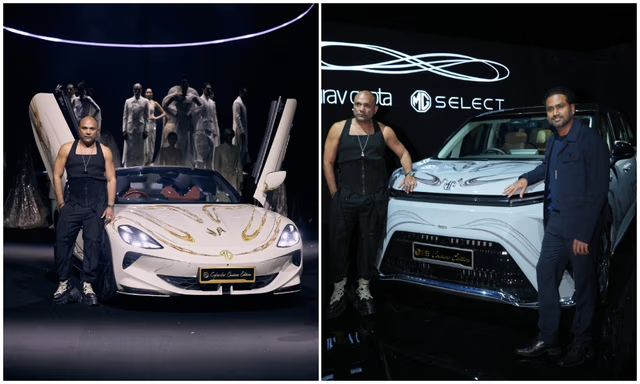 car&bike Team | Jul 20, 2026MG Cyberster, M9 Couture Editions Unveiled: Bookings OpenCouture Editions of the Cyberster and M9 are limited to just 50 units each.1 min read
 Shams Raza Naqvi | Jul 15, 2026Ferrari 849 Testarossa Spider Driven: Rs. 11.25 Crore Meets 1,000 bhpWe got behind the wheel of the most powerful convertible from Ferrari. What makes the 849 Testarossa Spider Special? We tell you.1 min read
 Bilal Firfiray | Jul 12, 2026Tata Sierra EV Review: Reborn In The Electric AgeThe Tata Sierra EV isn’t drastically different from its ICE counterpart when it comes to design. But being the seventh electric offering from the Indian brand, it has gotten a few things right, and very few things wrong. But is it a compelling package to buy?5 mins read
 Jafar Rizvi | Jul 13, 2026TVS Orbiter Long-Term Review (Report 1): Settling In Takes TimeFirst impressions weren't the strongest, but the Orbiter has made a mark in its first month in the car&bike garage.5 mins read
 Seshan Vijayraghvan | Jul 7, 2026Tata Altroz Petrol DCA Long-Term Review: Intercity & Highway Driving ReportWe tested the Tata Altroz Petro DCA’s highway manners, intercity performance, and real-world fuel efficiency.1 min read
 Seshan Vijayraghvan | Jun 29, 2026Renault Kiger vs Toyota Urban Cruiser Taisor: Which Underdog Deserves Your Money?Both the Kiger and the Taisor promise strong performance, solid features, comfortable cabins and everyday usability, all without breaking the bank. But which of these underrated subcompact SUVs deserves your money? Let's find out.1 min read