
End-of-Life Vehicle Rules In India: What Happens To Old Diesel And Petrol Cars?

- Several systems have been put in place to take older vehicles off the road
- The MoRTH, MoEF&CC, and NGT are working together to detect polluting vehicles
- There are different vehicle scrappage policy rules for Delhi NCR and the rest of the country
India’s Ministry of Road Transport and Highways (MoRTH), Ministry of Environment, Forest and Climate Change (MoEF&CC), and the National Green Tribunal (NGT) are all working in unison to flag and remove older vehicles under the recent ELV rule. While keeping a well-maintained car for 20 years used to be a badge of honour, the current regulatory environment makes it extremely difficult, and in some cities, legally impossible.
The Age Limit: Delhi NCR vs The Rest of India
One big confusion among car owners right now is the difference between the national scrappage policy and the specific rules for the National Capital Region (Delhi NCR). Let us clear that up first.
For Delhi NCR:
If you live in Delhi, Noida, Gurugram, or the surrounding NCR areas, the rules state that under the NGT and Supreme Court orders, diesel cars older than 10 years and petrol cars older than 15 years are completely banned. The situation applies even if your car is mechanically perfect and has a valid Pollution Under Control (PUC) certificate.
As of early 2026, the Delhi Transport Department has begun to flag these vehicles actively. Older BS-III and below cars are getting impounded and sent directly to the scrap yard, even if they are just parked outside your house. Furthermore, Automated Number Plate Recognition (ANPR) cameras installed at petrol pumps in Delhi actively flag ELVs, meaning these overage cars are not given fuel at all.
For the Rest of India:
Outside the NCR, the MoRTH National Vehicle Scrappage Policy checks a vehicle's status based on fitness, not just age. For private vehicles, the age limit is 20 years, while commercial transport vehicles have a 15-year limit.
But after your private car clocks in 20 years, you cannot just renew the registration with a renewed fee payment. You must take the car to a certified Automated Testing Station (ATS) first.
The Fitness Test and the 180-Day Rule
When you take your 20-year-old car for its mandatory fitness test, the ATS will check emission levels, brake efficiency, headlamp alignment, steering free play, and structural integrity.
If your car passes, you get a green signal to keep driving for another five years. If it fails, you are allowed to repair the issues and apply for a retest. But if it fails the retest, your car is officially labelled an End-of-Life Vehicle. The VAHAN portal will flag it, meaning you can no longer legally drive or transfer the car.
Because of the Environment Protection (End-of-Life Vehicles) Rules rolled out in 2025, vehicle owners now have exactly 180 days from the day a vehicle becomes an ELV to deposit it at a Registered Vehicle Scrapping Facility (RVSF) or a designated collection centre.
What Actually Happens at the Scrap Yard?
The days of handing your car over to a local mechanic for cash are over. Doing so leaves you legally vulnerable if the car's engine or chassis is used in a crime, as the registration remains in your name.
Today, you must use an RVSF. When you surrender your car, the facility scientifically drains the hazardous fluids like engine oil, coolant, and brake fluid. The battery and tyres are sent for separate recycling. The core metal body is then crushed and baled. Under the new Extended Producer Responsibility (EPR) framework, car manufacturers are now legally required to buy back these recycling certificates to meet their own steel recovery targets.
Once the RVSF destroys the chassis number, your car is permanently deregistered from the VAHAN database.
Financial Recovery: Getting Value from Your Scrapped Car
The government has also structured the policy to ensure you get some financial relief when buying your next vehicle. When you scrap your vehicle at an RVSF, you receive a Certificate of Deposit (CD). This certificate is incredibly valuable. Here is what it gets you:
- Scrap Value: The facility pays you the scrap value of the metal, which is usually around 4% and 6% of the ex-showroom price of a similar new vehicle. A standard small hatchback could demand somewhere from Rs. 15,000 to Rs. 30,000, while larger SUVs will return a lot more.
- Road Tax Rebate: State governments offer a road tax concession of up to 25% on your new private vehicle purchase when you present the CD. For a new car with a high ex-showroom price, this 25% discount on the road tax means massive savings.
- Registration Fee Waiver: The registration fee for your new car is completely waived.
- Manufacturer Discounts: Many car manufacturers will give you an additional upfront discount on a new car against a valid CD.
Keep in mind that the Certificate of Deposit is valid for two years and can be transferred to a family member once.
Can You Save Your Car by Moving It?
If you live in Delhi NCR and own a 10-year-old diesel SUV that's still in great shape, you might wonder if you can sell it elsewhere. Yes, you can, but it requires a No Objection Certificate (NOC) from your local RTO. You must secure this NOC and physically move the car out of the NCR before the 10-year deadline expires.
But selling an older car in a different state has also become harder as buyers are increasingly wary of the tightening fitness rules. An older BS-IV diesel car does not command the resale value it used to. For many owners, calculating the hassle of an inter-state transfer against the guaranteed benefits of the Certificate of Deposit makes scrapping the more logical choice.
The reality of 2026 is that the automotive market has moved firmly towards cleaner emissions and strict compliance. Letting go of a reliable older car is difficult, but understanding the ELV rules means you stay on the right side of the law while maximising your financial returns.


Latest News


 car&bike Team | Jun 29, 2026Delhi EV Policy Approved: Electric Cars Under Rs 30 Lakh To Get Full Tax ExemptionThe new policy offers purchase incentives and scrappage benefits while laying down a roadmap for EV-only registrations across several vehicle segments, including two-wheelers from 2028.2 mins read
 car&bike Team | Jun 29, 2026New-Gen BMW X5 Teased Ahead Of Global Debut TomorrowThe teaser previews a fresh X-shaped lighting signature in a familiar illuminated grille setup.3 mins read
 car&bike Team | Jun 29, 2026Tata Sierra EV Launch Tomorrow: What To Expect?The Sierra EV is expected to share much of its package with the Harrier EV.3 mins read
 Jaiveer Mehra | Jun 28, 2026Nissan Tekton Spied Undisguised Ahead Of July 9 DebutSole image of the SUV showcases the rear design of the SUV.1 min read
 Carandbike Team | Jun 28, 2026Renault Kwid Facelift India Launch On July 3Latest facelift marks the second major update for the entry hatchback since its launch in 2015.1 min read
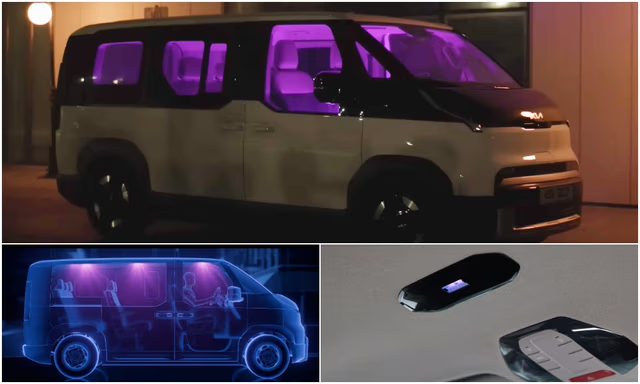 Amaan Ahmed | Jun 27, 2026Future Hyundai, Kia Cars May Feature In-Built UVC SanitiserHyundai Motor Group has unveiled 'Plasma Care UVC' technology, which utilises plasma lamps to safely and effectively destroy bacteria and viruses present inside a car.1 min read
 Seshan Vijayraghvan | Jun 29, 2026Renault Kiger vs Toyota Urban Cruiser Taisor: Which Underdog Deserves Your Money?Both the Kiger and the Taisor promise strong performance, solid features, comfortable cabins and everyday usability, all without breaking the bank. But which of these underrated subcompact SUVs deserves your money? Let's find out.1 min read
 Seshan Vijayraghvan | Jun 29, 2026Skoda Kodiaq RS Review: The Best Kodiaq Yet?The Skoda Kodiaq RS is finally here, and it's every bit as exciting as I expected. But was it worth the wait?7 mins read
 Bilal Firfiray | Jun 28, 2026BMW X6 M60i Review: It’s Back And HOW!The BMW X6 M60i blends a 530bhp twin-turbo V8, with its unmistakable coupe-SUV styling. There’s plenty of character, but is it worth your money?6 mins read
 Janak Sorap | Jun 25, 2026350cc Bajaj Dominar 400 Review: Same Character, Lower PriceA slightly lower displacement engine, a significantly lower price tag and nearly the same performance — the Bajaj Dominar 400 aims to be smarter rather than faster.6 mins read
 Preetam Bora | Jun 25, 20262026 Bajaj Pulsar NS400Z First Ride Review: Smaller Engine, But Should You Buy It?The Bajaj Pulsar NS400Z won our Two-Wheeler Upgrade of the Year. Then new tax slabs happened. Smaller engine, same badge – but does it still deliver?6 mins read