
Fiat Chrysler Paid $77 Million In U.S. Fuel Economy Penalties In 2018

Fiat Chrysler Automobiles NV told Reuters on Thursday it paid $77 million in U.S. civil penalties late last year for failing to meet 2016 model year fuel economy requirements, the first significant sign the industry is facing hurdles meeting rising emissions rules.
The Italian-American automaker has been lobbying the Trump administration to revise fuel economy requirements and last year regulators proposed freezing requirements at 2020 model-year levels through 2026.
Shane Karr, head of external affairs for Fiat Chrysler in North America, said in a statement the fuel economy program should be reformed rather than "requiring companies to make large compliance payments because assumptions made in 2011 turned out to be wrong."
Karr added that the automaker is "committed to improving the fuel efficiency of our fleet and expanding our U.S. manufacturing footprint."
The National Highway Traffic Safety Administration (NHTSA) said in a report dated Dec. 21 that the industry faced $77 million in fines in 2016 and that one unnamed manufacturer "is expected to pay significant civil penalties." The agency did not immediately comment on Thursday.
The civil penalty payment is much higher than in prior model years. The industry paid $2.3 million in civil penalties in 2014 and $40 million in 2011.
Under federal rules, automakers can accrue credits for overcomplying in some years. In 2012, the Obama administration finalized rules requiring automakers to nearly double the fleet-wide fuel efficiency of vehicles to more than 50 miles per gallon by 2025, but the Trump administration has proposed rolling back those requirements starting in the 2021 model year.
NHTSA also noted that the number of automakers' fleets with credit shortfalls had risen to 26 in 2016, up from 18 in 2011, and the number of surpluses fell from 26 in 2011 to 15.
Steve Bartoli, a Fiat Chrysler vice president who oversees fuel economy issues, said in September at a public hearing on the fuel rules that starting in 2016 the auto industry had been unable to meet current requirements without using credits earned from prior model years. Bartoli called the gap "a wake-up call that assumptions made seven years ago about the U.S. auto market need to be revisited."
The NHTSA report also said automakers collectively face projected shortfalls of about $1.2 billion for both the 2017 and 2018 model years, but it was unclear how much in credits can be used to offset the deficits.
Fiat Chrysler said the payment was anticipated and the costs were included in the company's fourth-quarter financial results released on Thursday.
The company has previously purchased emissions credits from Tesla Inc, Toyota Motor Corp and Honda Motor Co.
Fiat Chrysler paid penalties for its domestically produced car fleet that did not meet efficiency requirements. It noted rules governing domestically produced cars restrict the use of credits.
The company explained the shortfall in part by noting that starting in the 2011 model year some front-wheel-drive utility vehicles previously classified as trucks were moved to the car fleet, which have much tougher fuel-efficiency requirements.
Fiat Chrysler noted those vehicles are taller and require more energy than sedans. In 2016, the company produced four such vehicles: the two-row Dodge Journey, Jeep Cherokee, Jeep Compass and Jeep Patriot.
By contrast, Fiat Chrysler said its average light-truck fuel economy in 2016 was higher than Toyota, Ford Motor Co and General Motors Co, while its car numbers were significantly lower.
The Trump administration said last year the fuel economy freeze would save the automakers more than $300 billion in regulatory costs.
Trump's proposed freeze would result in 500,000 barrels per day more oil consumption by the year 2030. California says the proposal "would worsen air quality for the most vulnerable (and) waste billions of gallons of gasoline."
(This story has not been edited by NDTV staff and is auto-generated from a syndicated feed.)
Related News


Latest Cars


Upcoming Cars


Latest News


 Jaiveer Mehra | May 29, 20262026 Tata Tiago Variant-Wise Features, Prices DetailedThe new Tiago is offered in six trim levels, with petrol & CNG engine options and with either a manual or AMT.2 mins read
 Jaiveer Mehra | May 29, 20262026 Tesla Model Y Premium RWD Launched At Rs 50.89 LakhStandard Model Y is now offered in a single variant and only in standard range spec.2 mins read
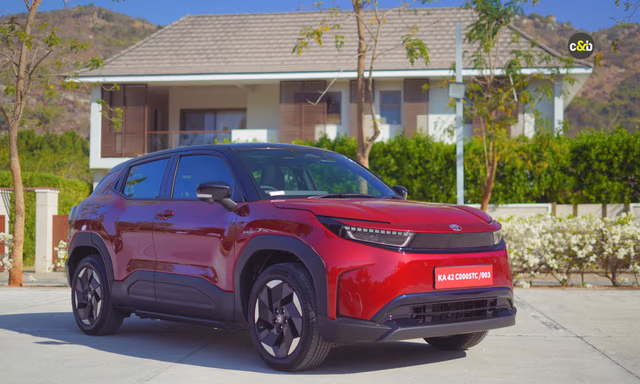 car&bike Team | May 29, 2026All-Electric Toyota Urban Cruiser EBella E3 Variant Launched At Rs. 23.60 LakhAs of now, Toyota has only announced the price of the top-spec EBella. Prices for the lower versions – the E1 and E2, will be announced later.3 mins read
 car&bike Team | May 28, 2026Royal Enfield Bullet 650 Vs Classic 650: Differences ExplainedThe Royal Enfield Bullet 650 and the Royal Enfield Classic 650 have a lot in common, including the basic platform and chassis. Yet, there are differences to give each its own identity.4 mins read
 Jaiveer Mehra | May 28, 2026New Tata Tiago, Tiago EV: In PicturesThe Tiago siblings now get greater design differentiation and pack in more modern tech.1 min read
 Jaiveer Mehra | May 28, 2026New Tata Tiago, Tiago EV Launched In IndiaThe Tiago twins get a notable styling update, new features and now sit on a new X-ALFA platform.1 min read
 Bilal Firfiray | May 29, 2026Skoda Octavia vRS Review: The Sensible Car Every Car Guy (Eventually) WantsThe Skoda Octavia vRS blends practicality with performance. It’s a real enthusiast appeal in a sensible sedan package.1 min read
 Bilal Firfiray | May 25, 2026Renault Duster 1.3 Turbo DCT Road Test Review: The Solid Middle GroundMarking its return, the Renault Duster offers a strong ride quality, a refined 1.3 turbo-petrol engine, balanced handling and lot more impressive cabin. Should you buy it though?5 mins read
 Preetam Bora | May 23, 20262026 Harley-Davidson X440T Road Test Review: Did Harley Just Fix Everything?We spent a few days with the Harley-Davidson X440T to understand if Harley-Davidson India has managed to fix all the shortcomings of the standard X440!1 min read
 Janak Sorap | May 20, 2026Norton Manx R First Ride Review: Brit Superbike Killer?The Norton Manx R is not just another 200 bhp superbike chasing lap times — it is a motorcycle that tries to bring character, exclusivity and real-world usability back into the superbike experience.8 mins read
 car&bike Team | May 20, 2026Axor Brutale Surges Dual Spoiler Helmet Review: Best Of Both WorldsThe Axor Brutale Surges Dual Spoiler Helmet promises a strong mix of everyday comfort and track-focused safety. But does it? Let's find out.5 mins read