
Here's The Difference Between Level 1 And Level 2 Charging in Electric Cars


- Level 1 and Level 2 chargers are mainly applicable in the US.
- Their speed of charging EVs differ significantly.
- They have their own pros and cons.
When you buy an electric car, the best way to ensure that it will always be juiced up when you need it is by installing a home charging station. And while most EV manufacturers offer you the choice to install it wherever you want, it gets confusing when they ask which one among the two options you wish to install at your place - Level 1 or Level 2. Today, we're going to dispel all your confusion and doubts about this topic by telling you the exact difference between Level 1 and Level 2 charging that's offered mainly in the US.
What's a Level 1 charger?

Photo Credit: upload.wikimedia.org
Using a Level 1 charger is a slower method of charging your electric car. It's hence also the cheaper choice between the two. However, an advantage is that it fits into the normal 120V electrical outlet that's present in US homes. That means it's a simple wall outlet with a cable that connects to your battery and charges it whenever you want. A Level 1 charger can typically deliver just 1.4kW of power. Using such a charger leads to an average battery getting 7.2kms of range every hour. That means a typical battery will take around 20 hours to get charged fully. You will have no other option than to keep the car battery on charging for the entire night to ensure that it's always topped up.
What's a Level 2 charger?

Photo Credit: www.pexels.com
A Level 2 charger is a much bigger apparatus. Moreover, it needs to be professionally installed at your place of dwelling. This extra effort will net you huge benefits as well. Level 2 chargers are 240V in nature and can deliver 6.2 to 7.6kW of power. This translates to incredibly fast charging speeds. You can extract an average of 51kms of range through just one hour of charging. Considering a regular-sized battery of an EV, it will be fully charged in about 4 to 8 hours thanks to a Level 2 charger.
Which one is right for you?
It all depends on the kind of usage you put your electric car through. If you use it for daily commutes to work that won't burn much of your battery life, you will most probably manage multiple commutes on a single charge. In such a case, having a Level 1 charger can suffice as you can keep topping up its charge to ensure that you don't run out of juice. Or you can simply, charge your car over the weekend when it's not in use.

But if your lifestyle involves going on unexpected long trips, you better opt for a Level 2 charger. Imagine finding out that you need to leave for a faraway destination in a few hours and there are no charging stations on your way there. That's where a Level 2 charger will come in handy, allowing you to quickly top up your battery before you leave.
Now that you know the difference between Level 1 and Level 2 charging, you can make your choices accordingly.
Related News


Latest Cars


Upcoming Cars


Latest News


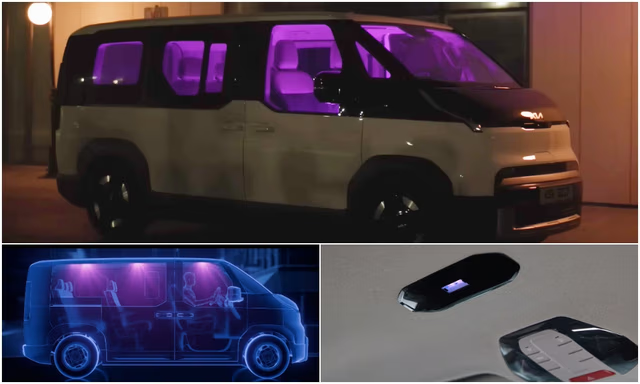 Amaan Ahmed | Jun 27, 2026Future Hyundai, Kia Cars May Feature In-Built UVC SanitiserHyundai Motor Group has unveiled 'Plasma Care UVC' technology, which utilises plasma lamps to safely and effectively destroy bacteria and viruses present inside a car.1 min read
 Amaan Ahmed | Jun 27, 20262026 Maruti Suzuki Brezza Facelift To Be Launched On July 23Launched back in 2022, the current generation of the Brezza subcompact SUV is expected to gain a new engine option, along with a longer list of features.1 min read
 Jaiveer Mehra | Jun 26, 2026New Hyundai Elantra Makes Global Debut: Boxy Styling, Hybrid Powertrain & Pleos InfotainmentNew generation of the Elantra – sold as the Avante in South Korea – adopts Hyundai’s Art of Steel design language.1 min read
 car&bike Team | Jun 26, 2026TVS NTorq 125 Launched With New Colours From Rs. 82,500TVS Motor Company has introduced three new colours for the NTorq 125 Race Edition and two colour options for the disc variant of the scooter.1 min read
 Jaiveer Mehra | Jun 26, 2026New BMW X6 Launched In India At Rs 1.78 CroreThe X6 is offered solely in the hot M60i spec and goes up against the Audi SQ8 and the Mercedes-AMG GLE 53 Coupe1 min read
 car&bike Team | Jun 25, 2026TVS iQube Electric Scooter Crosses 10 Lakh Units Production MilestoneIntroduced in 2020, the iQube is TVS' first high-speed, long-range electric scooter, which has soared to the top of sales charts in recent years.1 min read
 Janak Sorap | Jun 25, 2026350cc Bajaj Dominar 400 Review: Same Character, Lower PriceA slightly lower displacement engine, a significantly lower price tag and nearly the same performance — the Bajaj Dominar 400 aims to be smarter rather than faster.6 mins read
 Preetam Bora | Jun 25, 20262026 Bajaj Pulsar NS400Z First Ride Review: Smaller Engine, But Should You Buy It?The Bajaj Pulsar NS400Z won our Two-Wheeler Upgrade of the Year. Then new tax slabs happened. Smaller engine, same badge – but does it still deliver?6 mins read
 Preetam Bora | Jun 25, 2026Triumph Tracker 400 First Ride Review: What's It Really Like?The Triumph Tracker 400 is here, now with a downsized 349 cc engine. We spent a couple of hours with it to share our first impressions. Is it worth your attention?1 min read
 Preetam Bora | Jun 15, 20262026 Yezdi Scrambler Review: The Update That Changes EverythingThe Yezdi Scrambler gets a comprehensive update with an updated engine, revised chassis, reduced weight and proper features list. Does it deliver? Here’s our take.10 mins read
 Preetam Bora | Jun 10, 20262026 BMW F 450 GS Review: A True GS - But Should You Buy It?The GS badge on a BMW means something and always has. Can the new made-in-India BMW F 450 GS truly live up to that legacy? We spent a few days getting familiar with the F 450 GS to see if it’s worth a buy.12 mins read