
Independent Suspension Explained And If It's Right For You


To define it in simple terms, a suspension is the system of tires, springs, shock absorbers, and linkages that connects the wheels to the rest of the vehicle, ensuring relative motion between the two which propels the vehicle forward or backward. It can also absorb the harshness of the road. Suspension systems must support ride quality and road handling, and both should not throw each other off the track. Hence, finding the right compromise between the two is imperative.
Independent suspension allows each wheel on the same axle to move independently of the others. The ability of each wheel to address the road without interference from others offers a smoother ride, better safety, more stability, more comfort, and better traction on the road.
Having said that, we must address that independent suspension is not always ideal. For example, trucks that carry heavy loads require a stabler camber setting between the wheels. Independent suspension would not be a good choice in such a scenario, and one should opt for dependent or semi-dependent suspension.

However, vehicles that can achieve relatively higher speeds without affecting the safety of the passengers—like sports cars—would always require independent suspension to evade the shock absorbed at such high speeds from getting reverberated across the vehicle.
Different kinds of independent suspension:
-
Double wishbone suspension is designed using two wishbone-shaped arms to locate the wheel. The design ensures that the engineer is able to control the motion of the wheel through suspension travel and can also control the essential parameters such as camber angle, caster angle, etc.

-
The multi-link suspension uses three or more lateral arms and one or more longitudinal arms—they can be of unequal length—to locate the wheel. This is used in the Mercedes Benz W201 and W124 series.

-
MacPherson Strut is the most widely used front suspension system that utilizes a strut-type spring and shock absorber that cooperate to pivot on a single ball joint. This system had been adopted by BMW, Porsche, and Ford cars. Now, it is popular among all car manufacturers for front suspension designs.

To conclude, it entirely depends on the kind of vehicle and its purpose on the road to decide if an independent suspension should be used or not. In general, most of the modern vehicles use independent front suspension while a few also have independent rear suspension, i.e., the rear wheels are independently sprung. On average, independent systems are more comfortable and cost-effective as compared to other kinds of suspension systems.
Related News


Latest Cars


Upcoming Cars


Latest News


 car&bike Team | Jun 29, 2026Tata Sierra EV Launch Tomorrow: What To Expect?The Sierra EV is expected to share much of its package with the Harrier EV.3 mins read
 Jaiveer Mehra | Jun 28, 2026Nissan Tekton Spied Undisguised Ahead Of July 9 DebutSole image of the SUV showcases the rear design of the SUV.1 min read
 Carandbike Team | Jun 28, 2026Renault Kwid Facelift India Launch On July 3Latest facelift marks the second major update for the entry hatchback since its launch in 2015.1 min read
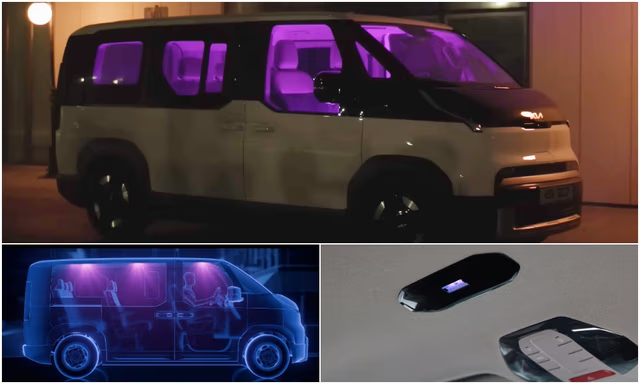 Amaan Ahmed | Jun 27, 2026Future Hyundai, Kia Cars May Feature In-Built UVC SanitiserHyundai Motor Group has unveiled 'Plasma Care UVC' technology, which utilises plasma lamps to safely and effectively destroy bacteria and viruses present inside a car.1 min read
 Amaan Ahmed | Jun 27, 20262026 Maruti Suzuki Brezza Facelift To Be Launched On July 23Launched back in 2022, the current generation of the Brezza subcompact SUV is expected to gain a new engine option, along with a longer list of features.2 mins read
 Jaiveer Mehra | Jun 26, 2026New Hyundai Elantra Makes Global Debut: Boxy Styling, Hybrid Powertrain & Pleos InfotainmentNew generation of the Elantra – sold as the Avante in South Korea – adopts Hyundai’s Art of Steel design language.1 min read
 Seshan Vijayraghvan | Jun 29, 2026Skoda Kodiaq RS Review: The Best Kodiaq Yet?The Skoda Kodiaq RS is finally here, and it's every bit as exciting as I expected. But was it worth the wait?7 mins read
 Bilal Firfiray | Jun 28, 2026BMW X6 M60i Review: It’s Back And HOW!The BMW X6 M60i blends a 530bhp twin-turbo V8, with its unmistakable coupe-SUV styling. There’s plenty of character, but is it worth your money?6 mins read
 Janak Sorap | Jun 25, 2026350cc Bajaj Dominar 400 Review: Same Character, Lower PriceA slightly lower displacement engine, a significantly lower price tag and nearly the same performance — the Bajaj Dominar 400 aims to be smarter rather than faster.6 mins read
 Preetam Bora | Jun 25, 20262026 Bajaj Pulsar NS400Z First Ride Review: Smaller Engine, But Should You Buy It?The Bajaj Pulsar NS400Z won our Two-Wheeler Upgrade of the Year. Then new tax slabs happened. Smaller engine, same badge – but does it still deliver?6 mins read
 Preetam Bora | Jun 25, 2026Triumph Tracker 400 First Ride Review: What's It Really Like?The Triumph Tracker 400 is here, now with a downsized 349 cc engine. We spent a couple of hours with it to share our first impressions. Is it worth your attention?1 min read