
Smart Charging May Be Key To Saving Power Grid In World Of EVs


As electric vehicle (EV) sales rise, the big question for power grid operators, charging companies and governments is how to run tens of millions of vehicles without crashing local networks or spending billions on grid upgrades.
The answer: smart charging.
Simply put, smart charging software allows EV owners to plug in during expensive peak hours, without the vehicle drawing power until cheap off-peak hours. This eases strain on the electric grid, makes better use of renewable energy and saves drivers money.
Without it, millions of EV owners plugging in after work - auditing firm EY estimates Europe will have 65 million EVs by 2030 and 130 million by 2035 - could overload local grids, causing blackouts.
"The shift to electric will be nigh on impossible without smart charging," Chris Pateman-Jones, CEO of British EV charger company Connected Kerb, told Reuters while demonstrating a pilot project on public chargers in Hackney, a London borough.
Using Connected Kerb's smartphone app you can set your charging speed, charge time and exact price down to a low, slow "Eco" rate of 19 pence (26 U.S. cents) per kilowatt.
"It's so much cheaper and simpler," said Ged O'Sullivan, a 65-year-old pub owner who cut his plug-in hybrid's charging bill by 30% with Connected Kerb.
Smart charging for public chargers is a significant challenge because so few are available for people who cannot charge at home because they park on the street.
According to a report from EY and Eurelectric, Europe alone will need 9 million public chargers by 2035, up from 374,000 today.
The near future should also bring "bidirectional" or "vehicle-to-grid" charging, where millions of EV owners could sell their EV batteries' juice back to grid operators during peak hours.
Even in Britain where smart charging at home is widely available, many EV owners are unaware it exists, according to Britain's energy regulator, Ofgem. In the United States, only a tiny fraction of utilities offer it, according to utilities group the Smart Electric Power Alliance.
And few cars today beside Renault and Hyundai's upcoming Ioniq model are capable of bidirectional charging - though more are coming.
"Most cars, at this point, do not support this bidirectional charging yet," said Robin Berg, CEO of We Drive Solar, which has supplied hundreds of bidirectional chargers for a pilot project in the central Dutch city of Utrecht and worked with Renault SA and Hyundai Motor Co on their vehicles. "Other carmakers will follow."
Nearly 20% of new cars sold in the Netherlands and almost 12% in Britain in 2021 were fully electric.
State support has put Norway at the forefront of electrification, where EVs made up almost three-quarters of sales in the capital Oslo. Some local substations were built in the 1950s and without smart charging Oslo would need massive, costly grid upgrades.
"To handle this we need smart charging solutions because we don't want to over-invest in the grid," said Sture Portvik, who heads Oslo's charging infrastructure efforts.
'AWARENESS IS LOW'
Connected Kerb aims to have 190,000 UK on-street chargers by 2030, enabling it to predict consumer charging patterns for grid operators and offer lower rates when the available renewable energy is abundant, said Pateman-Jones.
"Today when there's too much wind on the grid, wind farms are told to turn the wind turbines off," he said. "With smart charging we can pull more of that power."
Some UK energy providers already offer low off-peak rates for home smart charging, but few EV owners use them.
"The perception is smart charging at home is a done deal," said Charlie Cook, CEO of Rightcharge, a UK firm that helps EV owners find low tariffs. "But the reality is awareness of these tariffs is surprisingly low."
Rightcharge estimates smart charging could save UK drivers 10 billion pounds ($13.5 billion) by 2030.
British car dealer network Lookers guides EV buyers to Rightcharge's website to check their options.
Lookers' business development director, Andrew Hall, said "early adopter" EV buyers are "pretty savvy about smart charging."
"But that is changing as EV sales rise," he added.
Utilities group the Smart Electric Power Alliance estimates only 50 out of 3,000 U.S. utilities offer smart charging.
EV charging company ChargePoint's U.S. chargers can all smart-charge, but it wants more utilities to offer it.
"We see a lot of positive response from customers when their utility is offering those rates," said Anthony Harrison, ChargePoint's North American head of utility partnerships.
Charging provider Blink Charging Co has one set rate until smart charging is widely available.
"We decided to keep it simple for our customers," said Blink CEO Michael Farkas.
'HORRENDOUSLY EXPENSIVE'
Bidirectional charging may be crucial.
"The whole idea behind bidirectional charging is to balance the grid," said We Drive Solar's Berg, who estimates a fully charged EV can power the average home in the Netherlands for a week.
Serge Colle, EY's global energy resources leader, said smart and bidirectional charging are better than "horrendously expensive" power grid upgrades.
"We can't possibly open up streets quickly enough to add more copper and do the necessary reinforcement," Colle said.
Regulator Ofgem estimates that peak power reductions from smart and bidirectional charging by 2050 could match "10 Hinkley Point C Nuclear Plants" - a two-reactor plant under construction in England.
The U.S. market has more than 10 vehicle-to-grid pilot projects using school buses under way.
California-based vehicle-to-grid company Nuvve Holding Corp has formed Levo, a joint venture with private equity firm Stonepeak - which chipped in $750 million - to enable EV fleet owners to sell power to utilities.
"Because our customers are able to generate revenue we're able to reduce the total cost of ownership for those vehicles, at times completely cost-neutral," said Nuvve CEO Gregory Poilasne.
Charger makers like Brisbane, Australia-based Tritium Dcfc Ltd are also developing bidirectional chargers.
CEO Jane Hunter said Tritium will launch a bidirectional, fast-charging wall unit in 2023 for fleets and homeowners.
More automakers are embracing bidirectional charging. Ford Motor Co has partnered with solar power company Sunrun Inc to use its F-150 Lightning pickup truck to power homes.
But Oslo has invested extra money in pilot projects for bidirectional chargers because it believes in the concept. So far, however, it has been disappointed that more carmakers have not yet introduced vehicles that can feed power back into the grid.
"The limitations for bidirectional charging has been the car producers," infrastructure chief Portvik said. "The big carmakers have to step up."
(This story has not been edited by NDTV staff and is auto-generated from a syndicated feed.)
Related News


Latest Cars


Upcoming Cars


Latest News


 Seshan Vijayraghvan | Jul 23, 2026Kia Syros EV Launched In India; Prices Start At Rs. 13.49 LakhOffered with two battery pack options, the electric SUV delivers a claimed range of up to 526 km and comes with features such as DC fast charging, Level 2 ADAS and Vehicle-to-Load (V2L).1 min read
 Jafar Rizvi | Jul 23, 20262026 Maruti Suzuki Brezza Bags 5 Stars In Bharat NCAP Crash TestsMaruti’s heavyweight has managed to achieve 30.41/32 for adult occupant protection and 43/49 for child occupant protection.2 mins read
 Jafar Rizvi | Jul 23, 2026Mercedes-AMG E 53 Plug-In Hybrid Launched In India At Rs 1.45 CroreThe performance sedan packs a six-cylinder petrol engine paired with an electric motor to deliver nearly 600 bhp.3 mins read
 car&bike Team | Jul 23, 2026Honda To Showcase Multiple Products On July 24; To Be Made in Indiacar&bike has learnt that at least 5-6 new products will be showcased, including the Honda Rebel 300, Honda ADV 160, CRF300L, Honda CB500 Hornet and CB500R. All of these will be made in India, although prices will be announced later.1 min read
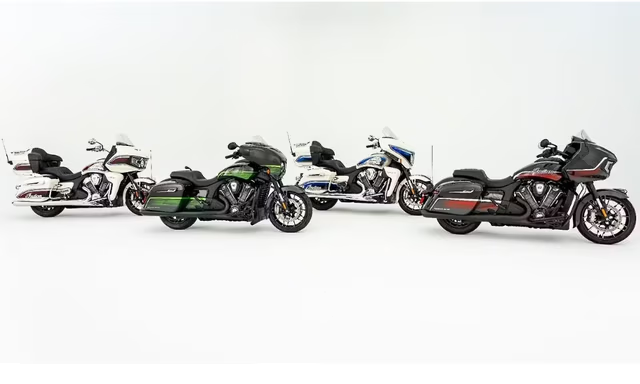 car&bike Team | Jul 23, 2026Indian Motorcycle Unveils Limited-Edition Signature Series For PowerPlus Line-upIndian Motorcycle has introduced the Signature Series, an ultra-exclusive collection of four premium touring motorcycles based on its PowerPlus platform.1 min read
 car&bike Team | Jul 22, 2026Simple Energy To Unveil Its First Family Electric Scooter On September 2Simple Energy is set to enter India's family electric scooter segment with the debut of an all-new model on September 2.1 min read
 Girish Karkera | Jul 23, 2026Mercedes-AMG E53 4MATIC+ PHEV First Drive Review: Just What The Doctor OrderedThere are luxury cars and there are high-performance cars. But what if you want both for the price of one? Mercedes-Benz has a recommendation that promises to tread a fine line between the two – the second generation E53 with a twist.7 mins read
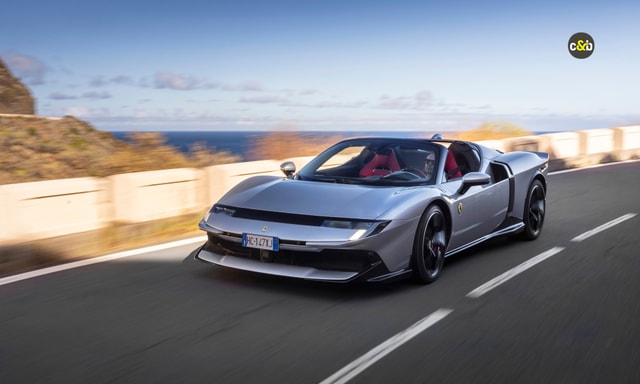 Shams Raza Naqvi | Jul 15, 2026Ferrari 849 Testarossa Spider Driven: Rs. 11.25 Crore Meets 1,000 bhpWe got behind the wheel of the most powerful convertible from Ferrari. What makes the 849 Testarossa Spider Special? We tell you.1 min read
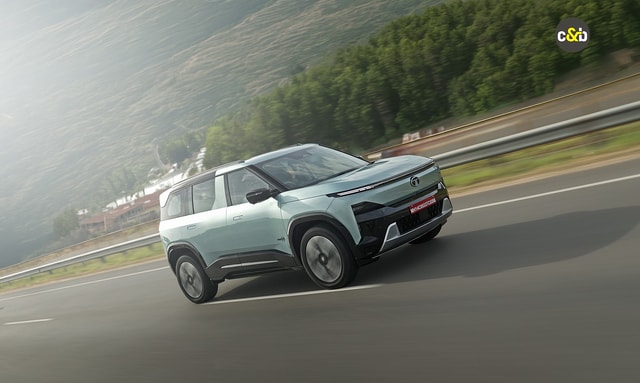 Bilal Firfiray | Jul 12, 2026Tata Sierra EV Review: Reborn In The Electric AgeThe Tata Sierra EV isn’t drastically different from its ICE counterpart when it comes to design. But being the seventh electric offering from the Indian brand, it has gotten a few things right, and very few things wrong. But is it a compelling package to buy?5 mins read
 Jafar Rizvi | Jul 13, 2026TVS Orbiter Long-Term Review (Report 1): Settling In Takes TimeFirst impressions weren't the strongest, but the Orbiter has made a mark in its first month in the car&bike garage.5 mins read
 Seshan Vijayraghvan | Jul 7, 2026Tata Altroz Petrol DCA Long-Term Review: Intercity & Highway Driving ReportWe tested the Tata Altroz Petro DCA’s highway manners, intercity performance, and real-world fuel efficiency.1 min read