
Tata Harrier EV vs Tata Harrier Diesel: What Are The Differences?
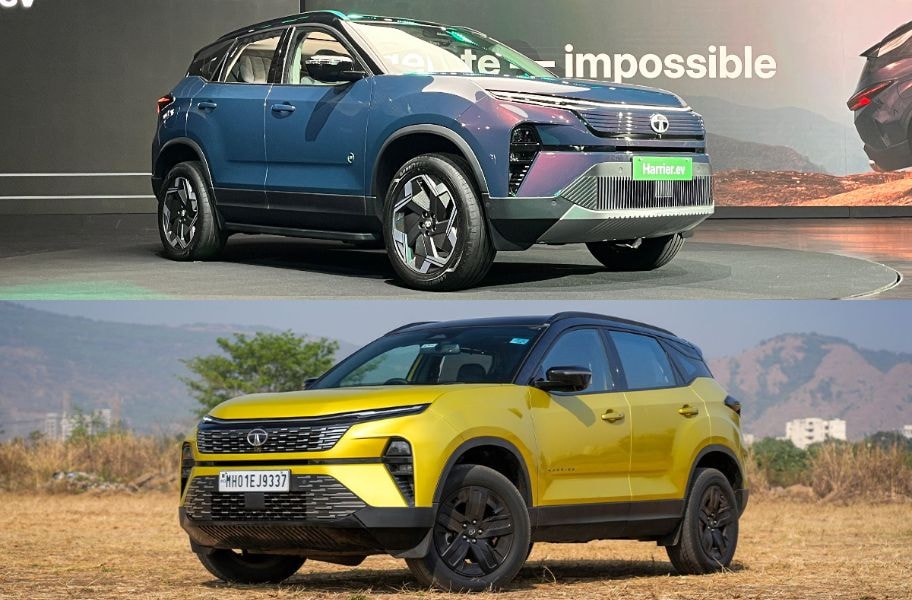
- The Harrier EV has a set of subtle exterior differences from the Harrier ICE.
- The electric SUV has a larger features list than the ICE.
- The Harrier EV is more powerful than the Harrier ICE.
Tata Motors finally launched the much anticipated, all-electric version of the Harrier SUV in India. Based on the company’s Acti.ev platform, the Harrier EV starts at Rs 21.49 lakh, and upon its full price reveal, will become the most expensive Tata EV on sale in India. While visually similar to its ICE counterpart, the Harrier EV represents many firsts for the company, and has a vast set of differences from the diesel Harrier, especially on the feature and powertrain front. Here’s a deeper look at all the ways the Harrier EV is different from the Harrier diesel.
Also Read: Tata Harrier EV Launched At Rs 21.49 Lakh; Gets Dual Motor Powertrain, Terrain Modes & More
Exterior Design
The Harrier EV gets a series of subtle tweaks over the Harrier ICE
While the Harrier EV may look identical to its diesel counterpart at first glance, closer inspection does reveal an array of changes. The changes, while subtle, do try to help differentiate the duo. The most obvious change is up front with regards to the grille, or rather, the lack of it. The Harrier EV gets an enclosed upper fascia, with the grille area painted in body colour, unlike the diesel SUV, which gets a traditional black grille. Furthermore, the air dam on the Harrier EV has been redesigned and features vertical slats, sporting a metallic finish.
The Harrier EV rides on new 19-inch aero-optimised alloy wheels which, in recent times, have gone on to become an almost trademark design element in EVs. The standard Harrier meanwhile, gets more conventional alloy wheels. The SUV also comes with EV badging on the front door, and lettering at the rear which reads ‘Harrier.EV’.
The Harrier EV is only offered in four colour schemes at the moment
A rather underwhelming bit about the Harrier EV is the fact that it is currently only offered in four colour schemes which appear sober. A Stealth Edition with a matte black shade will soon be on offer though. The Harrier ICE meanwhile, can be had in eight colour schemes which include Yellow, Red, Grey, White, Black, Matte Black and Green shades.
Also Read: Tata Harrier EV vs Mahindra XEV 9e: Specifications, Features, Prices Compared
Interior Design and Features
The interior layout of the Harrier EV is identical to the ICE model
The interior of the Harrier EV is the exact same as the combustion-powered Harrier, featuring a floating display, four-spoke steering wheel, and air con vents with vertical slats. The centre console also continues to feature a rotary selector for drive and terrain modes, while the climate controls are on a capacitive touch panel beneath the air vents. However, what’s changed is the sheer number of features offered in the car.
The Harrier EV gets a larger 14.5-inch touchscreen with a Samsung QLED display
The floating display, for instance, is now a larger 14.5-inch touchscreen system from Harman with a Samsung Neo QLED display, a first for any car, according to Tata. Additionally, the Harrier EV also debuts Tata’s new TiDAL (Tata Intelligent Digital Architecture Layer) architecture, which powers the SUV's connected car features, such as over-the-air (OTA) updates, voice commands. There's also a new DrivePay feature that enables drivers to make FASTag payments without the use of a mobile phone. With the Harrier EV, Tata has gone one step further and introduced a digital key function, wherein the car can be controlled using an app on a cellphone. Up to seven users can be granted access to the vehicle via the app. Alternatively, the Harrier EV can also be unlocked/locked using a remote control or an NFC card.
Few of the features offered in the Harrier EV- Electronic IRVM (Top-left), NFC card (Top-right), 360 degree camera transparent mode (Down)
The Harrier EV also comes with more terrain modes than the standard Harrier. These include Normal, Sand, Mud Ruts, Snow/Grass,Rock Crawl, and a custom mode. The internal combustion Harrier meanwhile, only offers Normal, Wet and Rough modes. The Harrier EV’s drive modes also include Drift and Boost modes, both of which are not offered in the other. A 360-degree camera is also on offer in the Harrier diesel, although in the EV there is also a blind view monitor and a transparent mode for the camera which also gives the driver a view of the terrain surface underneath the car and alerts when you’re too close to the curb. Other novel features include a digital IRVM with dual dashcams which can record up to 6 hours of footage and has 64 GB of storage, which can be expanded to 128 GB.
When it comes to autonomous driving functions, the Harrier EV comes with an e-valet mode, which, as its name suggests can automatically park the car, and a Summon mode, wherein the Harrier EV automatically makes its way to where you’re standing from its parking spot. The SUV also comes with auto park assist for both parallel and perpendicular parking spots. Like its diesel counterpart, the vehicle comes with a Level-2 ADAS suite of features, although it also gets a low-speed emergency braking function, which is a first. The Harrier EV is offered with seven airbags, similar to the Harrier diesel.
The Harrier EV also supports Vehicle-to-Vehicle and Vehicle-to-Load functions. The former can be used at a peak rate of 5 kW while the latter offers a peak 3 kW output.
Drivetrain, Powertrain and Suspension
The Harrier EV can be had in both single-motor and dual-motor formats, both more powerful than the diesel Harrier
Unlike its front-wheel-drive ICE counterpart, the Harrier EV gets rear-wheel drive as standard, and all-wheel drive in the dual-motor variants. Being an EV, it might not come across as a surprise to many that the Harrier EV is far more powerful than the Harrier diesel. Even in single-motor guise, it is equipped with an rear-axle mounted electric motor that churns out 235 bhp, more than the Harrier diesel’s 2.0-litre turbo-diesel engine (170 bhp). In dual-motor format however, a second 156 bhp electric motor is added to the front axle, taking the combined output to over 300 bhp and 504 Nm of peak torque. While the Harrier ICE takes over 11 seconds to go from 0 to 100 kmph, the dual-motor EV can do the sprint in just a claimed 6.3 seconds when Boost mode is activated.
Another upgrade is on the suspension front, as the EV comes with an all- independent setup, with Multi-link rear suspension with frequency-selective damper.
Prices
Tata has only announced prices for the base variant of the Harrier EV, which will be prices at Rs 21.49 lakh (ex-showroom, charger not included). While the manual Harrier diesel starts at Rs 15 lakh (ex-showroom), the prices of the automatic variants start Rs 19.35 lakh (ex-showroom) and go all the way up to Rs 27 lakh. While not officially announced yet, we expect the prices of the Harrier EV dual-motor will top out at around Rs 32 lakh.

Sidharth has always been fascinated with cars. Many of his favourite machines have 6 cylinders, rear-wheel-drive and are Japanese. Although a mechanical engineer by education, he decided this field was more apt for him as it combined his passion for both cars and writing. In his freetime, Sidharth likes to watch Formula 1 and cheer for a certain Italian team.
Read all latest news and reviews from Sidharth Nambiar →


Related News


Learn more about


Popular Models


Latest Cars


Upcoming Cars


Latest News


 car&bike Team | Oct 7, 20262026 MG Hector Storm Series Launched At Rs 20 LakhThe MG Hector Blackstorm and Snowstorm editions get cosmetic changes and an all-black interior over their standard counterpart.2 mins read
 Janak Sorap | Oct 7, 2026Suzuki V-Strom SX Gets New Black And Grey Colour OptionSuzuki has added a new Glass Sparkle Black and Metallic Matte Fibroin Grey colour option to the V-Strom SX, with prices and mechanicals remaining unchanged.1 min read
 Jafar Rizvi | Oct 7, 2026Triumph Bonneville T40 vs RE Classic 350 vs Honda CB350C: Specifications, Features, Prices ComparedThe Bonneville T40 enters the 350cc retro class with significantly more power and tech than the RE Classic 350 and Honda CB350C, but it also carries a much higher price.5 mins read
 Sarthak Mahajan | Oct 7, 2026Honda Elevate Facelift: In PicturesPrices for the Elevate starts at Rs 11.80 Lakh.3 mins read
 Preetam Bora | Oct 7, 2026Triumph Bonneville T40: 5 Ways It Differs From Other Triumph 400sSignature Triumph Bonneville design, easy-going state of tune of the new engine, new features as well as updated frame set the Bonneville T40 apart.5 mins read
 Janak Sorap | Oct 7, 2026Ducati DesertX V2 Teased For India Launch: Gets New 890cc V2 EngineDucati has teased the new-generation DesertX V2 for India, with the adventure motorcycle scheduled to arrive in the fourth quarter of 2026.1 min read
 Seshan Vijayraghvan | Oct 4, 20262026 Skoda Slavia Facelift Review: Upgrades That Matter And A Better AutomaticThe new Skoda Slavia brings a handful of visual and mechanical changes, most notably a new 8-speed automatic for the volume-selling 1.0-litre TSI variants.5 mins read
 Bilal Firfiray | Oct 3, 2026Kia Sorento Review: Is Bigger Always Better?The Kia Sorento has arrived to our shores at the right time. But does it have what it takes to take the market by a storm?7 mins read
 Abhishek Nigam | Oct 2, 2026MINI Countryman C Review: Has MINI Finally Grown Up Without Losing Its Personality?The new Countryman C is bigger, more practical and packed with technology, but its quirky appeal comes with a few compromises.1 min read
 Preetam Bora | Oct 3, 2026ViaTerra Spencer Riding Jacket Review: The Ideal Jacket For Indian Summers?The ViaTerra Spencer mesh riding jacket makes a strong case as a well-built, street-focussed riding jacket, combining good airflow with Level 2 protection and a snug, secure fit. Is it perfect? Read on.6 mins read
 Janak Sorap | Oct 1, 2026Yamaha YZF-R2 Track Review: New TerritoryYamaha's all-new YZF-R2 brings 200cc performance, lightweight construction and R-series DNA to a new generation of riders, but its true track potential is held back by one crucial component.7 mins read