
Tata Harrier EV vs Mahindra XEV 9e: Specifications, Features, Prices Compared

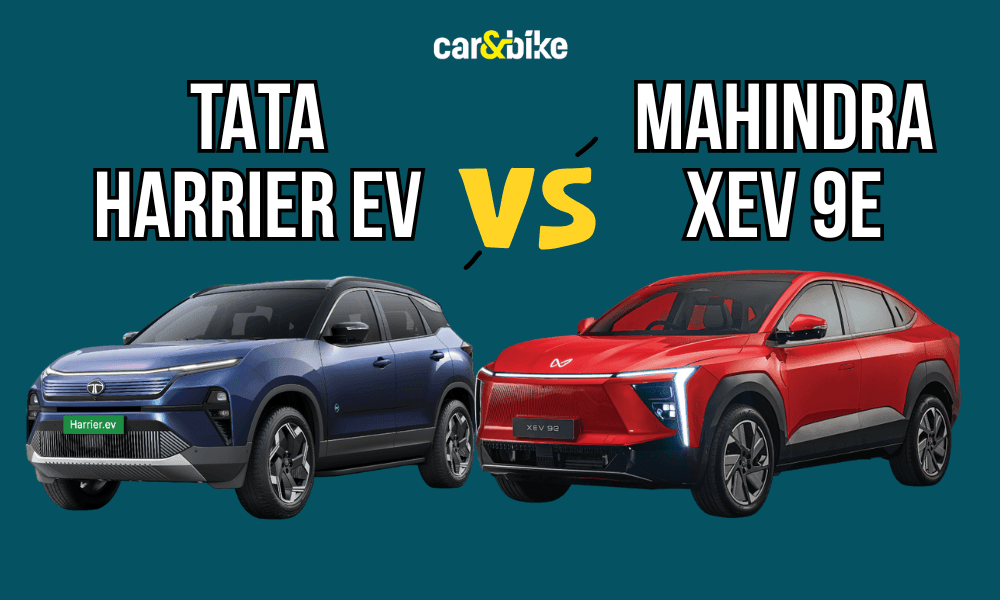
- The XEV 9e is slightly longer in length and wheelbase
- The Harrier EV has a strong edge with its dual motor QWD offerings
- The XEV 9e features a slightly larger battery pack and offers more range
Tata Motors has finally launched the all-electric Harrier in the Indian market, with prices starting at Rs 21.49 lakh (ex-showroom, excluding charger). The Harrier EV holds the top spot in Tata's electric vehicle lineup and comes equipped with a host of features never seen in any previous Tata vehicle. The Harrier EV gets into the ring with Mahindra’s new contender, the XEV 9e, so let’s see how these two electric SUVs in their top-spec variant stack up against each other on paper.
Also Read: Tata Harrier EV Launched At Rs 21.49 Lakh; Gets Dual Motor Powertrain, Terrain Modes & More
Tata Harrier EV vs Mahindra XEV 9e: Dimensions
The Mahindra XEV 9e's wheelbase is slightly longer than the Harrier EV.
| Tata Harrier EV | Mahindra XEV 9e | |
| Length | 4607 mm | 4,789 mm |
| Width | 2132 mm | 1,907 mm |
| Height | 1740 mm | 1,694 mm |
| Wheelbase | 2741 mm | 2,775 mm |
| Boot Space | 502 litres | 663 litres |
| Frunk Space | 35 litres | 150 litres |
The Mahindra XEV 9e is the longer of the two SUVs, measuring 182 mm more in length. However, the Harrier EV is both wider and taller, by 225 mm and 46mm, respectively. The wheelbase of the Mahindra SUV is slightly longer at 2,775 mm, versus 2,741 mm for the Harrier. In terms of storage, Mahindra also leads with 663 litres of boot space and 150 litres of frunk space, significantly more than the Harrier EV’s 502-litre boot and 35-litre frunk.
Also Read: Tata Harrier EV: In Pictures
The XEV 9e (below) offers increased storage capacity in both the frunk and the boot.
Tata Harrier EV vs Mahindra XEV 9e: Battery, Motor, Charging
| Tata Harrier EV | Mahindra XEV 9e | |
| Motor | Dual motor (AWD) | Single motor (RWD) |
| Battery Capacity | 75 kWh | 79 kWh |
| Power | 235 + 156 bhp | 281.61 bhp |
| Torque | 504 Nm | 380 Nm |
| Claimed Range | 622 km | 656 km |
| AC Charging Time (10-100%) | 10.7 hrs/7.2 kW | 11.7 hrs/7.2 kW |
| DC Fast Charging (20-80%) | 25 mins/120 kW | 20 mins/180 kW |
The Tata Harrier EV features a dual-motor all-wheel-drive setup with a 235 bhp rear electric motor and 156 bhp front, and 504 Nm of torque in its fully loaded avatar. On the other hand, the Mahindra XEV 9e uses a single rear-mounted motor putting out 281.61 bhp and 380 Nm across its variant lineup. The Harrier EV is the first Tata EV vehicle to feature an all-wheel drive setup, while neither of the Mahindra Born electric duo comes equipped with it.
Also Read: Mahindra BE 6, XEV 9e Sales Cross 10,000 Unit Mark
In their top variants, the Harrier EV has a 75 kWh battery, while the XEV 9e gets 79 kWh.
The XEV 9e comes with a slightly larger 79 kWh battery pack compared to Tata’s 75 kWh unit. This results in a higher claimed range for the XEV 9e at 656 km, whereas the Harrier EV offers a slightly lower range of 622 km. Both the electric SUVs offer the same set of regen levels (L0, L1, L2, L3), where L0 is with no regen at all and maximum regen is achieved at the L3 setting.
Both vehicles support AC charging via a 7.2 kW charger, with the Harrier EV taking approximately 10.7 hours to go from 10 per cent to 100 per cent, slightly faster than the XEV 9e’s 11.7 hours. As for DC fast charging, the XEV 9e can be juiced up in 20 minutes from 20-80 per cent using a 180 kW charger, while the Harrier EV takes about 25 minutes to do the same using a 120 kW DC fast charger.
Also Read: Mahindra XEV 9e First Drive Review: A Star Is Born!
Tata Harrier EV vs Mahindra XEV 9e: Features
The XEV 9e features a triple-screen setup spanning the dashboard.
Both the Harrier EV and the XEV 9e are loaded with features, but each takes a different approach. The Harrier EV comes with a larger 14.53-inch touchscreen infotainment system, which Tata claims is a first in the automotive space. On the other hand, the XEV 9e offers a three 12.3-inch Super Screens setup stretching across the width of the dashboard.
Both vehicles get an autonomous parking system which can operate from the key.
Common to both SUVs are features like an autonomous parking system that can park the car without the driver inside, and a summon function that moves the vehicle out of a parking spot using the remote key of the vehicle, respectively. Both models also share features like a panoramic sunroof, multi-zone climate control, Level 2 ADAS and more.
The Harrier EV gets a V2V and V2L function, which is missing on the XEV 9e.
Where the Harrier EV stands out is with its Vehicle-to-Vehicle (V2V) and Vehicle-to-Load (V2L) capabilities, allowing it to charge other EVs or power external appliances, features not available on the XEV 9e. It also gets a transparent view mode through its 360-degree cameras, letting the driver see underneath the vehicle, another feature the XEV 9e lacks.
Being AWD, Harrier EV gets dedicated terrain modes to tackle uneven surfaces.
When it comes to driving modes, the Harrier EV QWD (Quad Wheel Drive) variants offer six terrain modes: Rock Crawl, Snow, Gravel, Sand, Normal, and a customisable sixth mode, along with four standard drive modes. In comparison, the XEV 9e provides five driving modes: Default, Range, Everyday, Race, and Snow.
Tata Harrier EV vs Mahindra XEV 9e: Prices
Tata Motors has revealed only the starting price of the Harrier EV, which begins at Rs 21.49 lakh, while the Mahindra XEV 9e starts slightly higher at Rs 21.90 lakh. The top-spec XEV 9e is priced at Rs 30.50 lakh. Although the fully loaded Harrier EV will feature a dual-motor all-wheel-drive setup – unlike Mahindra’s single-motor rear-wheel-drive configuration – Tata is expected to price it competitively. Bookings for the Harrier EV will open on July 2, with the full price list likely to be announced around that time.
(All prices ex-showroom and excluding charger.)
Related News


Learn more about


Popular Models


Latest Cars


Upcoming Cars


Latest News


 Sarthak Mahajan | Sep 19, 2026Mahindra XUV 3XO RevX Edge Variant Launched At Rs 9.39 LakhThe new variant features a 10.25-inch HD infotainment system with Android Auto and Apple CarPlay.1 min read
 Sarthak Mahajan | Sep 19, 2026Kia Carens CNG vs Maruti Suzuki Ertiga CNG: Fuel Tank Size, Power Outputs ComparedKia has launched the Carens with a factory-fitted CNG kit, with prices starting at Rs 12.12 lakh (ex-showroom).1 min read
 Shams Raza Naqvi | Sep 18, 2026Kia Carens CNG, Carens Clavis CNG Launched In India: Prices Start At Rs. 12.12 LakhWhile the Carens CNG has been introduced in a single variant, the Clavis CNG will have two variants.2 mins read
 Girish Karkera | Sep 18, 2026Maruti Suzuki Swift, Dzire and Baleno CNG AMT Launched: Check Mileage, PricesAutomated manual gearbox option makes the petrol-CNG hybrid a viable option for everyday city use for Swift, Dzire and Baleno models4 mins read
 car&bike Team | Sep 18, 20262026 TVS Apache RTR 200 4V: Top 5 UpdatesThe TVS Apache RTR 200 4V has been introduced in a new top-end variant which gets a lot of new features, including preload adjustable front suspension. Here’s a look at what’s new on the top-spec Apache RTR 200 4V.1 min read
 Jaiveer Mehra | Sep 18, 20262027 Mahindra Thar 3-Door Facelift Teased Ahead Of LaunchSecond update in two years to bring additional cosmetic changes and more features.1 min read
 Bilal Firfiray | Sep 19, 2026MG Hector Tomahawk EV Review: Play It SafeMG’s new electric SUV has one of the coolest names ever, and the coolest temperament amongst its peers. But is it worth buying?7 mins read
 Preetam Bora | Sep 16, 2026Royal Enfield Himalayan 440 Review: Better Than the 450?The new Himalayan 440 with an upsized engine and gearbox has certainly improved as a touring machine and at an extremely attractive price of Rs. 2.29 Lakh. Is it the better Himalayan to choose for many riders?9 mins read
 Seshan Vijayraghvan | Sep 15, 2026BMW i5 LWB Review: Not The M60, This Is The Proper Electric 5 SeriesThe BMW i5 LWB takes the electric 5 Series formula and puts a stronger focus on rear-seat comfort and long-distance luxury. With a 669 km claimed range, 268 bhp and a more relaxed character, is this the i5 that makes the most sense for India?7 mins read
 Preetam Bora | Sep 14, 2026Ladakh Uncharted: Himalayan Basecamp Off-Road Ride ExperienceA day-long off-road excursion from Royal Enfield’s Himalayan Basecamp event in Ladakh, the Ladakh Uncharted ride by Alpinestars was all about re-discovery!6 mins read
 Janak Sorap | Sep 12, 2026New Bajaj Pulsar 125 First Ride Review: More Tech, Less Weight, Same Pulsar DNAThe new Bajaj Pulsar 125 retains the familiar Pulsar identity but gets a new engine, lighter construction, more features and a sharper riding experience.5 mins read