
Triumph 350 Range First Ride Review: More Affordable, More Refined, Still Fun?


- New 349cc engine is smoother, more refined with reduced vibrations.
- Slight drop in power, but better usability and linear performance.
- Lower GST brings significant price reduction across the range.
With the recent revision in GST rates impacting motorcycles above 350cc, manufacturers have been forced to rethink their strategy — and Triumph has responded in an interesting way. Instead of passing on the price hike to customers, the brand has downsized its entire 400 range to 350cc, making the motorcycles more accessible on paper. But beyond the numbers and pricing, what also matters is how this change translates on the road. To find out, we spent some time riding the updated Speed 400 and Scrambler 400 X in Pune to understand whether the smaller engine has taken away from the experience or quietly made it better.
What has changed?
Visually, there is very little to distinguish the new motorcycles from the earlier versions, apart from the updated TR Series badging that no longer mentions “400”. The real changes lie within the engine.
While the bore remains unchanged, the stroke has been reduced from 64 mm to 56.6 mm. In addition, Triumph has reworked the combustion chamber, camshaft profile and valve timing, resulting in a revised power and torque curve. On paper, the differences seem modest. Power is down by roughly 2 bhp, while peak torque sees a reduction of about 5 Nm. Interestingly, the redline has increased by 500 rpm, hinting at a slightly freer-revving nature.
400s Vs 350s – POWERTRAIN OUTPUT COMPARISON
| T4 | SPEED 400 | SCRAMBLER 400 X | THRUXTON 400 | |||||
| OLD | NEW | OLD | NEW | OLD | NEW | OLD | NEW | |
| PEAK POWER | 30.58 bhp @ 7,000 rpm | 28.60 bhp @ 7,500 rpm | 39.45 bhp @ 8,000 rpm | 36.49 bhp @ 8,500 rpm | 39.45 bhp @ 8,000 rpm | 36.49 bhp @ 8,500 rpm | 41.43 bhp @ 9,000 rpm | 39.45 bhp @ 8,750 rpm |
| PEAK TORQUE | 36 Nm @ 5,000 rpm | 31Nm@ 5,500 rpm | 37.5 Nm @ 6,500 rpm | 32 Nm @ 7,000 rpm | 37.5 Nm @ 6,500 rpm | 32 Nm @ 7,000 rpm | 37.5 Nm @ 7,500 rpm | 32 Nm @ 7,000 rpm |
| 0-60 kmph (seconds) | 3.3 | 3.5 | 3.0 | 3.1 | 2.9 | 3.3 | 2.9 | 3.6 |
| 0-100 kmph (seconds) | 8.9 | 9.6 | 7.4 | 8.1 | 7.4 | 8.8 | 7.5 | 8.3 |
| RATED TOP SPEED (kmph) | 141.4 | 137.0 | 148.7 | 147 | 146.5 | 144 | 161 | 157 |
What remains unchanged?
Beyond the engine, very little has changed on the updated motorcycles. In terms of design, the Speed 400 and Scrambler 400 X remain identical to their earlier versions, with no visual alterations to how they look or feel. The overall build quality and fit-and-finish continue to be at the same premium level that Triumph has consistently delivered across its portfolio.
Mechanically too, the motorcycles remain untouched — the chassis, swingarm and overall weight are unchanged, as are the cycle parts including the suspension, brakes, wheels and tyres. Apart from the revised engine and its associated changes, the core package remains exactly as it was before. A detailed specification comparison between the new 350cc versions and the earlier 400cc models are provided in the table below.
TRIUMPH 350s, NO CHANGE FROM THE 400s
| 400cc/350cc | Speed T4 | Speed 400 | Scrambler 400 X | Scrambler 400 XC | Thruxton 400 |
| Front suspension | Telescopic | USD | USD | USD | USD |
| Rear suspension | Monoshock | Monoshock | Monoshock | Monoshock | Monoshock |
| Ground clearance (mm) | 170 | 164 | 195 | 195 | 158 |
| Saddle height (mm) | 806 | 803 | 835 | 835 | 795 |
| Kerb weight (kg) | 180 | 179 | 185 | 190 | 183 |
| Fuel tank (litres) | 13 | 13 | 13 | 13 | 13 |
| Tyre size - Front | 110/70-R17 | 110/80-R17 | 100/90-R19 | 100/90-R19 Tubeless spoke | 110/70-R17 |
| Tyre size - Rear | 140/70-R17 | 150/70-R17 | 140/80-R17 | 140/80-R17 Tubeless spoke | 150/60-R17 |
How is it to ride?
While the numbers suggest a compromise, out in the real-world, the ride experience tells a slightly different story.
The new 350cc motor feels more refined, with reduced vibrations across the rev range. The power delivery is smoother and more linear, as opposed to the slightly peaky and eager nature of the earlier 400cc version. Acceleration off the line remains brisk, and roll-on performance continues to be strong and consistent through the gears, with only a marginal drop in top-end performance.
On the Speed 400, this translates to a motorcycle that feels just as lively as before, but significantly easier to manage. Whether riding in the city or cruising on the highway, the bike now feels more composed and predictable. Those familiar with the earlier version of the motorcycle might miss the sharp, immediate burst of power, but the improved refinement and usability make the new engine better suited for everyday riding as well as longer journeys.
The Scrambler 400 X follows a similar pattern. The smoother delivery and reduced vibrations enhance overall rideability, making it more approachable and comfortable over longer distances. However, given its scrambler’s character, the slight reduction in punch may be more noticeable here, again especially for riders who have experienced the older 400cc version. That said, for most new buyers, the difference is unlikely to be a deal-breaker.
Efficiency, Pricing and Ownership benefits
One of the advantages of the downsized engine is improved efficiency. Triumph claims a marginal increase in fuel economy of around 2–3 kmpl. While this will need to confirm this through a proper fuel efficiency test, once we get the bikes are a longer duration. However, it is an improvement particularly for those planning to use these motorcycles for daily commutes or touring.
More importantly, the reduction in engine capacity brings the motorcycles into a lower GST bracket. The tax rate drops from around 40 per cent to 18 per cent, resulting in more attractive pricing across the range.
NEW PRICELIST OF THE RANGE
| SPEED T4 | SPEED 400 | SCRAMBLER 400 X | SCRAMBLER 400 XC | THRUXTON 400 | |
| PRICE (ex-showroom) | ₹1.95L | ₹2.32L | ₹2.59L | ₹2.89L | ₹2.65L |
| SAVINGS | ~ ₹10,000 | ~ ₹17,300 | ~ ₹21,300 | ~ ₹17,800 | ~ ₹21,600 |
Verdict
The shift from 400cc to 350cc might initially sound like a step back, but in reality, it feels more like a thoughtful refinement of an already strong package.
The new engines are smoother, more refined and easier to live with, without significantly compromising on performance. For most riders, especially those using the motorcycle daily or for touring, these improvements outweigh the slight drop in outright performance.
Combined with the more accessible pricing, the updated Triumph range now makes an even stronger case for itself. In fact, this change doesn’t dilute the experience — it expands the appeal, making these motorcycles more usable, more efficient and ultimately, more relevant for a wider set of riders.
Research More on Triumph Speed 400

Popular Triumph Models


Latest Cars


Upcoming Cars


Latest News


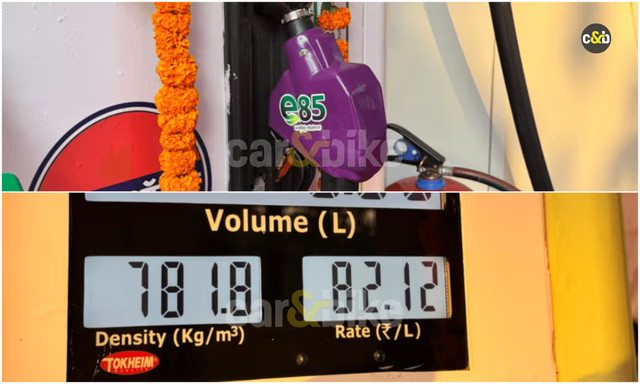 Amaan Ahmed | Jun 5, 2026E85 Fuel Priced At Rs 82.12 Per Litre In Delhi; First E85 Station InauguratedAt the opening of the first E85-dispensing station in the national capital, petroleum minister Hardeep Singh Puri promised E85 will be Rs 20 cheaper than E20 petrol.1 min read
 car&bike Team | Jun 5, 2026Renault Duster 1.0 Turbo Fuel Efficiency Figure RevealedSmaller turbo-petrol unit is offered in the base and lower mid-spec trims of the new Duster; it only gets a manual gearbox option.1 min read
 car&bike Team | Jun 5, 2026Green SM's Electric Taxi Service Now Live In India: VinFast Limo Green MPVs Deployed In Delhi-NCRBacked by VinFast parent Vingroup, the fleet uses the VinFast Limo Green electric MPV and will compete with established players such as Uber and Ola.2 mins read
 Jaiveer Mehra | Jun 5, 2026Audi Nuvolari Debuts As Limited-Run 987 bhp Hybrid SupercarLimited to 499 units, the Nuvolari shares its running gear with the Lamborghini Temerario though Audi has upper the performance figures.1 min read
 Amaan Ahmed | Jun 5, 2026Tata Design Chief On Ferrari EV's Polarising Shape: Avoiding "Sameness" Crucial, But...Social media didn't take kindly to the reveal of Ferrari's first-ever electric car, with innumerable brickbats thrown in Maranello's direction over its design. We spoke to Tata's Martin Uhlarik to understand a car designer's take on the subject3 mins read
 Bilal Firfiray | Jun 4, 2026BMW M2 Gets AWD For The First Time; No Additional Power, But Is 0.3 Seconds QuickerWe all frowned when the M3/M4 got a (switchable) AWD system. Now the smaller and more fun to drive M2 has received the same hardware. Should the RS3 be worried?1 min read
 Preetam Bora | Jun 4, 2026Royal Enfield Bullet 650 Review: Is This the Most Desirable RE 650 Twin Yet?We spent some quality time with the new Royal Enfield Bullet 650, and here's our honest take – what we love, and where there's room to do better.1 min read
 Janak Sorap | Jun 2, 2026California Superbike School: Finding Speed The Right WayThree days of coaching, track time and self-discovery at California Superbike School revealed that riding faster begins with understanding how to ride better.7 mins read
 Girish Karkera | May 31, 20262026 Honda City e:HEV Review: Smartest Compact Sedan To Buy?The most affordable strong hybrid sedan in India looks more interesting than any of its past avatars1 min read
 Bilal Firfiray | May 29, 2026Skoda Octavia vRS Review: The Sensible Car Every Car Guy (Eventually) WantsThe Skoda Octavia vRS blends practicality with performance. It’s a real enthusiast appeal in a sensible sedan package.1 min read
 Bilal Firfiray | May 25, 2026Renault Duster 1.3 Turbo DCT Road Test Review: The Solid Middle GroundMarking its return, the Renault Duster offers a strong ride quality, a refined 1.3 turbo-petrol engine, balanced handling and lot more impressive cabin. Should you buy it though?5 mins read