
Triumph World Speed Record Streamliner - Everything You Need To know!


- The Streamliner uses 2 engines from the Triumph Rocket III cruiser
- It's a one of a kind machine that employs a carbon-Kevlar chassis
- The Streamliner Was Built for the Triumph Team by Hot Rod Conspiracy
Custom Twin-Engine Powertrain:
Two engines from Triumph's largest cruiser, the Rocket III, power the Triumph Infor Rocket Streamliner. Of course, these haven't been left standard at 2300cc each but have actually been stroked down to 1485cc. This is because the largest official category to set a world speed record is the 'up to 3000cc class'. The makers of the bike, Hot Rod Conspiracy and Triumph themselves took the standard engine and put in longer forged connecting rods to reduce the displacement to just under 1485cc. Everything in the two engines is custom forged specially for the streamliner. This includes the camshafts, crank and the special heads that have been made for this application. The two engines have then been turbocharged with standard Garrett GT2876R ball bearing turbos to make a total of 500bhp each. Total power then is 1000bhp of peak power at 9000rpm and 678Nm of peak torque from a 3000cc combined displacement.
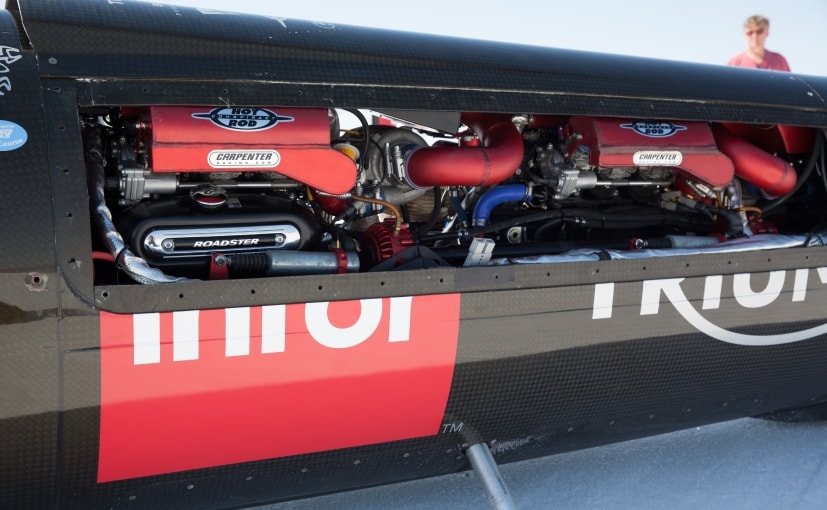
Triumph Infor Rocket Streamliner Uses Two Rocket III Engines
Both the engines are fired up individually but then run in sync thanks to a custom Motec ECU setup. Drives from each engine are run through the standard Rocket III gearbox which has been customised by straight cut high tensile gears to a combination drive unit which then sends power to the rear wheel through a special shaft drive. The gearshift itself is done with a set of buttons and the Motec information cluster tells the driver when to shift through LED lights just above the screen. As the streamliner has about 5 miles to build up power and speed, the engines run at a very relaxed 9500rpm at their highest potential in fifth gear. According to the engine makers, the engines have a LOT more potential to make a lot more power if the boost is turned up from 25psi that it is at right now. The low compression nature of the engine also ensures that the bike doesn't need frequent maintenance on the engine and gearbox front.
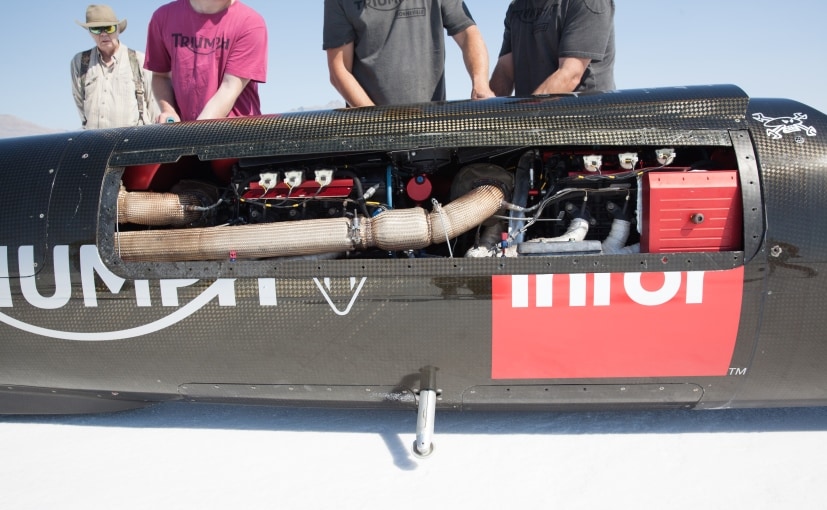
Triumph Infor Rocket Streamliner Engine 2
Interestingly, these engines can be directly fitted into a stock frame of a Triumph Rocket III street bike allowing of course of some changes to the way the turbocharger is placed. In fact, Hot Rod Conspiracy actually tested these engines in a road going Triumph Rocket III motorcycles to see how they held up in real life conditions as compared to only dyno testing. As is the norm for this class, the Triumph streamliner runs on Methanol and not standard pump or race fuel.
Radiators and Cooling System:
Since the bike is streamlined and only has a very small ram-air intake for the engines to feed on, the cooling system on the streamliner is very unique. The twin radiators on the streamliner are placed below the engine and are filled with dry ice just before the run. The whole streamliner has to be lifted up for the radiators to be filled and fitted on and the radiators are hoisted into the bike below the engine through two custom made jacks.
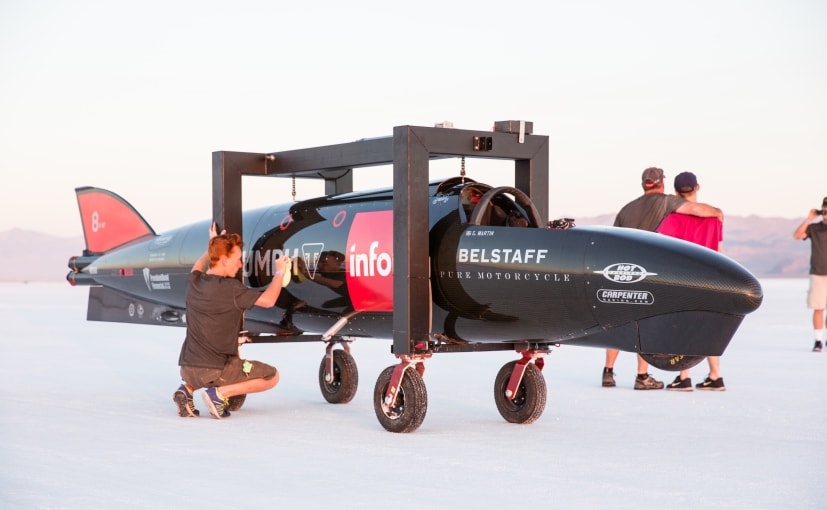
Triumph Infor Rocket Streamliner Radiator are Placed Below the Engine
There is no air flow through the engine whatsoever in terms of cooling and thus the powerplant is cooled through a condensation method with the coolant pipes running through the boxes that contain the dry ice. This method has been used for years by top fuel drag racers to cool their racing fuel just before making a 1/4-mile pass.
Steering Systems:
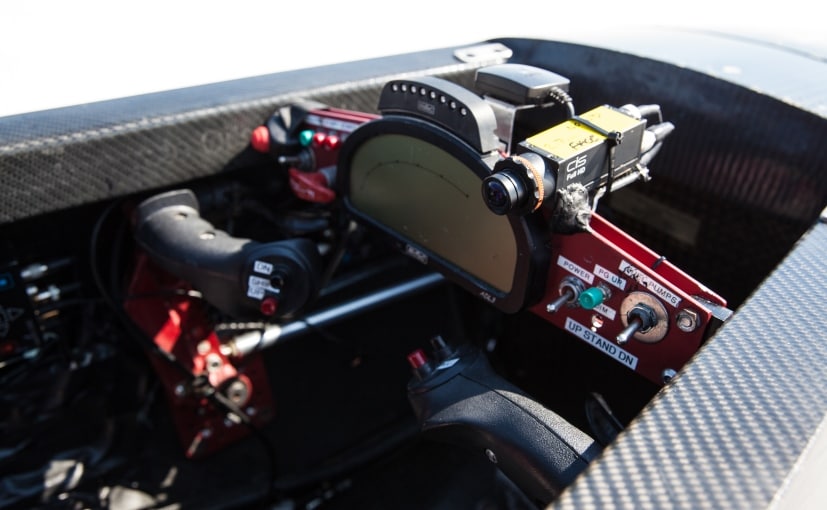
Triumph Infor Rocket Streamliner Steering System
The Triumph streamliner essentially has to run in a straight line on either side of the marked-out centre line on the 11-mile course. The bike thus requires very limited steering capabilities, which is why the front wheel only has two degrees of movement on either side. The steering itself is done not through a conventional handlebar setup but by horizontally mounted joysticks, which work in sync with each other. The rider can adjust these joysticks on the go to steer the streamliner on its course. The braking lever is also mounted on these controls and the right-hand control also features a twist type throttle as is conventionally found on a motorbike. To put things into perspective, the turning radius on the bike to do an 180-degree turn would be about 1 kilometre!
Braking and Parachutes:

Triumph Infor Rocket Streamliner Braking Parachutes
Due to the immense speeds and the slippery nature of the salt, the streamliner has only one carbon-ceramic disc brake mounted on the rear wheel. Just as the bike needs about 5-miles to build up speed, it needs about the same distance to slow down to a complete halt too. After the mile marker 6 point (where the laser beam measures the speed), the rider starts very gradually applying the brake so that the bike can slow down. Once under 300m/h (483km/h), the first of two specially crafted parachutes is deployed. The second parachute is deployed closer to about 200m/h (320 km/h) and is larger to slow the bike down quicker. The parachutes are packed into two tubes at the rear with a simple push-plate firing solution used to deploy them. Deployment of the parachutes exerts a force of over 1G on the rider.
Wheels and Tyres:
Normal street wheels and tyres are enough to take a motorcycle to 300km/h but when you have to do more than twice that speed, a special set of tyres and wheels are what you need. The front and rear wheels on the Triumph streamliner are both custom crafted and are bead-locked to keep the tyres from flying off due to the centrifugal force. Bead-locked wheels are essentially the same technology you find on off road wheels or old truck wheels. What it does is hold the tyre in place by four flanges (or lips) instead of it being held in just by two lips like a conventional expansion road tyre. The front wheel is made from aluminium to keep the nose weight as low as possible. The wheel itself has 200 fasteners that need to be fixed on to keep the tyre in place. The rear wheel is larger and heavier and is made of tool steel to keep the weight high and help with traction and just like the front wheel has 200 individual fasteners that need to be torqued to an exact point.
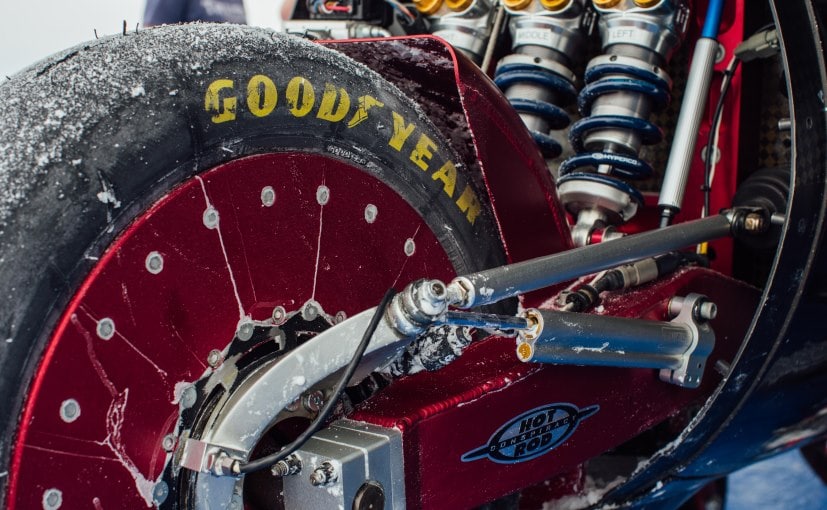
Triumph Infor Rocket Streamliner Wheels and Tyres
The special tyres are made by Good Year and were originally made for the Ack-Attack team that currently holds the record at 376.3m/h (606km/h). The tyres were designed about a decade ago and have a special multi-layer cross nylon construction. They were recently tested to see if they could exceed 400m/h in an American laboratory that also tests high-performance tyres for aeronautical applications. The tyres are filled to about 125psi and nitrogen is used instead of air to make the mixture less adaptive to extreme heat. At 400mph, the wheels will be rotating at over 5000rpm with their small cross-section being the only thing keeping the Triumph streamliner in control.
Chassis and Carbon-Kevlar Structure:
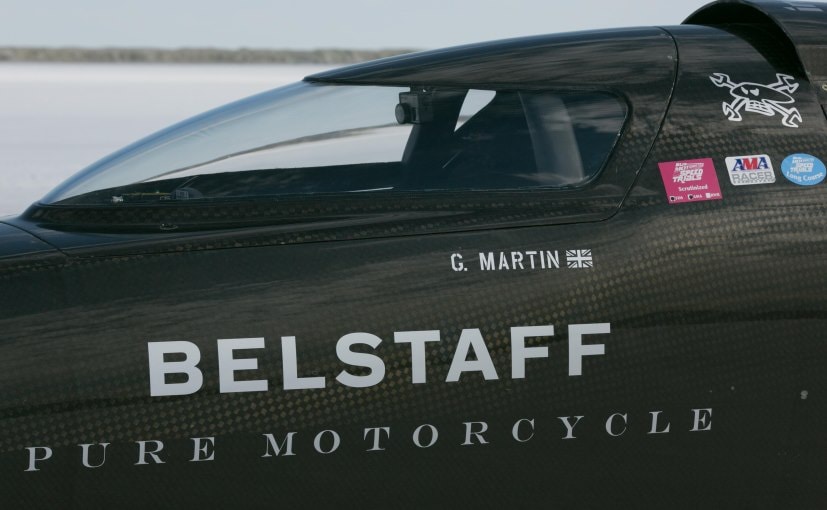
Triumph Infor Rocket Streamliner Carbon-Kevlar Chassis
The Triumph Streamliner is the only one of its kind that employs a carbon-Kevlar monocoque construction. Every other streamliner ever made (4 or 2 wheeled) has always employed a framed chassis on which a carbon fibre or fibreglass panel is mounted. The Ack-Attack team that currently is the record holder is of the same construction too. Triumph wanted to go one step further in its developmental stages and make a monocoque construction out of carbon-Kevlar in order to make the vehicle stiffer and sleeker while keeping the weight down. Due to this, the streamliner has no actual roll cage separately built but the construction of the body itself acts as a protection shell for the rider. The resulting shell is actually much stronger than a rolled steel roll cage and also helps avoid panels from flying off and digging into the salt in the event of a crash. As an additional advantage, naked carbon-Kevlar looks great especially when the sun reflects off it at certain angles.

The Infor Rocket Streamliner Was Built for the Triumph Team by Hot Rod Conspiracy
The actual shape and design of the structure was actually made in a computer simulation and changed about 30 times to come to the shape it is at now. The final mockups were made and tested in a brand new wind tunnel that was custom created only for the Triumph team by Hot Rod Conspiracy. Apart from the front nose cone, the cockpit cover, the engine cover (which consists of three separate panels) and an exhaust panel, everything on the streamliner is one large singular moulded structure. The cockpit canopy itself it made from a special polymer which is the same material out of which fighter jet cockpit canopies are made out of.
Related News




Popular Triumph Models


Latest Cars


Upcoming Cars


Latest News


 Sarthak Mahajan | Aug 19, 2026Mahindra XEV 9S 6-Seater Variant Launched At Rs 25 LakhSince its launch, the electric SUV has been offered exclusively in a 7-seater configuration.1 min read
 Jaiveer Mehra | Aug 19, 2026Volvo EX90 India Launch On October 12Volvo’s all-electric flagship will go up against the likes of the BMW iX and Mercedes-Benz EQS.3 mins read
 Sarthak Mahajan | Aug 19, 2026Skoda Slavia Facelift Prestige Vs Monte Carlo: Differences ExplainedThe 2027 Skoda Slavia facelift was unveiled on August 18, 2026. Prices are yet to be revealed.1 min read
 car&bike Team | Aug 19, 2026BMW 7 Series, i7 Facelift India Launch On September 11Bookings for the luxury sedan opened earlier this month.1 min read
 Jafar Rizvi | Aug 19, 2026Fifth-Gen Hyundai Tucson SUV RevealedThe new SUV is larger than before and gets a completely new identity.1 min read
 Abhishek Nigam | Aug 19, 2026New Bajaj Pulsar 125 and 150 To Launch On August 24New platform, sharper styling and premium features headline the biggest update yet for Bajaj’s popular Pulsar range1 min read
 Seshan Vijayraghvan | Aug 19, 20262026 BMW X1 Long-Wheelbase Review: Is This The X1 To Buy?Along with the extra rear legroom, the new BMW X1 LWB offers more features, more safety tech, and a more powerful petrol engine. But do these updates actually make it a better SUV?1 min read
 Janak Sorap | Aug 17, 2026Bajaj Pulsar N160 SS First Ride Review: The Most Tech-Loaded Pulsar Yet?The Bajaj Pulsar N160 SS brings more power, new-age electronics and sharper styling to the familiar 160cc Pulsar formula.5 mins read
 Jaiveer Mehra | Aug 16, 2026Honda Amaze CVT Long Term First Report: 1800 Km InThe Amaze is the first sedan to join our long term feet in a year, and while on paper it lacks some of the features offered in its rivals, there’s plenty of promise in the package.1 min read
 Preetam Bora | Aug 12, 2026Royal Enfield Himalayan 440 Custom Review: Beating RE to the PunchDelhi-based custom motorcycle shop TNT Motorcycles introduces packages to convert existing Himalayan 411 adventure bikes to Himalayan 440. Is it worth the expense?8 mins read
 Seshan Vijayraghvan | Aug 11, 20262026 Nissan Tekton 700 km Review: Can It Conquer The Himalayas?We drove the newly launched Nissan Tekton from Chandigarh all the way up to Leh, covering over 700 km with the new SUV. From exploring the Tekton’s capabilities in the Himalayas to setting an India Book Record, here’s how the trip unfolded.8 mins read