
Kinetic DX+ Review: Pure Nostalgia Can Only Take You So Far

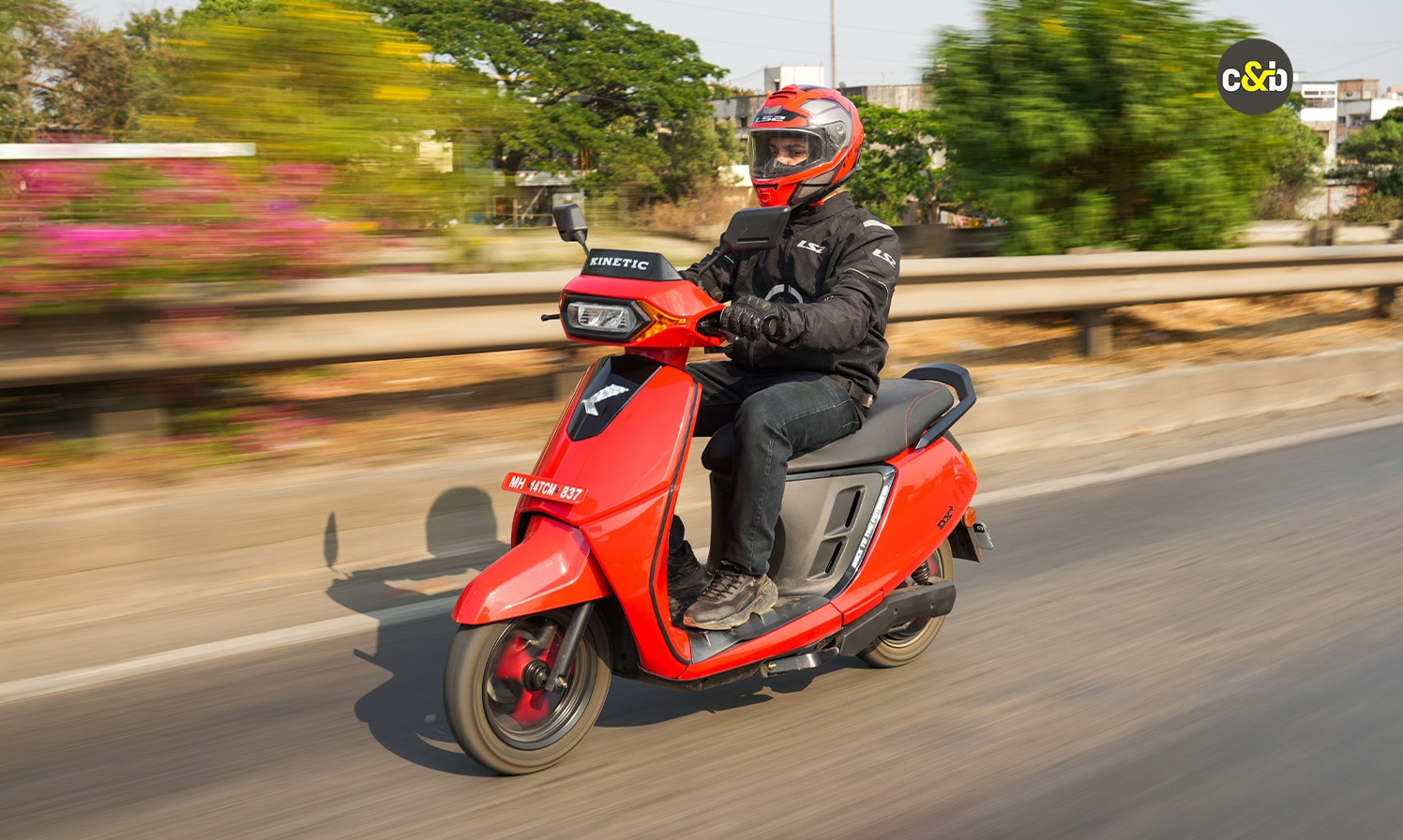
- Reborn Kinetic DX has surprisingly peppy performance, but small battery limits range.
- Overall quality levels and user experience are not up to the mark in 2026.
- At Rs 1.17 lakh (ex-showroom), it isn’t the most sensible buy.
PHOTOGRAPHY: VAIBHAV DHANAWADE
If you’re familiar with words like ‘Walkman’, ‘PCO’ or ‘Gold Spot’, chances are you either grew up riding a Kinetic Honda or grew up envying someone who did. I fell in the latter camp, as I was not even old enough (or tall enough) to place my feet on the ground while being seated on one, in its heyday. The lustrous metallic blue paint of the Kinetic Honda I saw often in my aunt’s apartment is still fresh in my eyes, and the raucous note of its two-stroke engine as it sped away in a smoky haze still rings in my ears. It is indelible memories like these – harboured by countless other Indians – that the reborn Kinetic DX+ wants to capitalise on. It wants you to believe that the good old days are no longer consigned to the past – that they’re back, just how you remember them.
The Kinetic DX+ arrives nearly two full decades after the Kinetic Honda DX was phased out.
But now, there is no smoke. The symphony of the two-stroke is nowhere to be found. Even though the shape may seem familiar, the traits exhibited by this much delayed successor, aren’t.
It is an electric scooter. It is a Kinetic, reimagined for the demands of 2026. Unlike its namesake from yesteryears, today’s Kinetic DX isn’t exactly breaking new ground. If anything, it is surrounded on all sides by electric scooters that are already more popular, and possibly more capable, too. Then, where exactly does that leave the DX+?
2026 Kinetic DX+: Design and dimensions
Kinetic knew its best chance was to tug hard at the heartstrings with the appearance of the new DX, so it’s no surprise the scooter tries hard to mimic the design of the original. I had the good fortune of being able to sample the new DX with the Kinetic Honda right next to it, and while I must give Kinetic credit for a serious stab at recreating that visual magic, I’m not fully convinced.
Visor-like element with Kinetic branding is merely cosmetic, and serves no other purpose; amber turn signals a nod to the past.
The signature cues are all in place – nearly flat apron, amber-hued turn indicators, two vents under the seat, gills in the side panels. The three-spoke alloy wheel up front is a nod to the triangular wheel of the OG, and even the instrument cluster – now fully digital and connected, unlike the Kinetic Honda’s analogue unit – is styled to look the same.
New DX+ is much bigger, and heavier, than its predecessor.
But look closer, and you realise it just isn’t the same. For starters, it is much, much larger (and heavier) than the compact and light Kinetic Honda. The smoked visor of the original is replaced by a similarly-shaped black trim piece that is effectively a mini ‘Kinetic’ hoarding. The gently curved apron houses a large, illuminated Kinetic logo, and the wheels sport red inserts – over-the-top touches that could’ve easily been skipped to retain the simple nature of the original. There’s also no tail-mounted spare wheel, which isn’t surprising considering no other modern-day scooter has one. However, I can’t help but wonder if a spare wheel-shaped charger storage compartment could’ve been part of the package. I am told it was considered during the design phase, but the idea was allowed to fade away over time, as another charger packaging idea was greenlit – which we shall get to in just a bit.
Three-spoke alloy in place of the Kinetic Honda's triangular wheel; red inserts are unnecessary.
To my eyes, the Kinetic DX+, instead of being neo-retro, is caught somewhere in the chasm that exists between neo and retro. It doesn’t lean as hard into its predecessor’s charming design as I would like it to, and viewed in isolation as a modern-day design, I think it’s borderline ordinary. For those unfamiliar with the Kinetic Honda – and I believe they’d constitute a big chunk of today’s young riders – relatability will be less of a factor, and this scooter will be just another unremarkable shape in the crowd.
Subtle Kinetic branding built into the wide LED tail-light.
2026 Kinetic DX+: Practicality, features and quality
Setting off on the Kinetic Honda was a straightforward process – get astride, insert the key into the ignition slot, press the starter button and you’re off. On the 2026 Kinetic DX+, it isn’t quite so simple, because the humble key has been replaced by a numeric passcode start system. The keyboard sits under a flip-up cover that employs tiny magnets, and you must first long press the power on key for a couple of seconds, before you punch in the four-digit passcode to start the scooter, which takes a few more seconds to power up fully.
Numeric passcode serves as the key; flip-up cover may not last the test of time.
The dash serves up a personalised greeting, and you can pair it with your smartphone using Bluetooth and the official Kinetic app for navigation and music. Yes, the scooter will play your favourite tracks on the move through a speaker placed behind the grille to the right of the cluster, and at a maximum volume that won’t wake your neighbours when you get home late at night. The app also lets you control other vital functions, including adjusting dash brightness and unlocking the scooter’s seat, among other things. You can also choose from a host of regional as well as foreign languages for the voice alerts built into the scooter, and while the app isn’t always seamless or quick to use, it presents a novel set of nifty controls. With a future software update, Kinetic promises you will even be able to start the scooter up using the app alone.
Digital dash is legible for the most part; single speaker mounted behind grille on the right.
Unlike the original, the Kinetic DX+ does not have a glove compartment. Instead, that space is used to house the scooter’s onboard charger and retractable charging cable. With a three-metre long cable, the DX+ promises the flexibility of being able to plug into a socket that may otherwise be blocked by other two-wheelers parked in front of it, and also saving the owner the hassle of having to pack the charger into the scooter when charging is complete. '
Fixed onboard charger – with a three-metre long retracting cable – is included on the DX+ variant.
There’s also lots of room under the seat – 37 litres, to be exact – including a clever pocket built into the base of the compartment, along with a phone charger and a light. The pillion foot pegs flip out smartly when you press the dedicated (mechanical) lever just beneath the left cube, making it one among several features you’ll enjoy flexing in front of friends and colleagues, at least in the initial period of ownership.
Underseat storage compartment is wide and deep, and has nifty bins carved into the base.
What you won’t enjoy is the complete dependency on electronic controls. You cannot open the charging lid, or unlock the seat, when the scooter is switched off, so every time you need to complete either of those actions when the scooter is parked, you will have to enter the passcode and start the scooter. Speaking of which, the passcode is also the only way to start the scooter.
Pillion foot pegs will only flip out when you press this mechanical lever.
The flip-up cover is not lockable, leaving the keys vulnerable to mischief, and the small magnets securing the non-hinged side were already falling off during our test. If the keys are somehow damaged, you won’t be able to start your scooter. In a household where the scooter is shared, older family members forgetting the passcode will be another annoyance, and 10 incorrect attempts will lock the scooter, which can then only be unlocked via the app.
The charging cable, with a slight tug, retracts almost violently into the scooter, and could potentially hurt the person holding it, or the scooter's bodywork as it snaps back into its housing. Paint had already started chipping off the frame of the charger housing on our test scooter, a problem that will only worsen over time.
Seat length, at 714 mm, is on the shorter side compared to rivals.
Overall quality levels also leave a lot to be desired. Gaps around the pillion foot peg housings were uneven on test scooters, and the grips were hard and cheap. The ill-fitting, low-grip floor mat is another put-off, and not befitting the scooter’s price.
Floor mat on our test scooter looked and felt cheap, and lacked any meaningful grip.
The buttons on the cubes are an ergonomic disaster. Eight different buttons are clubbed into a small near-square enclosure on the left (six on the right), with nearly all of them being the same shape and sitting almost flush with the panel. The top row has the lighting controls, and in the middle are the turn indicator buttons and the service support button. The bottom row has the horn, seat unlock, and charger lid unlock buttons.
Congested and nearly flush button cluster is a nightmare to use on the go, forcing plenty of accidental presses.
Because there’s practically no room between the tiny buttons [and no tactile feedback], you will inadvertently press a button you didn’t mean to, while simply trying to switch on the turn signal, a problem exacerbated when wearing riding gloves. I kept accidentally unlocking the seat every time I wanted to turn right and honking every time I wanted to turn left. There’s simply no justification for an arrangement that is functionally flawed.
2026 Kinetic DX+: Performance, range and charging
In its powertrain choices, the Kinetic DX+ is more budget scooter than premium. It employs a BLDC in-wheel hub motor, which draws energy from a small, 2.6 kWh LFP battery. Peak power output is rated at 4.78 kW (6.41 bhp), which is lower than what the Kinetic Honda offered all those years ago. But the ace up the new kid’s sleeve is its peak torque – 60 Nm, which is available from standstill.
Kinetic has chosen to go with a BLDC hub motor developing a peak 6.41 bhp and 60 Nm of torque.
Unsurprisingly, throttle response is soft and acceleration is gentle in the base Range mode, which displayed a figure of over 100 km on a full charge. Top speed is limited to 50 kmph, and unless you’re snaking through jams on the regular, this mode is not quick enough for open stretches.
In Power mode, the DX+ accelerates with a surprising amount of gusto.
Power mode strikes a good balance between performance and efficiency, offering crisper throttle response, a higher top speed of 75 kmph and a range of around 80 kilometres, making it best suited to everyday riding. It is in Turbo mode where you can access full performance – this mode grants a top speed of 90 kmph, a speed at which the DX+ feels reasonably planted, but drops range to just 60 kilometres on a full charge. In this mode, it feels surprisingly quick, and doesn’t feel like it weighs 128 kg.
Holding high speeds on the highway is easy in Turbo mode, but range takes a hit.
Grip from the 100/80-section MRF Zapper N tyres is good, and while the DX+ isn’t built for corner-carving and feels a touch nose-heavy, it can deal with twisty roads just fine. Ride quality, while acceptable, isn’t particularly comfortable, with the telescopic fork transmitting plenty of road imperfections, especially potholes and malformed speed breakers, back to the rider’s arms. The brakes offer sufficient stopping power, even though the levers lack feel, and the front has a tendency to dive under hard braking.
Front disc offers plenty of stopping power, even if feel at the lever is mostly wooden.
Charging the scooter to 80 per cent will take about three hours, and a full charge will take somewhere between four to five hours. The charger is the only major difference between the DX and DX+ variants – the former comes with an off-board charger. As a result, the DX is Rs 6,000 cheaper.
2026 Kinetic DX+: Verdict
There’s good reason to leverage nostalgia – when you get it right, a ‘resurrected’ crowd favourite can replicate success. Just ask Bajaj, which has seen its Chetak touch new heights every year since it was brought back as an electric scooter. And even if the product has a few flaws, the emotions associated with its precursor can help potential buyers overlook shortcomings. But in the case of the DX+, there just isn’t enough room for forgiveness.
At Rs 1.17 lakh (ex-showroom), the Kinetic DX+ has to contend with far more popular scooters.
The visual statement aside, there’s nothing the Kinetic DX+ does that helps it stand out. The novelty of some features and functions will wear off after some time, and there’s a big question mark on their durability and reliability in the long run. Kinetic also has a much thinner sales and service network than any of the incumbents, and then comes the price – at Rs 1.17 lakh (ex-showroom), the Kinetic DX+ is simply too expensive for what it offers. For this kind of money, you could have a Bajaj Chetak, TVS iQube, TVS Orbiter, Ather Rizta or even a Vida VX2, all of which have something more to offer than the Kinetic. For the DX+ to stand any chance of being seriously considered, it needed to have a five-figure sticker price, along with considerably wider availability of sales and service. In its present form, the Kinetic DX+ will have you feeling briefly wistful, but the fleeting nostalgia is unlikely to cloud your good judgement.
KINETIC DX+ IN NUMBERS
Price as tested: Rs 1,17,499 (ex-showroom, Pune)
Peak power: 4.78 kW (6.41 bhp)
Peak torque: 60 Nm
Kerb weight: 128 kg
Battery capacity: 2.6 kWh
Range: 100 km (Range), Power (80 km), Turbo (60 km)
Charging time: 3 hours (0-80%); 4-5 hours (0-100%)
Underseat storage: 37 litres
Related News




Research More on Kinetic DX Electric

Popular Kinetic Models

Latest Cars


Upcoming Cars


Latest News


 Jaiveer Mehra | Jul 14, 2026Kia Carens, Carens Clavis Cumulative Sales Cross 3 Lakh UnitsMilestone arrives a little over a year after the 2 lakh unit milestone and a little over 4 years after the MPV’s India launch.3 mins read
 Jaiveer Mehra | Jul 14, 2026Renault Duster Adventure Edition Launched At Rs 12.99 LakhThe new special edition is positioned between the Evolution and Techno trims and is offered with both the 1.0 Turbo and 1.3 Turbo engine options.1 min read
 Bilal Firfiray | Jul 13, 2026Toyota Innova Hycross Facelift Spied For The First TimeIt’s been a good chunk of four years since the Toyota Innova Hycross was launched in India. So, it seems to be a good time to get in a facelift.1 min read
 car&bike Team | Jul 13, 2026Hero MotoCorp Flags CAFE Norm Risks for Two-Wheelers Ahead of New Fuel Efficiency RulesHero MotoCorp says the proposed expansion of Corporate Average Fuel Economy (CAFE) norms to two-wheelers will improve fuel efficiency but could also bring significant cost and compliance challenges for manufacturers.1 min read
 car&bike Team | Jul 13, 2026Hero MotoCorp To Launch New 150-350 cc Premium MotorcyclesTo capitalise on market trends and growth in the sub-350 cc premium motorcycle segment, Hero MotoCorp says it will launch new products under both Hero and Harley-Davidson brands.3 mins read
 car&bike Team | Jul 13, 2026Ignyte Launches New Carbon Fibre Series Helmets In India; Prices Start From Rs 14,999New helmet series features a carbon fibre composite shell & kevlar reinforcement and meets ISI & DOT standards.1 min read
 Bilal Firfiray | Jul 12, 2026Tata Sierra EV Review: Reborn In The Electric AgeThe Tata Sierra EV isn’t drastically different from its ICE counterpart when it comes to design. But being the seventh electric offering from the Indian brand, it has gotten a few things right, and very few things wrong. But is it a compelling package to buy?5 mins read
 Jafar Rizvi | Jul 13, 2026TVS Orbiter Long-Term Review (Report 1): Settling In Takes TimeFirst impressions weren't the strongest, but the Orbiter has made a mark in its first month in the car&bike garage.5 mins read
 Seshan Vijayraghvan | Jul 7, 2026Tata Altroz Petrol DCA Long-Term Review: Intercity & Highway Driving ReportWe tested the Tata Altroz Petro DCA’s highway manners, intercity performance, and real-world fuel efficiency.1 min read
 Seshan Vijayraghvan | Jun 29, 2026Renault Kiger vs Toyota Urban Cruiser Taisor: Which Underdog Deserves Your Money?Both the Kiger and the Taisor promise strong performance, solid features, comfortable cabins and everyday usability, all without breaking the bank. But which of these underrated subcompact SUVs deserves your money? Let's find out.1 min read
 Seshan Vijayraghvan | Jun 29, 2026Skoda Kodiaq RS Review: The Best Kodiaq Yet?The Skoda Kodiaq RS is finally here, and it's every bit as exciting as I expected. But was it worth the wait?7 mins read