
The US Army to Get Autonomous Vehicles Soon

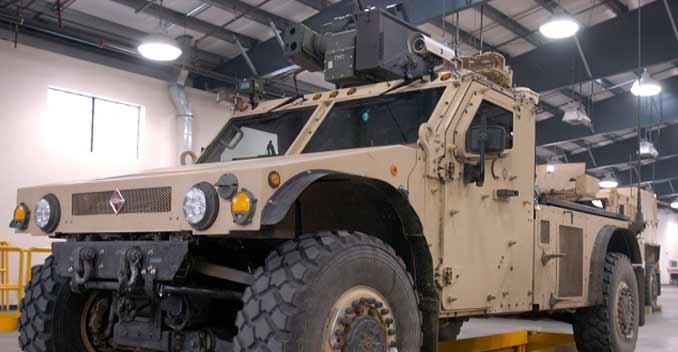
US soldiers may soon get help from autonomous vehicles in the battlefield!
The US Army is embracing systems which will provide increased situational awareness and decrease the probability of accidents using safety features such as obstacle detection, collision avoidance, lane departure, tip-over warnings and vision enhancements for low-visibility conditions.
In the future, some of those vehicles could even be completely driver-less.
"The US Army Tank Automotive Research Development and Engineering Center's 30-Year Ground Vehicle Strategy "introduces scalable autonomy that will serve as a force multiplier and augment the capabilities of Soldiers," said Dr Paul D Rogers, director of the US Army Tank Automotive Research, Development and Engineering Center (TARDEC).
This new technology is capable of making almost every military vehicle an optionally-manned vehicle.
As far as removing the assistant driver, "I believe we can do that now with the autonomous capability that we'll be integrating into our vehicle systems," said Rogers.
"It's a mature capability that is ready to go into a programme of record and could be fielded in the 2025 time-frame," he said.
Removing both drivers is about two years behind that in research and development, he said.
"That will mature from the technology and integration perspective by 2019 and be ready to transfer into a programme of record followed by fielding within a decade after that," Rogers said.
The US Army's most recent demonstration of driver-less vehicles took place in May in South Carolina, where a convoy of seven different tactical vehicles were driven completely unmanned at speeds exceeding 64kph.
The first kit is the "autonomy kit," which includes sensors that are the eyes of the platform that observes what's around the vehicle.
Some of its technology includes the LIDAR system, or Light Detection and Ranging, which looks for curves in the road and changes from pavement and gravel to grass and uses those to inform the platform where the road surface is and its expected travel path.
The Google Self-Driving Car is also using LIDAR technology. While the Army is not partnering with Google, "we're on similar paths," Rogers said.
The second kit is the "by-wire drive," which operates the basic driving functions of the platform such as acceleration, braking and steering.
Both kits are designed in a modular fashion to allow for flexibility in the future as technology matures so that new capabilities can be added, Rogers said.
For the latest automotive news and reviews, like us on Facebook or follow us on Twitter and Instagram.
Related News

Latest Cars


Upcoming Cars


Latest News


 Sarthak Mahajan | Nov 13, 2026Denza Z9 GT: In PicturesPriced at Rs 1.57 crore, it is the only shooting brake-style vehicle in India.1 min read
 Jafar Rizvi | Nov 13, 2026BYD Denza Z9 GT Launched In India At Rs 1.57 CroreThe Z9 GT is the only car of its kind in India, currently.3 mins read
 Sarthak Mahajan | Nov 13, 2026BYD Denza D9 Electric MPV Launched At Rs 90 Lakh In IndiaDenza has entered the Indian automotive market with the launch of two models: the Denza Z9 GT and the Denza D9.1 min read
 car&bike Team | Nov 13, 2026Honda CR-V to go hybrid-only with next-generation model in 2027The 2028 CR-V will debut a new platform and two-motor hybrid system as Honda expands its hybrid lineup1 min read
 car&bike Team | Nov 13, 2026BYD's Denza D9 MPV, Z9 GT Shooting Brake India Launch Today: What To Expect?BYD’s luxury brand Denza will enter India with two very different electric offerings: the D9 luxury MPV and the 1,140 bhp Z9 GT Shooting Brake.3 mins read
 car&bike Team | Nov 12, 2026Hyundai Creta vs Maruti Suzuki Grand Vitara vs Toyota Urban Cruiser Hyryder: Which Compact SUV Fits You?The Hyundai Creta, Maruti Suzuki Grand Vitara and Toyota Urban Cruiser Hyryder are among the popular choices in the compact SUV space. But which one fits your bill?10 mins read