
Hidden Costs Nobody Mentions Before Buying a Used Luxury Car
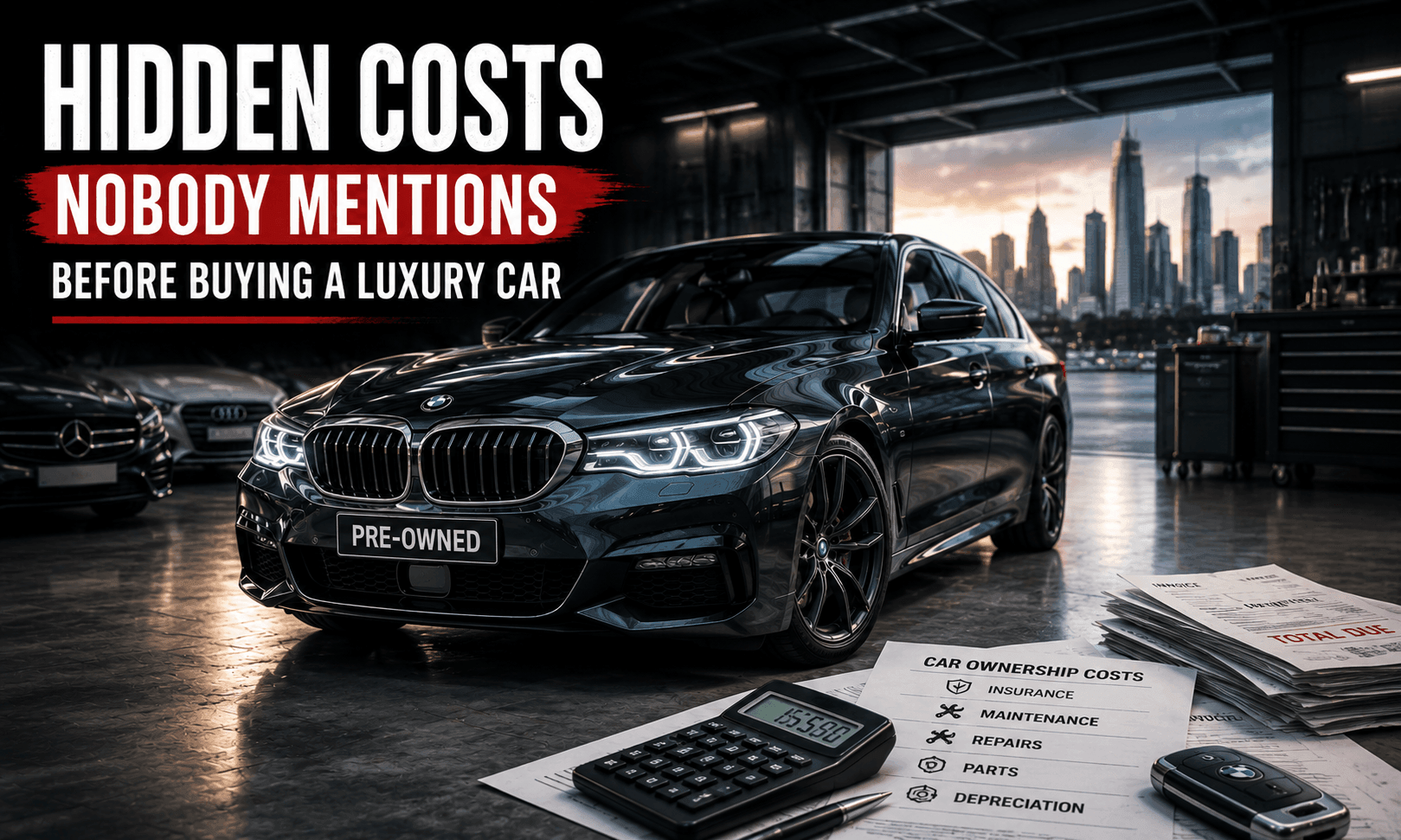
- Luxury car maintenance costs often remain high even after depreciation.
- Premium tyres, insurance and repairs can cost significantly more than mainstream cars.
- A low purchase price does not always mean low ownership costs.
Many buyers are tempted to purchase used luxury cars because the prices can look incredibly attractive. A five-year-old BMW, Mercedes-Benz or Audi can often cost the same as a brand-new top-spec SUV from a mainstream brand. On paper, it feels like a chance to own a premium badge for much less money.
But, the catch is that while luxury cars depreciate, their maintenance and repair costs usually do not. Parts, labour, insurance and even routine wear-and-tear items are often priced according to what the vehicle originally cost when new. As a result, a used luxury car can sometimes cost far more to own than what buyers initially expect. Before signing the cheque, it is important to understand the hidden expenses that can turn an apparent bargain into a much costlier ownership experience.
How are Luxury Cars Becoming so Cheap to Buy?
This is where many buyers get trapped. A BMW 3 Series, Mercedes-Benz C-Class or Audi A4 that once cost Rs. 60-70 lakh can often be found in the used market for Rs. 25-35 lakh after a few years. That sounds like incredible value. The reality is that depreciation affects the purchase price, not the ownership costs. A headlamp, suspension component or electronic module are still priced like it belongs to a luxury vehicle, regardless of how old the car is. Simply put, a Rs. 30 lakh used luxury sedan often behaves financially like a Rs. 70 lakh car.
Also Read: Third-Party vs Comprehensive Insurance: What Protection Should You Actually Get?
Expensive Servicing and Diagnostic Charges
Routine servicing is often the first surprise for new owners. A standard annual service for an entry-level German luxury car can easily cost between Rs. 35,000 and Rs. 65,000. Larger luxury SUVs can push that figure well beyond Rs. 1 lakh. The bigger shock comes when something goes wrong. Luxury brands use proprietary diagnostic systems that require specialised software and trained technicians. Even identifying a warning light can sometimes involve diagnostic charges running into several thousand rupees before any repair work begins.
Typical Annual Service Costs
| Vehicle Type | Approximate Service Cost |
| Mainstream SUV | Rs. 8,000 - Rs. 15,000 |
| Entry Luxury Sedan | Rs. 35,000 - Rs. 65,000 |
| Luxury SUV | Rs. 50,000 - Rs. 1 lakh+ |
Premium Tyres Can Empty Your Wallet
Luxury cars are heavier, more powerful and often run on larger wheels. This means tyre replacement bills can be significantly higher than what most owners expect. Many German luxury cars use run-flat tyres, which are designed to continue moving after a puncture. While convenient, they are also considerably more expensive. A single tyre can cost anywhere between Rs. 15,000 and Rs. 45,000 depending on the tyre size and brand. Replacing all four tyres can easily result in an expense that can range anything between Rs. 60,000 to Rs. 1.8 lakh.
Air Suspension Can Become a Financial Nightmare
Many premium luxury cars offer exceptional ride comfort through sophisticated air suspension systems. The comfort is impressive. But the repair bills can really set one back. Unlike conventional coil springs, air suspension relies on compressors, sensors and rubber air bellows that work constantly to maintain ride height and damping. Over time, dust, heat and rough road conditions can accelerate wear. If one component fails, repair costs can quickly become substantial. A single air suspension strut can cost well over Rs. 1 lakh on some luxury vehicles, while major system repairs can run into several lakhs.
Premium Fuel Becomes Part of the Budget
Many luxury petrol cars are designed to perform best on higher-octane fuel. While they may run on regular petrol in some cases, owners often choose premium fuels such as XP95, XP100 or similar options to maintain performance and engine efficiency. That extra cost per litre may not sound significant initially. However, when combined with real-world fuel economy figures of 6-10 kmpl in city traffic, fuel expenses can become surprisingly high. For some owners, the monthly fuel bill alone can exceed the EMI of a small hatchback.
Also Read: Why Car Insurance Premiums Differ So Much Between Similar Vehicles
Insurance Remains Expensive
Insurance is another cost many buyers underestimate. A minor accident involving a luxury car can result in repair bills running into lakhs because of expensive headlights, sensors, cameras and body panels. This is why many owners continue opting for comprehensive coverage and zero-depreciation protection. Annual premiums often remain significantly higher than those of mainstream vehicles.
Typical Insurance Costs
| Vehicle Type | Annual Insurance Cost |
| Mainstream SUV | Rs. 15,000 - Rs. 35,000 |
| Entry Luxury Sedan | Rs. 55,000 - Rs. 85,000 |
| Luxury SUV | Rs. 75,000 - Rs. 1.2 lakh+ |
| Flagship Luxury Sedan | Rs. 1.5 lakh - Rs. 3 lakh+ |
Electronics Can Become Expensive After Warranty
Modern luxury cars are packed with technology. Large touchscreens, digital instrument clusters, radar sensors, cameras, powered seats, ambient lighting systems and advanced driver assistance features all add to the ownership experience. Unfortunately, they also add potential repair costs once the warranty expires. Replacing a failed camera module or electronic control unit can often cost significantly more than expected. As luxury cars age, electronic faults become one of the biggest ownership concerns.
The Real Cost of Owning a Used Luxury Car
The purchase price is only the entry ticket. A realistic annual ownership budget for an out-of-warranty luxury car often looks something like this:
| Luxury Segment | Estimated Annual Upkeep |
| Entry Luxury Sedan | Rs. 1.5 lakh - Rs. 2 lakh |
| Luxury SUV | Rs. 2 lakh - Rs. 3 lakh |
| Flagship Luxury Car | Rs. 4.5 lakh - Rs. 6 lakh+ |
This includes servicing, tyres, insurance, wear-and-tear items and occasional repairs.
Also Read: Ceramic Coating vs Paint Protection Film (PPF): Understanding The Differences
The Smarter Way to Buy a Luxury Car
A luxury car can still be a fantastic purchase if you go in with realistic expectations.
Before buying:
- Research vehicle service history thoroughly
- Check insurance costs beforehand
- Inspect tyre condition carefully
- Verify suspension health
- Keep an emergency repair fund aside
- Consider specialist independent workshops for older vehicles
Most importantly, never stretch your entire budget on the purchase price alone.
A Rs. 30 Lakh Used BMW vs A Rs. 30 Lakh New XUV 7XO: Which Costs More Over 5 Years?
Many buyers compare a used luxury car with a brand-new premium SUV because both can cost roughly the same to purchase. However, ownership costs tell a very different story. Here is a typical example.
| Expense Category | Used BMW 3 Series (5 Years Old) | New Mahindra XUV 7XO |
| Purchase Price | Rs. 30 lakh | Rs. 30 lakh |
| Annual Service Cost | Rs. 35,000 - Rs. 65,000 | Rs. 10,000 - Rs. 15,000 |
| Tyre Replacement | Rs. 60,000 - Rs. 1.2 lakh | Rs. 35,000 - Rs. 60,000 |
| Insurance | Rs. 55,000 - Rs. 85,000 | Rs. 20,000 - Rs. 35,000 |
| Unexpected Repairs | Can run into lakhs | Generally lower during warranty |
| Parts Availability | Expensive imported parts | Easier and cheaper availability |
Over a five-year ownership period, the BMW may offer a more premium driving experience, but the XUV700 will usually be far cheaper to maintain and repair. For many buyers, the difference in running costs can easily add up to several lakhs.
So Which One Makes More Sense?
If you prioritise badge value, driving dynamics and luxury features, the BMW may still be worth considering. However, if you want predictable ownership costs, warranty coverage and fewer financial surprises, a new premium SUV like the XUV700 is often the safer long-term choice.
What Should Buyers Remember?
A luxury car can deliver an experience that few mainstream vehicles can match. The comfort, refinement, technology and driving experience are genuinely special. The catch is that depreciation only makes the car cheaper to buy, not cheaper to own.
If you can comfortably afford the maintenance, insurance and occasional repair bills, a used luxury car can be a rewarding purchase. If not, that tempting bargain price can quickly become one of the most expensive decisions you make as a car owner.

carandbike is not merely another name in the world of automotive web sites. We bring together the best from the world of both, cars and bikes. New cars, used cars, new bikes, - we endeavour to help you with all of that. Additionally, carandbike also strives to keep its users updated with the latest from the global automotive industry. car price, car reviews, car dealers, new bikes, and everything in between, carandbike is happy to help!
Read all latest news and reviews from car&bike Team →


Related News


Learn more about Mercedes-Benz C-Class


Popular Mercedes-Benz Models


Latest Cars


Upcoming Cars


Latest News


 car&bike Team | Oct 8, 2026Harley-Davidson Sprint 440 Teased; Will Be Based On The X440Harley-Davidson has teased its upcoming Sprint 440, suggesting the new motorcycle will be a much more on the lines of a traditional cruiser than the X440.1 min read
 car&bike Team | Oct 8, 2026River Indie Electric Scooter Now Available On FlipkartRiver Mobility is the latest two-wheeler brand in India to list its two-wheeler on Flipkart.2 mins read
 car&bike Team | Oct 8, 2026Mahindra XUV 3XO CNG Launch On October 15The 3XO will be the third subcompact SUV to offer a factory-fitted CNG kit.1 min read
 car&bike Team | Oct 8, 2026Suzuki GSX-8R Gets Rs. 80,000 Discount; Price Drops To Rs. 9.08 LakhSuzuki is offering an Rs. 80,000 discount on the GSX-8R, bringing the price of its middleweight faired motorcycle down to Rs. 9.08 lakh.1 min read
 car&bike Team | Oct 8, 2026VinFast To Open Two-Wheeler Showrooms In Over 30 Indian CitiesAfter its electric cars which made its India debut in 2025, VinFast is gearing up to bring its electric two-wheeler portfolio to the country, most likely at the start of 2027.1 min read
 Janak Sorap | Oct 8, 2026Triumph Bonneville T40 Vs Speed 400: Which Triumph is for you?Triumph now has two very different takes on its small-capacity modern-classic formula, the Speed 400 and the new Bonneville T40. So, which Triumph is better suited to you and why?1 min read
 Bilal Firfiray | Oct 8, 2026Tata Aeris Review: New And Improved, But Is It Good Enough?Tata has replaced the Tigor with the new Aeris and improved it in every aspect. We drove the CNG AMT and Petrol MT derivatives to find out how much it improved over its predecessor.4 mins read
 Seshan Vijayraghvan | Oct 4, 20262026 Skoda Slavia Facelift Review: Upgrades That Matter And A Better AutomaticThe new Skoda Slavia brings a handful of visual and mechanical changes, most notably a new 8-speed automatic for the volume-selling 1.0-litre TSI variants.5 mins read
 Bilal Firfiray | Oct 3, 2026Kia Sorento Review: Is Bigger Always Better?The Kia Sorento has arrived to our shores at the right time. But does it have what it takes to take the market by a storm?7 mins read
 Abhishek Nigam | Oct 2, 2026MINI Countryman C Review: Has MINI Finally Grown Up Without Losing Its Personality?The new Countryman C is bigger, more practical and packed with technology, but its quirky appeal comes with a few compromises.1 min read
 Preetam Bora | Oct 3, 2026ViaTerra Spencer Riding Jacket Review: The Ideal Jacket For Indian Summers?The ViaTerra Spencer mesh riding jacket makes a strong case as a well-built, street-focussed riding jacket, combining good airflow with Level 2 protection and a snug, secure fit. Is it perfect? Read on.6 mins read