
Ceramic Coating vs Paint Protection Film (PPF): Understanding The Differences

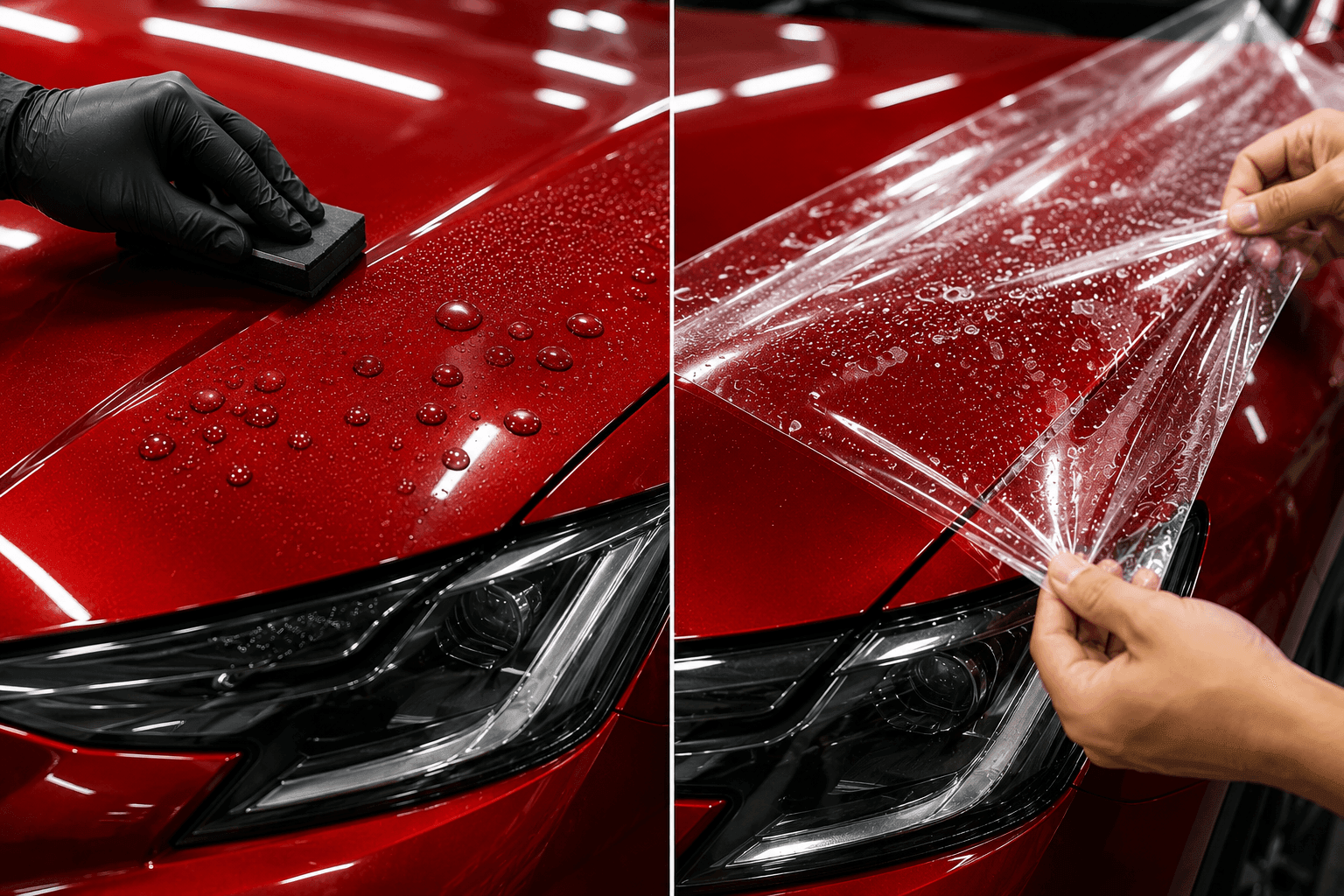
- Ceramic coating improves gloss, makes cleaning easier, and protects against the environment
- PPF provides physical protection against stone chips, scratches, and road debris
- The right choice depends on your vehicle, driving conditions, ownership plans, and budget
Why Paint Protection Has Become More Popular in India
Modern cars are more expensive than ever, and even minor paint repairs can cost thousands of rupees. At the same time, Indian roads expose vehicles to conditions that can quickly damage paintwork.
Highway construction zones often throw small stones at the front bumper. Urban traffic increases the risk of scratches and door dings. Add intense summer heat, tree sap, bird droppings, and monsoon grime, and it becomes easier to understand why many owners now invest in paint protection soon after buying a vehicle.
This is where ceramic coating and PPF enter the conversation. While both help preserve a car's finish, they protect against different types of damage.
Also Read: Why Your Car's AC Cools Better While Driving Than At Idle
What Is Ceramic Coating?
Ceramic coating is a liquid polymer applied over a vehicle's painted surfaces. Once cured, it forms a thin protective layer that bonds with the paint.
Its primary purpose is to protect against environmental damage rather than physical impacts.
A quality ceramic coating can help:
- Improve gloss and paint depth
- Make washing easier
- Repel water and dirt
- Reduce damage from bird droppings and tree sap
- Slow down the paint oxidation caused by UV exposure
For many Indian owners, the biggest benefit is reduced maintenance. Dust, mud, and road grime generally do not stick to the surface as aggressively, making routine cleaning easier.
However, ceramic coating is often misunderstood. It does not create an armour-like shield around the vehicle and cannot stop most scratches or stone chips.
Also Read: Extended Car Warranties Explained: When They Make Sense and When They Don't
What Is Paint Protection Film (PPF)?
Paint Protection Film is a transparent polyurethane film applied directly over the vehicle's painted surfaces.
Unlike ceramic coating, PPF acts as a physical barrier between the paint and external damage.
Modern PPF products can help protect against:
- Stone chips
- Road debris
- Minor scratches
- Swirl marks
- Insect stains
- Light parking lot damage
Many premium films also feature self-healing technology. Minor surface scratches can gradually disappear when exposed to sunlight or warm water.
This makes PPF particularly popular among owners who frequently drive on highways, where paint damage from flying debris is much more common.
Also Read: Brake Fade Explained: Why Brakes Feel Weak After Repeated Hard Braking
Ceramic Coating vs PPF: The Biggest Differences
The simplest way to compare them is by understanding what they are designed to protect against.
| Protection Area | Ceramic Coating | PPF |
| Gloss Enhancement | Excellent | Good |
| Water Repellency | Excellent | Good |
| UV Protection | Good | Good |
| Bird Droppings and Tree Sap | Good | Good |
| Swirl Resistance | Moderate | High |
| Scratch Protection | Minimal | High |
| Stone Chip Protection | Minimal | Excellent |
| Self-Healing Capability | No | Available on many premium films |
In practical terms, ceramic coating focuses on surface protection and ease of maintenance, while PPF focuses on impact protection.
Which One Lasts Longer?
Longevity is one of the most common questions buyers ask. A professionally applied ceramic coating can typically last between two and five years, depending on product quality, maintenance, and environmental conditions. PPF generally offers a longer service life, often lasting between five and ten years when properly maintained.
Indian conditions can influence both. Vehicles parked outdoors under constant sun exposure or regularly driven through harsh environments may experience faster wear regardless of the protection chosen. If maximum long-term durability is the goal, PPF usually has the advantage.
Which Is Easier to Maintain?
Both options reduce maintenance compared to untreated paint, but they do so differently. Ceramic coating makes cleaning easier because dirt and water have a harder time bonding to the surface. Many owners notice that routine washing becomes faster and less frequent.
PPF also simplifies maintenance, but its main advantage is that owners worry less about physical damage during everyday use. Neither option completely eliminates the need for proper washing techniques. Poor washing habits can still create swirl marks and surface damage over time.
Also Read: How Interstate Vehicle Transfers Work In India: NOC, Re-registration And Road Tax Explained
How Indian Driving Conditions Influence the Decision
This is where the choice often becomes much clearer. Consider a vehicle that spends most of its life inside city limits. It encounters traffic, dust, bird droppings, and occasional scratches, but relatively few stone impacts. In this situation, ceramic coating often provides sufficient protection while keeping costs manageable.
Now consider a vehicle that regularly travels between cities on highways. High-speed driving increases exposure to loose gravel, construction debris, and flying stones. These are exactly the situations where PPF delivers its biggest advantage. For many Indian owners, highway usage is often the deciding factor between ceramic coating and PPF.
Is PPF Worth the Extra Cost?
PPF is significantly more expensive than ceramic coating, which naturally raises the question of value. For an entry-level hatchback or compact sedan, spending a large amount on full-body PPF may not always make financial sense.
For premium SUVs, luxury sedans, or vehicles expected to remain in the family for many years, the calculation changes. The cost of repainting multiple panels can quickly exceed the cost of preventive protection. The answer depends less on the vehicle's price and more on how much preserving factory paint matters to the owner.
Which Areas of the Car Need PPF the Most?
Not every owner chooses a full-body PPF.
Many opt for protection only on high-impact areas, including:
- Front bumper
- Bonnet
- Front fenders
- Side mirrors
- Headlamps
- Door edges
These panels usually suffer the most damage from stones, debris, and daily use. This approach allows owners to gain much of the protective benefit while keeping costs under control.
Should New Car Buyers Choose Ceramic Coating or PPF?
For many buyers, this decision comes down to priorities.
Choose Ceramic Coating If:
- You want better gloss and shine
- Easy maintenance is a priority
- Most driving happens within the city
- Budget is a major consideration
- Minor scratches are not a major concern
Choose PPF If:
- You frequently drive on highways
- You want protection against stone chips
- You own a premium or luxury vehicle
- Long-term paint preservation is important
- You want greater protection against everyday wear
Can You Use Ceramic Coating and PPF Together?
Yes, and many premium detailing studios recommend exactly that. In this setup, PPF provides the primary defence against physical damage, while a ceramic coating is applied over the film to improve gloss, enhance water repellency, and simplify maintenance.
Although this combination costs more than either solution individually, it also delivers the most comprehensive level of paint protection currently available.
Common Myths About Ceramic Coating and PPF
Several misconceptions continue to influence buying decisions.
"Ceramic Coating Makes the Car Scratch-Proof"
Ceramic coatings can reduce minor swirl marks, but they cannot stop most scratches or impacts.
"PPF Makes the Paint Indestructible"
PPF can absorb many minor impacts, but severe collisions and heavy impacts can still damage both the film and the paint beneath it.
"Paint Protection Means No Maintenance"
Neither ceramic coating nor PPF eliminates the need for proper washing and care. Both still require periodic maintenance to perform effectively over time.
Also Read: Green Tax in India Explained: Who Pays It and How Much Does It Cost?
So, Which One Should You Choose?
There is no universal winner because ceramic coating and PPF are designed to solve different problems. If your goal is maximum gloss, easier cleaning, and protection against environmental contaminants, ceramic coating offers excellent value. If protecting the paint from stone chips, scratches, and road debris is your priority, PPF remains the stronger option.
For Indian drivers, the decision often comes down to where the vehicle spends most of its time. Urban commuters may find ceramic coating more than sufficient, while frequent highway travellers are likely to benefit far more from PPF. Understanding the type of damage you are most likely to encounter is ultimately the best way to choose the right protection for your vehicle.
Related News


Latest Cars


Upcoming Cars


Latest News


 Sarthak Mahajan | Sep 15, 2026Checking Pending Challans On Pre-Owned Cars To Get Easier With New 'Rosmart' Digital PlatformRDSL has signed an MoU with FADA through Rosmart, allowing customers to access challan-related and other vehicle compliance services.1 min read
 Sarthak Mahajan | Sep 15, 2026Volvo XC60 and XC90 Long-Range Plug-In Hybrid RevealedThe XC60 offers up to 200km of electric range, while the XC90 offers up to 160km. Their combined ranges stand at up to 1,240km and 1,100km, respectively.1 min read
 Seshan Vijayraghvan | Sep 15, 2026Mahindra XUV 7XO Scores 5 Stars In Bharat NCAP Crash TestThe Mahindra XUV 7XO has scored 5 stars for both adult and child occupant protection.1 min read
 Sarthak Mahajan | Sep 15, 2026Honda Amaze Prices Hiked By Up To Rs 15,210: Check Updated Price ListHonda Cars India has hiked the prices of the Amaze for the second time this year, with the mid-spec variant receiving the highest price increase.1 min read
 car&bike Team | Sep 14, 2026Hyundai Bayon SUV Confirmed For India Launch; Coming This DiwaliBrand-new crossover from Hyundai India is expected to slot in between the Venue and Creta in the Korean carmaker's existing portfolio.2 mins read
 Sarthak Mahajan | Sep 13, 2026BMW 7 Series, i7 Facelift: In PicturesThe BMW 7 Series will ditch its diesel powertrain and will now be available with only one petrol variant, while the i7 will be offered in two variants. The i7 M70 xDrive will arrive as a full import (CBU).5 mins read
 Seshan Vijayraghvan | Sep 15, 2026BMW i5 LWB Review: Not The M60, This Is The Proper Electric 5 SeriesThe BMW i5 LWB takes the electric 5 Series formula and puts a stronger focus on rear-seat comfort and long-distance luxury. With a 669 km claimed range, 268 bhp and a more relaxed character, is this the i5 that makes the most sense for India?7 mins read
 Preetam Bora | Sep 14, 2026Ladakh Uncharted: Himalayan Basecamp Off-Road Ride ExperienceA day-long off-road excursion from Royal Enfield’s Himalayan Basecamp event in Ladakh, the Ladakh Uncharted ride by Alpinestars was all about re-discovery!6 mins read
 Janak Sorap | Sep 12, 2026New Bajaj Pulsar 125 First Ride Review: More Tech, Less Weight, Same Pulsar DNAThe new Bajaj Pulsar 125 retains the familiar Pulsar identity but gets a new engine, lighter construction, more features and a sharper riding experience.5 mins read
 Bilal Firfiray | Sep 10, 2026Mahindra XEV 9S Review: 3 Reasons To Buy It, And 3 Reasons To AvoidEveryone keeps telling me that the Mahindra XEV 9S is not the electric XUV 7XO. I disagree.1 min read
 Abhishek Nigam | Sep 12, 2026New Bajaj Pulsar 150 Review: Is The New Pulsar, Pulsar Enough?The new Pulsar 150 gets a major mechanical and technological makeover, but does it retain the easy-going performance, familiar character and hooligan streak that made the original an icon? We ride the latest iteration to find out.8 mins read